
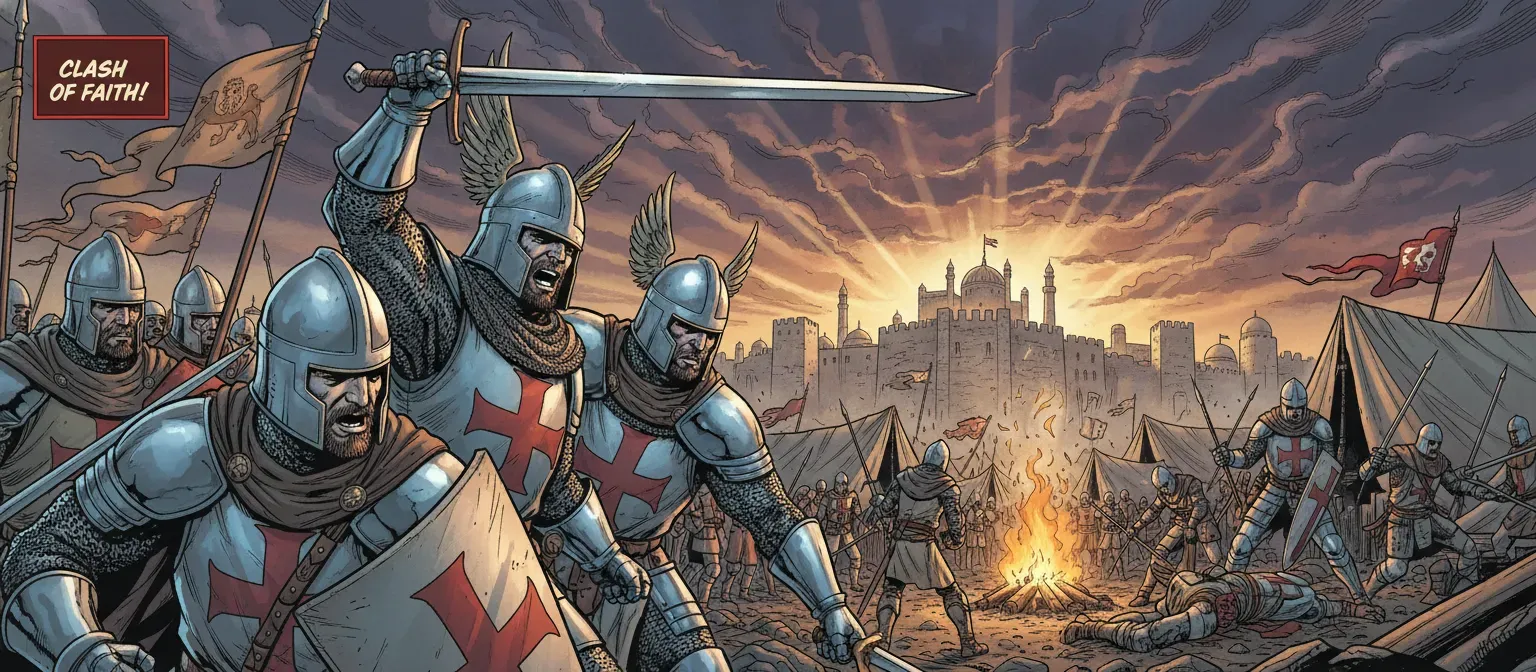
What were the Crusades? Imagine a world where fighting for your faith could lead to eternal salvation. In 1095, thousands of European knights and commoners heard Pope Urban II make this promise. They would travel thousands of miles to take back Jerusalem from Muslim rulers. This was the start of the medieval holy wars that would change history forever.
You’re about to learn about a series of religious military campaigns that lasted nearly two centuries. These weren’t just battles. They were a movement that changed entire civilizations.
Between 1095 and 1291, Western Christians went on many expeditions to capture and defend the Holy Land. The papacy backed these campaigns with promises of spiritual rewards. What started as a quest to reclaim Jerusalem grew much bigger.
Religious military campaigns didn’t just target Muslims. They also went after pagans and Christian dissidents. This crusading movement lasted into later centuries. Learning about this era shows how hundreds of thousands of people changed European and Middle Eastern societies forever.
Key Takeaways
- Medieval holy wars spanned from 1095 to 1291 as papacy-sanctioned military expeditions to reclaim Jerusalem from Muslim control
- Pope Urban II launched these campaigns with promises of spiritual rewards and eternal salvation for Christian participants
- Religious military campaigns eventually expanded beyond the Holy Land to target pagans and Christian dissidents across multiple continents
- These expeditions involved hundreds of thousands of participants from Western European kingdoms over nearly two centuries
- The crusading movement fundamentally reshaped political, religious, and cultural relationships between European and Middle Eastern civilizations
- Later campaigns continued into subsequent centuries, evolving far beyond their original purpose of reclaiming sacred sites
Introduction to the Crusades
The Crusades started with a mix of faith, politics, and money. They didn’t start with one event. Instead, they grew from long-standing tensions between Christians and Muslims, changing power in Europe, and new religious views.
The Crusades began long before armies went to the Holy Land. The world back then was shaped by faith, where Jerusalem was seen as a key to salvation. The lines between religious duty and politics were often unclear.
The Medieval World Before the Crusades
11th century Europe was very different from the strong kingdoms later. The weakening of central power led to local lords gaining power. This created a patchwork of territories ruled by feudal ties, not strong monarchies.
But change was coming. The Medieval Warm Period brought better weather for farming in Western Europe. This led to more food, more people, and growing towns. It also created a class of restless warriors looking for new adventures.
The Byzantine Empire in the East was facing challenges. This Christian empire, centered in Constantinople, had kept Roman traditions alive for centuries. But new threats were coming, forcing Byzantine emperors to seek help from the West.
Jerusalem had been under Islamic rule for centuries. Christians could visit, but they were treated as dhimmi. They were protected but had to pay extra taxes and follow certain rules.
This system had worked for a while. But from the 1040s, things started to change. Nomadic Turkomans disrupted the Middle East. In 1055, Tughril I of the Seljuk clan took control of the Abbasid Caliphate, introducing a new military force.
The Battle of Manzikert in 1071 was a turning point. It opened Anatolia to Turkoman migration, threatening the Byzantine Empire. Attacks on pilgrims to Jerusalem also became more common and violent.
The Forces That Sparked Conflict
So why did the Crusades happen? The crusades causes and effects were complex. The christian-muslim conflict in the late 11th century was fueled by many factors.
Religion was a key reason for the Crusades:
- Jerusalem’s spiritual significance: For Christians, Jerusalem was a sacred place. It was where Jesus lived, preached, died, and was resurrected. Visiting Jerusalem was seen as a way to atone for sins.
- Growing pilgrimage culture: From around 1000, thousands of Christians traveled to the Holy Land each year. They saw it as a way to atone for sins and secure salvation.
- Threats to pilgrims: Reports of attacks on Christian travelers outraged Europe.
- Development of just war theory: By the late 11th century, Christian theologians had developed arguments for violence in defense of faith or fellow Christians.
Politics and society also played a role. Aristocratic piety was growing, with nobles wanting to show their faith. The rise of penitential journeys made military expeditions seem like acts of devotion.
The papal authority saw an opportunity. Church leaders wanted to redirect violence toward what they saw as righteous causes. This thinking was key when Pope Urban II called for arms in 1095.
Economic pressures also mattered. Europe’s growing population meant younger sons of nobles often had little to inherit. The promise of land and wealth in the East was attractive to these warriors.
When you look at all these factors together, the Crusades were more than a simple religious war. They were the result of a complex mix of religious fervor, politics, economics, and social change. To medieval Europeans, what seems unthinkable to us today seemed necessary.
The First Crusade: Origins and Outcomes
Imagine being in Clermont in November 1095, hearing Pope Urban II call for reclaiming the Holy Land. This moment changed history. The pope’s call sparked a movement that sent thousands of Europeans on a dangerous journey eastward.
Urban’s message was clear and compelling. He offered spiritual rewards for those willing to fight. The pope proclaimed a remarkable promise to all who would answer his call:
Whoever for devotion alone, but not to gain honour or money, goes to Jerusalem to liberate the Church of God can substitute this journey for all penance.
The response was shocking. Nobles, knights, and common people prepared for the expedition. This wasn’t just a military campaign. It became a spiritual mission that transformed medieval society.
Leaders Who Answered the Call
You might expect kings to lead such an important expedition. Surprisingly, no crowned ruler joined the first crusade. Instead, powerful nobles stepped forward with their own armies and resources.
These leaders brought different strengths to the campaign. Some offered military expertise while others provided wealth and connections. Each had personal motivations beyond religious devotion.
The crusading force grew massive. Between 60,000 and 100,000 people joined the expedition. This included about 30,000 non-combatants and up to 7,000 knights. The logistics of moving this many people across continents presented enormous challenges.
| Leader | Origin | Key Contribution | Notable Achievement |
|---|---|---|---|
| Godfrey of Bouillon | Lower Lorraine | Military leadership and discipline | Became first ruler of Jerusalem |
| Bohemond of Taranto | Norman Italy | Tactical expertise and ambition | Established Principality of Antioch |
| Raymond of Saint-Gilles | Toulouse | Wealth and experienced troops | Founded County of Tripoli |
| Baldwin of Boulogne | Boulogne | Political strategy and opportunism | Created County of Edessa |
Other significant commanders included Hugh of Vermandois, brother of the French king. Robert Curthose, son of William the Conqueror, brought English forces. Stephen of Blois and Robert II of Flanders added their considerable resources to the expedition.
Pope Urban II remained the spiritual force behind the movement. His vision united these diverse leaders under one banner. Peter the Hermit, a charismatic preacher, led an earlier popular movement. His followers rushed ahead with disastrous results, but his passion inspired thousands.
The Journey to Jerusalem
The crusaders faced a three-year ordeal from Europe to the Holy Land. Each challenge tested their resolve and changed their tactics. You can trace their path through a series of critical battles and sieges.
The expedition achieved its first major success quickly. Nicaea fell in June 1097 after a brief siege. This victory boosted morale and provided valuable supplies for the long road ahead.
The Battle of Dorylaeum proved transformative. Turkish cavalry used hit-and-run tactics that initially overwhelmed the European knights. The crusaders adapted their strategies and won decisively. This battle taught them how to fight in unfamiliar terrain against new enemies.
Key milestones marked the crusaders’ progress:
- October 1097: The siege of Antioch began, lasting eight brutal months
- June 1098: Crusaders captured Antioch but immediately faced a counter-siege
- June 1098: Discovery of the Holy Lance reinvigorated exhausted troops
- June 1099: Crusading army reached Jerusalem
- July 15, 1099: Jerusalem fell to Christian forces
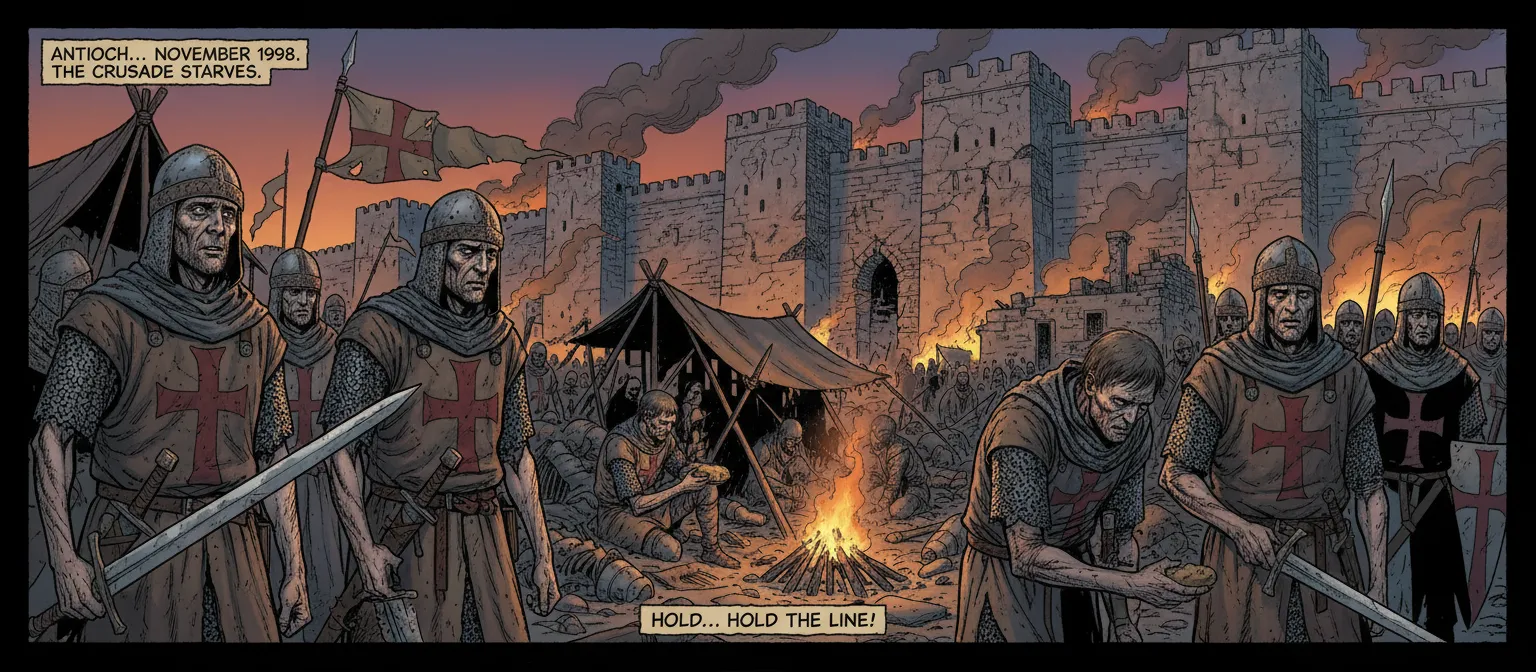
The siege of Antioch nearly destroyed the expedition. Starvation, disease, and desertion plagued the camps. Some leaders abandoned the mission entirely. Then crusaders discovered what they believed was the Holy Lance, the spear that pierced Christ’s side. This find restored their faith and fighting spirit.
The final push to recapture holy land tested every remaining crusader. The march through Syria in summer heat decimated their numbers. When they saw Jerusalem’s walls, many wept with joy and relief.
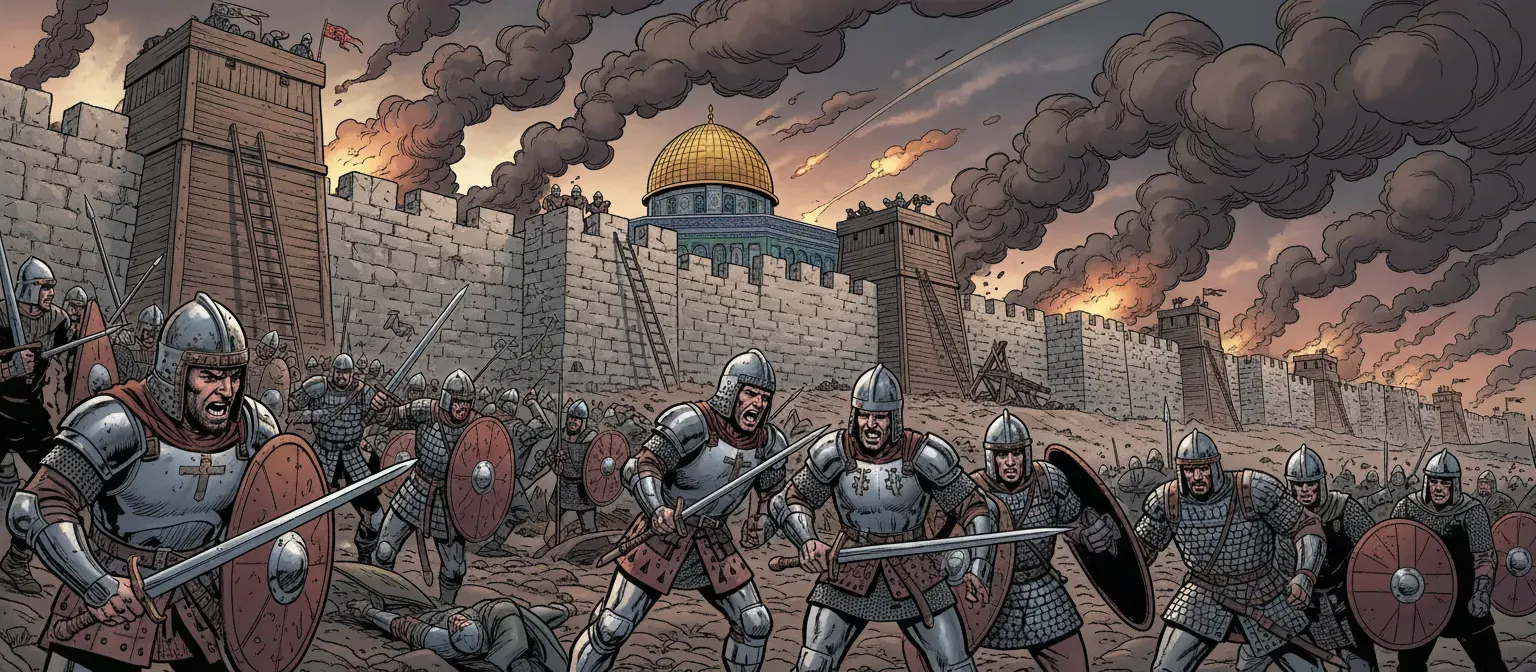
The siege of Jerusalem lasted just over a month. Crusaders built siege towers and battering rams from scarce timber. On July 15, 1099, they breached the walls. The victory came at a terrible cost for the city’s inhabitants.
What Changed After Victory
The successful expedition to recapture holy land created lasting consequences. You can see its impact on modern politics and culture. The crusaders established four separate states in the Levant.
These Crusader States included the Kingdom of Jerusalem, the County of Edessa, the Principality of Antioch, and the County of Tripoli. Each required constant defense against Muslim counterattacks. European nobles sent reinforcements and resources for decades.
Christian-Muslim relations fundamentally shifted. Centuries of relatively peaceful coexistence ended. Mistrust and hostility replaced earlier cooperation in trade and scholarship. These tensions continue in modern conflicts.
The First Crusade sparked unprecedented cultural exchange. Returning crusaders brought back new foods, textiles, and ideas. Eastern medicine and mathematics entered European universities. Architecture incorporated Islamic design elements.
Historical writing flourished as chroniclers documented the expedition. These accounts shaped European understanding of the East for generations. They also created unrealistic expectations for future crusades.
The expedition’s unexpected success became both blessing and curse. Later crusades tried to replicate this victory but faced better-prepared opponents. No subsequent expedition achieved the same dramatic results. The First Crusade set a standard that proved impossible to match.
You can see how this campaign established patterns for centuries of conflict. It created the template for crusading ideology. Military religious orders emerged to defend the new territories. The concept of holy war became embedded in medieval Christian culture.
Subsequent Crusades: A Brief Overview
Looking beyond the First Crusade, maintaining the crusader kingdoms proved tough. The campaigns that followed faced political rivalries, military mistakes, and a united Muslim resistance. Each effort brought new challenges the original crusaders hadn’t seen.
Later expeditions had more famous leaders. Kings, emperors, and popes put their reputations on the line. Yet, despite more resources, most crusades failed to meet their goals.
The Crisis That Sparked Renewed Action
In 1144, everything changed when the Seljuk general Zangi captured Edessa. This loss shook Europe. It shattered the confidence built up after the First Crusade’s victories.
The fall of Edessa called for a new crusade. For the first time, monarchs led the charge. King Louis VII of France and King Conrad III of Germany took up the cross, raising hopes.
The Second Crusade started in 1147 with high expectations. Having kings in charge was thought to guarantee success. But reality was far different.
Conrad’s army was destroyed at Dorylaeum. He barely escaped. The remaining crusaders, about 50,000 soldiers, attacked Damascus but were defeated, ending the Second Crusade.
“The Second Crusade was a disaster from start to finish, marked by poor planning, divided leadership, and strengthening Muslim unity that would only grow stronger in the decades ahead.”
This failure shook European confidence in the crusades. It would take a new crisis to spark another major expedition to the Holy Land.
The Legendary Campaign of Kings and Warriors
In 1187, Saladin launched a major campaign against the crusader kingdoms. His forces destroyed the Christian army at the Battle of Hattin and took Jerusalem. This loss demanded an immediate response.
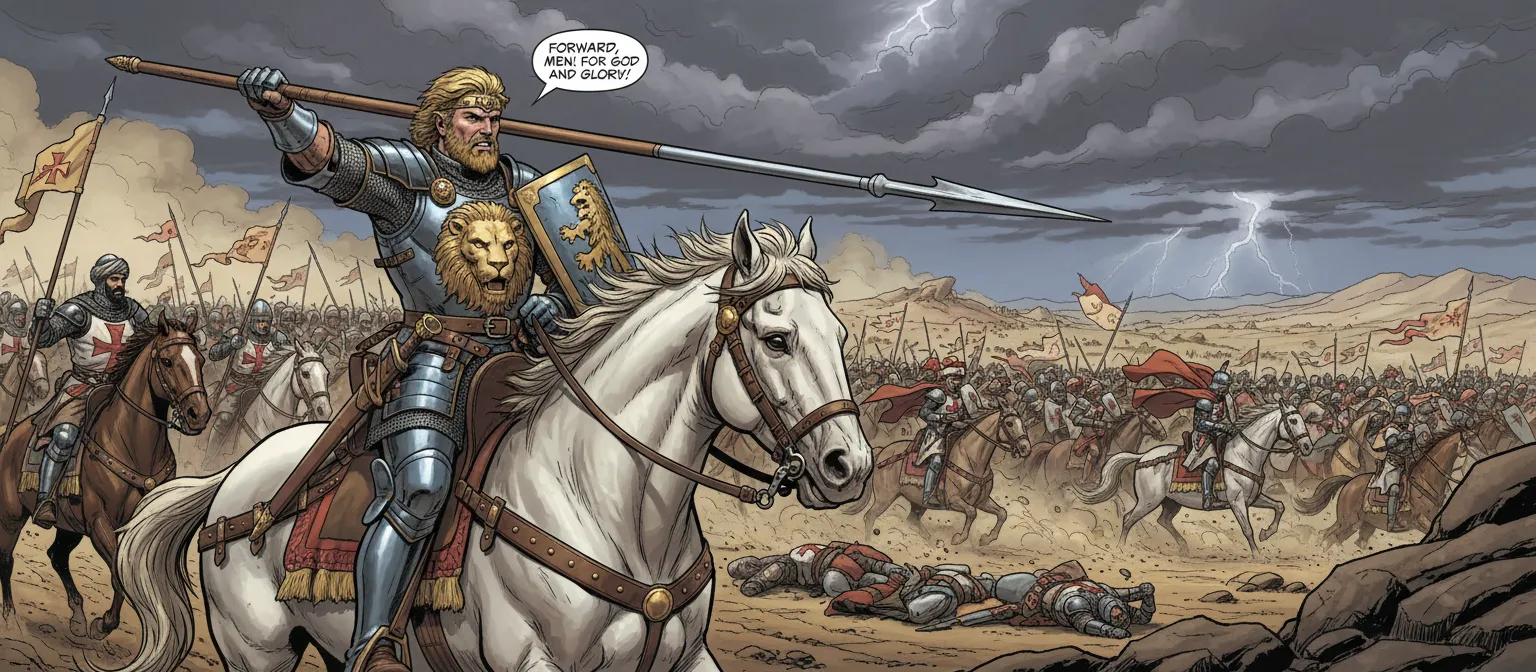
The Third Crusade brought together three powerful rulers. Emperor Frederick Barbarossa of Germany, King Philip II of France, and King Richard I of England (known as Richard the Lionheart) led their armies. This crusade was famous for its legendary figures.
Tragedy struck when Barbarossa drowned in Anatolia. His death devastated German morale, and most of his army returned home. Richard and Philip were left to lead the crusade.
Philip soon left, leaving Richard as the main commander. In September 1191, Richard’s genius shone at the Battle of Arsuf. He defeated Saladin’s army, showing his tactical brilliance.
Yet, Richard couldn’t take Jerusalem. The city’s fortifications were too strong, and his supply lines too thin. In September 1192, Richard and Saladin signed a peace treaty, reestablishing the Kingdom of Jerusalem but without the city itself. Christian pilgrims could visit holy sites, but Muslim forces controlled the territory.
An Unexpected Turn Toward Christian Lands
The Fourth Crusade was a strange detour. When Pope Innocent III called for a new campaign in 1198, he aimed to attack Egypt. Instead, the crusaders never reached Muslim lands. They were diverted to Constantinople, the Byzantine Empire’s capital, by political intrigue and financial pressures.
The crusaders became involved in a scheme to overthrow Byzantine Emperor Alexius III and install a more favorable ruler. The campaign ended with the devastating Fall of Constantinople in 1204. Crusaders brutally conquered and looted one of Christendom’s greatest cities, establishing a short-lived Latin Empire in Byzantine territory.
This disaster showed how far the crusading movement had strayed from its original purpose. Economic interests and political ambitions now drove decisions as much as religious devotion. The crusader kingdoms in the Holy Land received no help from this misdirected expedition, leaving them vulnerable to Muslim reconquest.
Examining these three campaigns, a clear pattern emerges. The Second Crusade showed royal leadership wasn’t enough. The Third Crusade proved brilliant commanders couldn’t overcome strategic realities. The Fourth Crusade showed how politics and economics overshadowed religious goals.
You might wonder how the crusading ideal survived these setbacks. The answer lies in the powerful combination of religious faith, economic opportunity, and political ambition that continued to motivate Europeans for another century. Despite repeated failures, the dream of controlling the Holy Land remained deeply embedded in medieval consciousness.
What Motivated the Crusaders?
The crusaders who joined these medieval holy wars were driven by many reasons. They were not just about spiritual devotion but also worldly concerns. Each crusader had their own hopes, fears, and ambitions.
These religious military campaigns attracted a wide range of people. From pious monks to ambitious knights, and from wealthy nobles to desperate peasants. Each had their own reasons for joining, often with overlapping motivations.
The Power of Faith and Salvation
Religious belief was at the heart of crusading. Pope Urban II promised that crusading could be a complete penance for all sins. This was a radical offer in a time when eternal damnation was feared.
Medieval Christians believed their souls were in a precarious balance between heaven and hell. The Pope’s promise offered a direct path to paradise for those who might face punishment in the afterlife.
Whoever went to Jerusalem for devotion alone could substitute this journey for all penance, effectively saving them from eternal damnation.
Pope Urban II’s Appeal, 1095
Jerusalem was seen as a place of unmatched spiritual significance. It was where Jesus Christ had walked, taught, suffered, and been crucified. The idea of praying at Christ’s tomb or walking His streets was incredibly powerful.
Crusade preachers combined spiritual opportunities with stories of mistreatment in the Holy Land. This created a potent emotional combination. The desire for vengeance mixed with spiritual advancement proved irresistible to many.

Wealth, Land, and Political Ambition
While recent scholarship highlights religious impulses, economic and political realities also played a role. Crusades were expensive, with a knight’s participation costing the equivalent of four years’ income. Most participants had to take out loans or sell land.
Despite these costs, material gain was a possibility. Stephen of Blois wrote to his wife about receiving valuable gifts and honors. He said he now had twice as much gold and silver as when he left home.
Different groups saw different opportunities in crusading:
- Italian merchant cities saw chances to establish trading networks in the Eastern Mediterranean
- Younger sons without inheritance prospects could find land and fortune in new territories
- Nobles and knights could boost their reputations and political standing
- Ambitious churchmen could advance their careers through participation and leadership
Church authorities officially disapproved of worldly motivations. Yet, many laypeople balanced their religiosity with practical concerns. This wasn’t hypocrisy but a reflection of the medieval view that spiritual devotion and material ambition were compatible.
Modern historians have moved away from the idea of crusaders seeking only adventure and profit. Instead, they see crusaders as complex individuals with both religious devotion and worldly ambitions. Their faith didn’t shield them from practical concerns or the hope for rewards.
The truth is, motivation for joining religious military campaigns varied. Some were driven almost entirely by faith, while others balanced spiritual goals with economic necessity. Most fell somewhere in between, carrying a mix of devotions that made sense in their medieval context but might seem contradictory today.
The Role of the Catholic Church
The Catholic Church played a huge role in the Crusades. It wasn’t just a supporter; it was the main force behind these big expeditions. The Church didn’t just bless these wars; it organized, funded, and promoted them for many years.
This shows how powerful religious institutions were in medieval society. They shaped spiritual life, military campaigns, and international politics.
The Church’s system for supporting crusading was amazing. It turned passionate religious beliefs into a huge military force.
Papal Authority and the Birth of Holy Wars
The First Crusade was announced at the Council of Clermont in November 1095. Pope Urban II spoke to clergy and nobles with a vision that changed Europe and the Middle East for centuries. He asked Christian warriors to stop fighting each other and fight to take Jerusalem back from Muslims.
Papal power had grown a lot by then. The Church had already fought wars and dealt with secular rulers. Urban saw the crusade as a chance for knights to change their violent lives into something holy.
Starting the crusade helped Urban too. He could get closer to the Orthodox Church and fix the split with Byzantine Christianity. It was more than just war; it was about growing the Church’s power.
Organizing these big campaigns needed strong institutions. The Church created crusade indulgences to reward participants. These spiritual rewards were like money for the soul, motivating thousands to join.
The Church also started military orders like the Knights Templar and Hospitallers. These groups were monks and warriors together, creating permanent forces for crusades. The Church even taxed clerical income to fund these wars, showing great financial planning.
“God wills it! March forth to reclaim the holy places defiled by the infidel, and your path to heaven shall be secured through your righteous struggle.”
— Attributed to crusade preaching rhetoric of the late 11th century
Over time, crusades went beyond Jerusalem. Popes called for crusades against pagans in the Baltic, against Christian heretics like the Cathars, and even against political enemies. This shows how the Church used crusading for many purposes, lasting into the 18th century.
Spreading the Crusading Message
The Church worked hard to keep the crusading spirit alive. Charismatic preachers traveled, giving emotional sermons that moved people and made them give money. They painted pictures of Christians suffering under Muslims and holy sites being desecrated.
These preachers talked about the conflict in dramatic ways. They promised eternal salvation, forgiveness of debts, and the chance to walk where Christ walked. The message was clear: turn your violence into holy service.
The Church made the ritual of “taking the cross,” where people sewed crosses on their clothes. This made them visible crusaders, hard to leave without shame. The cross was a symbol of honor and a promise.
Church leaders saw crusading as the highest form of devotion. They framed it as a battle between good and evil, where every fight served God. For knights, it was a chance to fight and be holy at the same time.
Managing the story of the conflict was key for the Church. They sometimes exaggerated Muslim threats or Christian suffering to keep people excited. They had to balance crusades in the East with other conflicts, sometimes losing focus on Jerusalem.
The Church’s message appealed to different people. Nobles saw glory and land, while common folk saw salvation and adventure. For the papacy, it was about power and influence across the world.
But, the Church faced challenges. Failed crusades and politics made it hard to keep people excited. Yet, they adapted, finding new enemies and reasons to keep the crusading spirit alive for generations.
Life for Crusaders: Experiences and Challenges
Crusaders faced harsh realities far from the glory of medieval tales. They endured brutal conditions that tested their limits. From Europe, they entered unfamiliar lands, hostile climates, and logistical nightmares.
Crusading life was grueling, with most time spent on survival, not battles. The image of knights in shining armor was just a small part of their journey. Practical survival challenges dominated their days.
The Daily Struggle of Medieval Military Campaigns
Joining a crusading army meant being part of a massive city of 60,000 to 100,000 people. This included 7,000 knights and 30,000 non-combatants. These non-fighters were vital for the army’s survival.
Logistical challenges were immense. Daily, the army needed food, water, and shelter. Summer heat and scarce water made life hard, with local populations often hostile.
Relationships with local rulers were complex. Byzantine Emperor Alexios held significant power over crusaders. They needed his supplies and safe passage, creating a delicate balance.
Camp life was harsh. By Antioch, only 40,000 crusaders remained. Winter conditions were extremely harsh. Disease killed more than battles.
The knights templar emerged to address these challenges. They provided defense for pilgrims and maintained order in captured territories. Their role was critical in distant lands.
Non-combatants played key roles. They maintained equipment, cared for the wounded, and managed supplies. Without them, crusader armies would have failed.

Adapting to Unfamiliar Warfare
European knights found their tactics dangerously inadequate in the Holy Land. Turkish and Arab forces used swift mounted archers, outmaneuvering knights.
Crusaders faced constant frustration from enemies who used hit-and-run tactics. Arrows rained down, disappearing before knights could respond.
Over time, crusader armies improved. They developed disciplined formations and adapted their tactics. Knights fought more defensively, waiting for the right moment to strike.
Siege warfare was common in crusading campaigns. Months-long sieges tested patience and engineering skills. Crusaders built siege towers and endured counterattacks while supplies dwindled.
Italian sailors and troops were vital, capturing coastal ports. They gained trading privileges, shaping Mediterranean commerce. Military success relied on cooperation between different groups.
Establishing crusader kingdoms was challenging. Maintaining military effectiveness was hard due to manpower shortages. Recruiting and retaining knights was difficult.
Frankish settlers had to balance military readiness with governance. Oppressing locals was disastrous. Without cooperation from locals, their economy would collapse.
Crusader kingdoms had to navigate complex cultures and religions. Successful ones adopted local techniques, climate-appropriate clothing, and diplomacy with Muslim states. Adaptation was key to survival.
Crusading taught that devotion and skill were not enough. Success required adaptability, learning from victories and defeats, and endurance in unimaginable challenges.
The Impact of the Crusades on Europe
The Crusades changed Europe in big ways. They affected trade, learning, and how people saw the world. These wars brought lasting changes to commerce, culture, and learning across the continent.
These impacts show how wars sparked economic and cultural changes. The Crusades connected East and West, opening channels that stayed open.
Changes in Trade and Economy
The Crusades started a commercial revolution. Italian city-states like Venice, Genoa, and Pisa became key players in Mediterranean trade. They helped crusaders cross the sea and got trading privileges in places like Acre and Jaffa.
This was very profitable for them. Italian merchants set up trading posts in the eastern Mediterranean. They brought wealth back to Europe.
The Medieval Warm Period helped Western Europe grow. Italian merchants soon became the top traders in the Mediterranean. They brought goods like spices and silks to eager European markets.
The need for money to fund crusades led to better banking. Knights sold their lands to finance their journeys. This led to the development of modern banking.
The movement between Europe and the Holy Land created a new industry. Ship-building and navigation skills improved. Italian sailors carried soldiers and pilgrims, making money.
Here’s how the Crusades boosted European economy:
- Expanded trade routes: New connections linked European markets with Eastern suppliers
- Monetized economy: More coins and merchant activity moved Europe away from farming
- Advanced financial tools: New banking methods and accounting emerged
- Taxation systems: Governments got better at collecting taxes for crusades
- Urban growth: Trading cities grew, creating new wealth centers
These changes helped monarchies grow stronger. Taxes for crusades showed what governments could do. This set the stage for future state-building.
Cultural Exchange and Influence
The Crusades brought big changes in ideas and culture. Crusaders and merchants brought back new ideas and knowledge that changed Europe.
The First Crusade sparked a burst of historical writing. This inspired authors across Europe to document these events. This helped literacy grow.
Islamic scholars had kept Greek and Roman knowledge alive. Crusaders brought this knowledge to Europe. This sparked an intellectual revival.
Architectural innovations moved both ways. European castles got better thanks to Eastern techniques. Crusaders saw impressive urban planning and architecture.
The cultural exchange included:
- Scientific knowledge: Europeans learned about math, medicine, and astronomy
- Literary traditions: Stories of crusading adventures spread literacy and shared culture
- Chivalric culture: Crusades helped shape knightly ideals and honor
- Culinary influences: New spices and cooking methods enriched European food
- Textile production: Exposure to Eastern fabrics and dyeing improved European textiles
Chivalric culture is a key example. Crusades helped define knightly behavior and ideals. These values shaped literature and social expectations.
The Crusades, despite their violence, brought lasting exchange. They enriched European civilization. This set Europe on a path to global influence.
The Legacy of the Crusades
The Crusades have sparked ongoing debate and reinterpretation. Their influence goes beyond their historical time. Scholars, politicians, and societies have viewed these campaigns differently over the centuries.
Each generation has seen the Crusades through its own cultural lens. This creates layers of interpretation that reveal as much about the interpreters as the events themselves.
In the last four decades, the Crusades have become a dynamic area of historical inquiry. This shows growing curiosity to understand these extraordinary events and their lasting impact on both medieval and modern civilizations.
Historical Perspectives Through Time
Understanding the Crusades depends on when and where you ask the question. Medieval Europeans saw these campaigns as glorious attempts to serve God. They produced heroic literature and detailed chronicles that celebrated crusader achievements.
The Enlightenment brought a shift in perspective. Intellectuals of the 17th and 18th centuries viewed the Crusades critically. They saw them as examples of religious fanaticism and papal manipulation.

The 19th century added complexity with European imperialism. Some romanticized the Crusades as noble precursors to Western expansion. Others saw them as regrettable episodes of intolerance.
The 20th century brought sophisticated scholarship. Academic debate moved forward significantly in the 1980s. Discussion concerning the definition of a crusade gathered momentum.
Scholars now recognize crusading continued down to the 16th century. These campaigns included expeditions against Muslims, pagan peoples, the Mongols, political opponents of the Papacy, and even Christian heretics. This expanded definition changed how historians approached the entire crusading movement.
| Historical Period | Interpretation of Crusades | Primary Focus | Cultural Context |
|---|---|---|---|
| Medieval Era (1100s-1400s) | Glorious religious duty | Heroic service to God | Christian faith dominance |
| Enlightenment (1600s-1700s) | Religious fanaticism | Papal manipulation | Rational thought emergence |
| Imperial Age (1800s) | Romantic noble ventures | Western expansion precedent | Colonial justification |
| Modern Scholarship (1980s-present) | Complex religious warfare | Expanded definition and scope | Academic rigor and debate |
Recent decades have seen intense debate among scholars about crusader motivations. Earlier emphasis on economic factors has given way to recognition of genuine religious devotion. This shift demonstrates how historical understanding continues to evolve.
How the Crusades Shaped Modern Society
The Crusades continue to resonate in today’s world. They contributed to long-lasting tensions between Christian and Islamic civilizations. These tensions create historical grievances and memories that extremists exploit.
Terms like “crusade” and “crusader” remain potent symbols in contemporary discourse. The horrors of 9/11 and President George W. Bush’s use of the word “crusade” to describe the war on terror demonstrated this reality. His choice fed extremists’ message of hate and the notion of a longer, wider conflict between Islam and the West.
Terrorist groups seized upon Bush’s language to frame contemporary conflicts as continuations of medieval religious wars. This example shows how medieval history can be weaponized in modern geopolitical struggles, regardless of whether such connections reflect historical accuracy.
The Crusades established patterns of East-West interaction and conflict that influenced subsequent centuries of diplomacy, trade, and warfare. Crusading ideology influenced European colonialism, with some colonial powers framing their expansionism in crusading terms. This connection between medieval religious warfare and modern imperialism reveals uncomfortable continuities in Western approaches to non-Christian societies.
Modern debates about religious violence frequently reference crusading history. The relationship between faith and warfare, and the role of religion in international relations, often draws upon examples from the crusading era. These discussions help understand contemporary conflicts while risking oversimplification of complex medieval realities.
Yet the legacy includes positive elements as well. The cultural and intellectual exchanges sparked by the Crusades contributed to European development in science, medicine, architecture, and philosophy. The experience of crusading influenced European institutions and governance, creating new models of military organization and international cooperation.
You’ll also discover that the military orders evolved into charitable organizations that exist today. The Knights Hospitaller, for example, continue as the Sovereign Military Order of Malta, focusing on medical and humanitarian work. This transformation demonstrates how institutions can adapt while maintaining connections to their historical origins.
Understanding the Crusades challenges you to think critically about how historical events are remembered, interpreted, and sometimes misused. The legacy teaches important lessons about religious tolerance, the dangers of framing conflicts in absolutist terms, and the importance of historical nuance. Recognizing what actually happened during the Crusades—and why—remains important for making sense of both medieval history and aspects of our contemporary world.
The Crusades and Their Geographic Reach
When you think of the Crusades, you might picture battles in Jerusalem. But the impact went far beyond that. The Jerusalem crusades spread across three continents, changing the medieval world in lasting ways.
The crusades were more than just battles. They were a vast network of military campaigns, settlements, and cultural interactions. This spread crusading ideology from the Levant to the Baltic coastlines, reshaping the medieval world.
Regions Affected by the Crusades
The Holy Land was the most famous crusading theater. There, four Crusader States emerged in the Levant. The Kingdom of Jerusalem was the crown jewel of these Latin Christian outposts.
Alongside it, you’d find the County of Edessa, the Principality of Antioch, and the County of Tripoli. These fragile Christian kingdoms survived for nearly two centuries in a predominantly Muslim region.
But the crusading phenomenon extended far beyond the Middle East. On the Iberian Peninsula, Christian kingdoms waged the Reconquista against Muslim al-Andalus. The papacy granted these campaigns crusader status, just like expeditions to Jerusalem.
In Northern Europe, the Baltic Crusades targeted pagan peoples in Prussia, Lithuania, and Latvia. German knights and religious orders established Crusader States that would eventually become major European powers.
The crusading concept proved remarkably flexible. In southern France, the Albigensian Crusade brutally suppressed the Cathar heretical sect between 1209 and 1229. This campaign devastated the wealthy region of Languedoc and brought it firmly under French royal control.
Later crusading efforts focused on the Balkans, where Christian kingdoms fought to halt the expanding Ottoman Empire. These campaigns stretched into the 16th century, demonstrating the lasting power of crusading ideology.
The Influence on Middle Eastern Cultures
The reality of crusader life in the Levant challenges many popular assumptions. Crusader life wasn’t always about constant warfare. Instead, pragmatic considerations often took precedence over ideology.
Frankish lords frequently made truces and treaties with Muslim neighbors. Sometimes they even allied with Muslim rulers against other Christian or Muslim rivals. These political alliances reveal a sophisticated understanding of regional power dynamics.
The crusader rulers had to accommodate an incredibly diverse population under their control. Their territories included Latin Christians from Europe, Greek Orthodox Christians, Armenian Christians, Syrian Christians, Jews, and Muslims. Each community maintained its own language, customs, and legal traditions.
Recent archaeological evidence has transformed our understanding of how Franks lived in the Holy Land. Contrary to older theories, they didn’t isolate themselves in urban enclaves. Instead, Frankish settlers integrated into the countryside more extensively than historians previously thought.
You can see this exchange in architecture, where crusader buildings incorporated Eastern design elements. Agricultural practices, cuisine, and language all showed mutual influence. Many French words entered Arabic vocabulary, while crusaders adopted Arabic terms.
Queen Melisende of Jerusalem (1131-1152) exemplifies this cultural bridge-building. With Armenian Christian heritage through her mother, she worked actively to support both indigenous and Latin Church communities. Her reign demonstrates that crusader leadership sometimes understood the necessity of cooperation with local populations.
The data from archaeological sites tells an important story: had the Franks oppressed the majority local population, their economy would have collapsed. Muslims and Eastern Christians who lived under Frankish rule provided essential agricultural labor and tax revenue. The christian-muslim conflict existed, but it coexisted with periods of peaceful interaction and economic interdependence.
This nuanced picture shouldn’t minimize the very real violence, displacement, and suffering that crusading campaigns caused. The initial conquests brought tremendous bloodshed. Later campaigns by Muslim rulers seeking to expel the Frankish presence created additional waves of violence.
Understanding this complexity helps you see that medieval societies, like modern ones, contained contradictions. Religious rhetoric about holy war coexisted with practical accommodation. Ideological conflict shared space with cultural curiosity. The Jerusalem crusades created a collision of civilizations, but also unexpected moments of coexistence that enriched both sides in ways that shaped the development of both European and Middle Eastern societies for centuries to come.
Modern Interpretations of the Crusades
Today, we see the Crusades through a new lens, showing us as much about now as then. Scholars, filmmakers, and the public are rethinking these events. This change comes from new research and shifting cultural views.
In the last 40 years, studying the Crusades has grown a lot. New findings and fresh views challenge old ideas. Now, we see the Crusades in a more complex light than before.
How Historians View the Crusades Today
The 1980s were a big turning point in how we see the Crusades. Historians started asking big questions about what these religious wars were. This shift changed how we view the Crusades.
There’s a big debate among scholars. Traditionalists say true Crusades were only about freeing or defending the Holy Land. Pluralists believe crusading was broader, including many military campaigns in Europe and beyond.

Pluralists think crusading lasted into the 16th century. It included battles against pagans, heretics, and Muslims. This view changes how we see medieval Christian warfare.
Today, historians use more evidence than before. Charters are key, showing the big financial costs of crusading on families.
Charters show crusaders mortgaging lands and borrowing money to fund their wars. This helps us understand their motivations. Were they seeking wealth or driven by faith?
Most scholars now believe genuine religious devotion was the main reason for the First Crusade. This challenges old views that crusaders were just after wealth or land.
Charters suggest crusaders often lost money. They sold valuable properties at bad rates to raise cash. This shows their religious beliefs were strong, even if they had other reasons too.
Recently, we’ve started to see the Crusades from the Muslim side too. For too long, we only heard from Christians. Now, we’re looking at Arabic texts that show how Muslims saw these invasions.
These texts reveal Muslims first saw the Frankish invasions as just another Byzantine move. Later, they developed a strong jihad ideology. Leaders like Nur al-Din and Saladin used this to unite Muslims against the Crusaders.
Archaeology has also changed our view. Excavations in Crusader States show surprising cultural mixing. Architecture and everyday items show Franks and locals got along better than we thought.
Historians are also looking at how crusade stories were made and shared. Medieval chronicles were not just records. They were stories with specific goals and audiences. Chansons de geste celebrated crusader bravery in a chivalric way.
Scholars now ask deeper questions about these stories:
- Why were certain stories told and others forgotten?
- How did authors use ancient and biblical themes to add authority?
- What borrowing happened between different texts?
- How did these stories shape collective memory and identity?
This analysis shows crusade memory was actively built, not just recorded. Different groups used these stories for their own agendas. This helps us critically evaluate these sources.
The Crusades in Popular Culture
The Crusades also show up in popular culture in interesting ways. Films, books, video games, and even politics keep reimagining these medieval events. These stories often reflect today’s worries more than the past.
Old novels often made crusaders seem noble and heroic. Sir Walter Scott’s The Talisman (1825) showed knights and Muslim foes as noble warriors. These stories reflected Victorian ideals of honor and masculinity.
More recent novels, though, offer complex views. They explore moral gray areas, question motives, and present different sides. This shift mirrors our growing recognition of historical complexity and the need to challenge simple stories.
Films about the Crusades have also evolved. Ridley Scott’s Kingdom of Heaven (2005) tried to show both sides fairly. It highlighted the tragedy of religious conflict and shared humanity.
Earlier films, like The Crusades (1935), showed clear good vs. evil lines. These films reflected the prejudices of their time. Watching these films over time shows how movies reflect changing social values.
Video games set in the Crusades offer another interesting angle. Games like Assassin’s Creed let players experience medieval battles and environments. Yet, they simplify complex issues for the sake of gameplay.
These games can spark interest in history, but they can also create misconceptions. The challenge is to make them both fun and educational.
The Crusades are also used in dangerous political rhetoric. Islamic extremist groups see their actions as responses to ongoing “crusades” by the West. They use medieval history to justify today’s violence, with distorted views.
Some Western extremists also use crusader symbols for anti-Islamic agendas. They misuse symbols like the Templar cross without understanding their history. These uses are historically wrong and harmful.
Popular culture sometimes spreads myths about the Crusades. Stories of crusader atrocities and chivalric honor are often exaggerated. Neither captures the true complexity of history.
Yet, some works aim for more nuanced views. Documentaries like The Crusades: An Arab Perspective share voices often ignored in Western accounts. Historical fiction by authors like Tariq Ali challenges readers to question their assumptions and see different viewpoints.
The key is to develop critical media literacy about crusade stories. When you see the Crusades in media, ask yourself:
- What perspective does this story favor?
- Who’s included or left out?
- What today’s concerns might be influencing this portrayal?
- Does this story oversimplify the past?
Knowing that today’s views often color our understanding of history helps us separate fact from fiction. These interpretations have real effects. They shape how we see the past and influence today’s politics and relations between cultures.
The ongoing rethinking of the Crusades shows history is a dialogue between past and present. Being aware of how these events are portrayed and why helps us engage more deeply with history and today’s issues it sheds light on.
Frequently Asked Questions About the Crusades
You might have questions about these complex medieval campaigns. Let’s clear up some important points that often confuse people when learning about this period.
Clearing Up Historical Myths
One big myth is that crusaders were mainly after wealth. Modern research shows crusading was incredibly expensive. Most participants spent fortunes to join efforts to recapture holy land. Religious devotion drove the majority of crusaders, not greed.
You might hear that the crusader kingdoms were brutal regimes. The reality was different. These states needed cooperation from diverse populations to survive economically. Muslims, Jews, and various Christian groups lived within these territories. Complete oppression would have destroyed their economies.
Another misconception is that the Crusades started an endless war between Christianity and Islam. This oversimplifies history. Christian and Muslim rulers sometimes allied against their own religious communities when politics demanded it. Trade and peaceful periods existed alongside conflicts.
Understanding these campaigns requires looking beyond simple stories. The Crusades involved genuine faith, political complexity, and human motivation across multiple centuries. They shaped trade routes, cultural exchange, and religious attitudes in ways that influence our world today. Your grasp of this history helps you see past modern misconceptions and appreciate the nuanced reality of medieval life.
FAQ
What were the Crusades and when did they take place?
The Crusades were a series of religious wars by Western Christians. They aimed to reclaim Jerusalem and the Holy Land from Muslims. These wars lasted from 1095 to 1291, nearly two centuries.But crusading didn’t stop there. It continued into the 16th century in various forms. Hundreds of thousands of Europeans participated, making it a significant event in history.
Why did the Crusades happen?
The Crusades had many causes. The Pope called for the First Crusade in 1095. This was due to the Seljuk Turks’ expansion and mistreatment of Christians in the Holy Land.Jerusalem’s religious significance was also a factor. The papacy wanted to assert its authority. Economic and social conditions in Europe played roles too.
Who were the Knights Templar and what role did they play?
The Knights Templar were a famous military order during the Crusades. They protected Christian pilgrims and defended the crusader kingdoms. Unlike typical crusaders, they remained in the East.They combined monk and warrior roles. Their financial operations made them wealthy and influential until their dissolution in the 14th century.
Why aren’t the Northern Crusades as famous as the crusades to Jerusalem?
The Northern Crusades lacked the religious symbolism of Jerusalem and lasted over 200 years, making them less dramatic than the expeditions to the Holy Land. They’re also seen as more political and colonial than purely religious.
Did the Children’s Crusade actually happen?
Not in the way the Children’s Crusade was often portrayed. There was no organized crusade of children marching to Jerusalem in 1212. The events that inspired the legend involved young adults and poor peasants, not literal children.
How long did the Crusades last?
The Crusades lasted nearly two centuries. They started in 1095 and ended in 1291. But crusading activities continued into the 16th century.Crusades took place in Spain, the Baltic, and within Europe. They were officially sanctioned by the Pope and involved hundreds of thousands of participants.
How many Crusades were there?
Historians traditionally count eight or nine major expeditions to the Holy Land. But there were many other crusades and campaigns.Crusades were called against pagans, Muslims, heretics, and political enemies. The exact number is difficult to count precisely.
Were crusaders motivated by greed?
This is a common misconception. While some crusaders sought wealth, most were motivated by religious devotion. Crusading was expensive, and many participants faced financial hardship.Current research shows that crusaders genuinely believed in the spiritual rewards of participating. They saw it as a way to earn remission of sins and achieve salvation.
What happened to the crusader kingdoms?
The crusader kingdoms existed from 1099 to 1291. They were established after the First Crusade. Edessa fell first in 1144, prompting the Second Crusade.The Kingdom of Jerusalem suffered a major setback in 1187. Muslim forces, including Saladin, recaptured the city. The crusader kingdoms gradually shrank as Muslim forces reconquered territories.Antioch, Tripoli, and Acre fell in the late 13th century. The last major stronghold, Acre, fell in 1291. After that, crusaders retained only Cyprus and some smaller islands.
Did Pope Urban II really start the Crusades?
Yes, Pope Urban II launched the crusading movement in 1095. He called for an armed pilgrimage to recapture Jerusalem. His speech was electrifying, prompting listeners to shout “Deus vult!” (“God wills it!”).Urban’s call was revolutionary. It channeled European warrior society toward a religious purpose. It offered unprecedented spiritual incentives and enhanced papal authority.
Were the Crusades just about religion, or were there other factors?
While religion was the primary driver, other factors motivated crusaders. Political motivations included the papacy’s desire for authority and kings and nobles seeking prestige and power.Economic factors played a role too. Italian merchant cities gained trading privileges. Crusading stimulated European economic development through trade and financial innovation.Social factors were also important. Younger sons without inheritances sought opportunities abroad. Knights could fulfill their social obligations while serving God. Families sometimes participated together.
How did the Crusades affect relations between Christians and Muslims?
The Crusades had profound effects on Christian-Muslim relations. The initial invasions shocked the Islamic world. The capture of Jerusalem in 1099 created deep resentment.Despite this, there were periods of peaceful coexistence and trade. Muslim leaders developed counter-crusade ideology. The legacy of the Crusades continues today, influencing East-West relations.
What is the geographic scope of the Crusades?
The Crusades spanned three continents. The main crusader kingdoms were in the eastern Mediterranean. But crusading extended beyond the Holy Land.In the Iberian Peninsula, the Reconquista against Muslim al-Andalus received crusade status. In Northern Europe, the Baltic Crusades targeted pagan peoples. Within Europe, crusades were called against Christian heretics.
Did all crusaders go to fight, or were there other participants?
Crusading armies included people of all social classes and genders. Knights were the most celebrated participants, but there were also non-combatants like clergy, merchants, and women.Women played a significant role in crusading. They accompanied their husbands, sought spiritual benefits, or performed support roles. Peasants and common people also joined, facing hardships due to lack of resources.
Why did the Crusades ultimately fail to maintain Christian control of the Holy Land?
The crusaders failed due to chronic manpower shortages and the enormous distance from Europe. Muslim unification under strong leaders was also a factor.Declining European enthusiasm for crusading and the diversion of resources to other conflicts weakened the crusader presence. The Fourth Crusade’s sack of Constantinople damaged relations between Western and Eastern Christians.
How do historians view the Crusades today?
Modern scholarship has become more sophisticated. Historians debate the definition, scope, and interpretation of the Crusades. There’s a shift away from purely materialistic explanations.Current consensus recognizes genuine religious devotion as the primary driver. Scholars use a wider range of sources, including charters, to understand motivations. There’s growing interest in the Muslim perspective and the development of jihad ideology.
Are the Crusades relevant today?
Unfortunately, yes. The Crusades remain relevant in contemporary discourse. Extremist groups on both sides exploit crusading history. These interpretations are historically inaccurate and dangerous.Understanding the Crusades is important for comprehending medieval history and the development of European institutions. They offer lessons about religious violence and the dangers of dehumanizing others.
What was life actually like for crusaders during their campaigns?
Life for crusaders was about survival and hardship, not glory or adventure. Moving armies across thousands of miles created enormous challenges.Crusaders faced constant struggles for food and water. Disease was a major killer. They had to negotiate with local rulers for supplies and safe passage.Crusaders had to adapt their military tactics to face different challenges. Siege warfare was common, testing endurance and engineering skill. Maintaining military effectiveness with chronic manpower shortages was a constant challenge.

Leave a Reply