
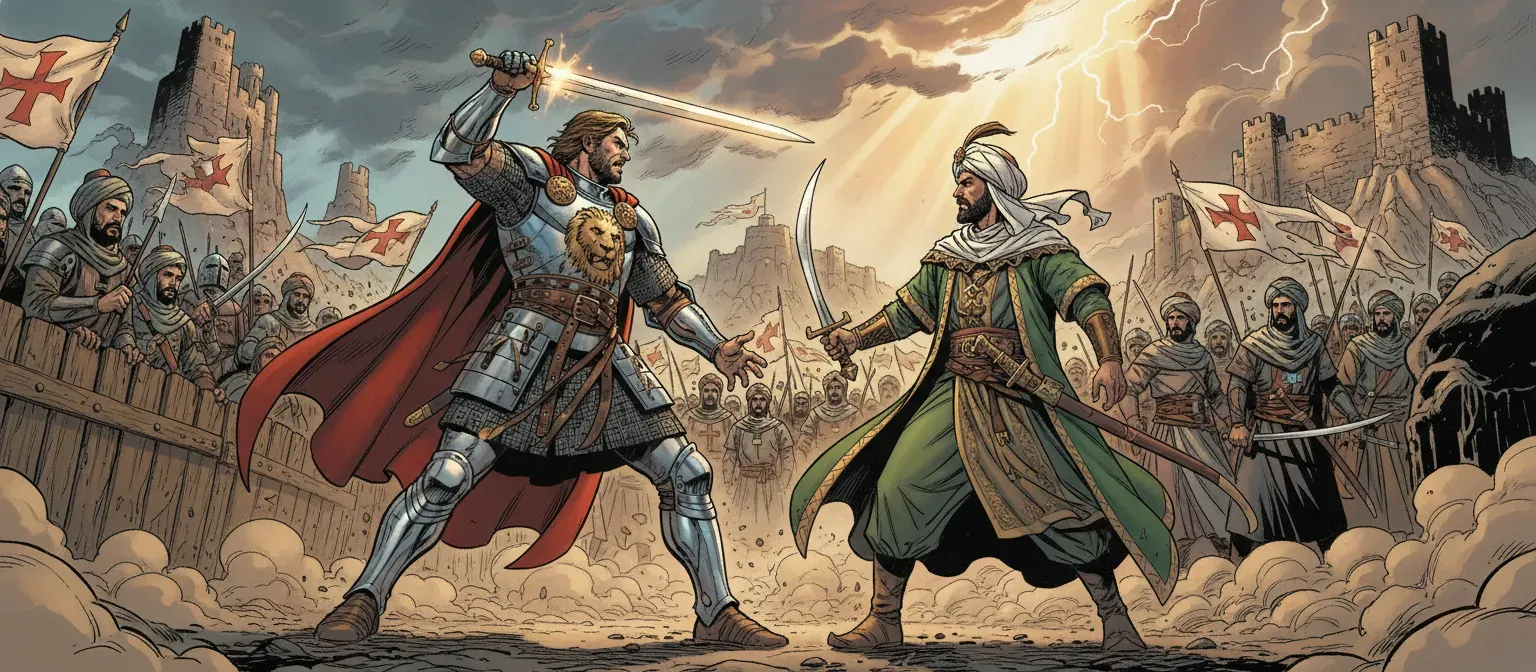
Imagine two legendary warriors locked in an epic struggle across deserts and ancient cities, yet they never met face to face. This is exactly what happened during one of history’s most dramatic medieval conflicts. You’re about to discover a story where personal courage, military genius, and surprising acts of respect between enemies shaped the fate of nations.
When Saladin recaptured Jerusalem in 1187, the news sent shockwaves through Christian Europe. Kings and emperors mobilized their armies for a massive campaign to win back the Holy Land. This became known as the Third Crusade, spanning from 1189 to 1192.
Richard the Lionheart of England emerged as the campaign’s driving force, facing off against Saladin, the brilliant sultan of Egypt and Syria. Their tactical maneuvers and battlefield decisions would reshape the political landscape of the region. Though Jerusalem remained beyond Christian reach, significant victories at Acre and Jaffa restored a coastal kingdom that would endure for generations.
You’ll explore how these two remarkable leaders commanded their forces through intense battles and diplomatic exchanges. Their mutual respect transcended the brutal realities of medieval warfare, creating a legacy that continues to fascinate us today.
Key Takeaways
- The campaign began after Saladin captured Jerusalem in 1187, triggering a massive European military response
- Richard the Lionheart earned his legendary reputation through brilliant military tactics and personal bravery during this conflict
- Despite being fierce enemies, both leaders demonstrated remarkable chivalry and mutual respect throughout their confrontation
- The crusaders successfully recaptured important coastal cities including Acre and Jaffa, securing Christian territories
- Jerusalem remained under Muslim control, making it the campaign’s primary unfulfilled objective
- The restored Kingdom of Jerusalem survived on a narrow coastal strip from Tyre to Jaffa for decades afterward
- This medieval clash between two legendary commanders continues to capture imaginations across cultures and centuries
Introduction to the Third Crusade
When news of Jerusalem’s fall reached Europe in 1187, it sparked a massive military campaign. This loss hit at the heart of Christian faith and pride. Soon, kings across Europe rallied their armies for a famous religious conflict.
The third crusade united an unprecedented coalition of European powers. These forces embarked on a journey that tested their military skills, diplomatic abilities, and religious conviction. The campaign lasted from 1189 to 1192 and involved thousands of soldiers, sailors, and support personnel.

The Fall That Changed Everything
Saladin’s conquest of Jerusalem on October 2, 1187, sent shockwaves throughout Christian Europe. The Muslim leader had achieved what seemed impossible just months earlier. The holy city, which Christians had controlled for 88 years, fell after a brief siege.
The news devastated European leaders and clergy alike. According to historical accounts, Pope Urban III suffered a fatal stroke upon hearing about Jerusalem’s loss. His death symbolized how deeply the defeat affected Christendom.
Pope Gregory VIII took immediate action after assuming leadership. He issued a papal bull declaring the fall of Jerusalem as divine punishment for Christian sins. This declaration transformed the loss from a military defeat into a spiritual crisis requiring urgent response.
European monarchs responded with remarkable speed. Henry II of England and Philip II of France ended their ongoing war to focus on the holy land. They introduced the Saladin tithe, a groundbreaking ten percent tax on income and movable goods. This financial measure demonstrated how seriously rulers took the crusading cause.
The Monarchs and Their Armies
Three powerful kings led the third crusade’s military effort. Each brought unique strengths and thousands of soldiers to the campaign. Their combined forces represented the largest Christian army assembled in centuries.
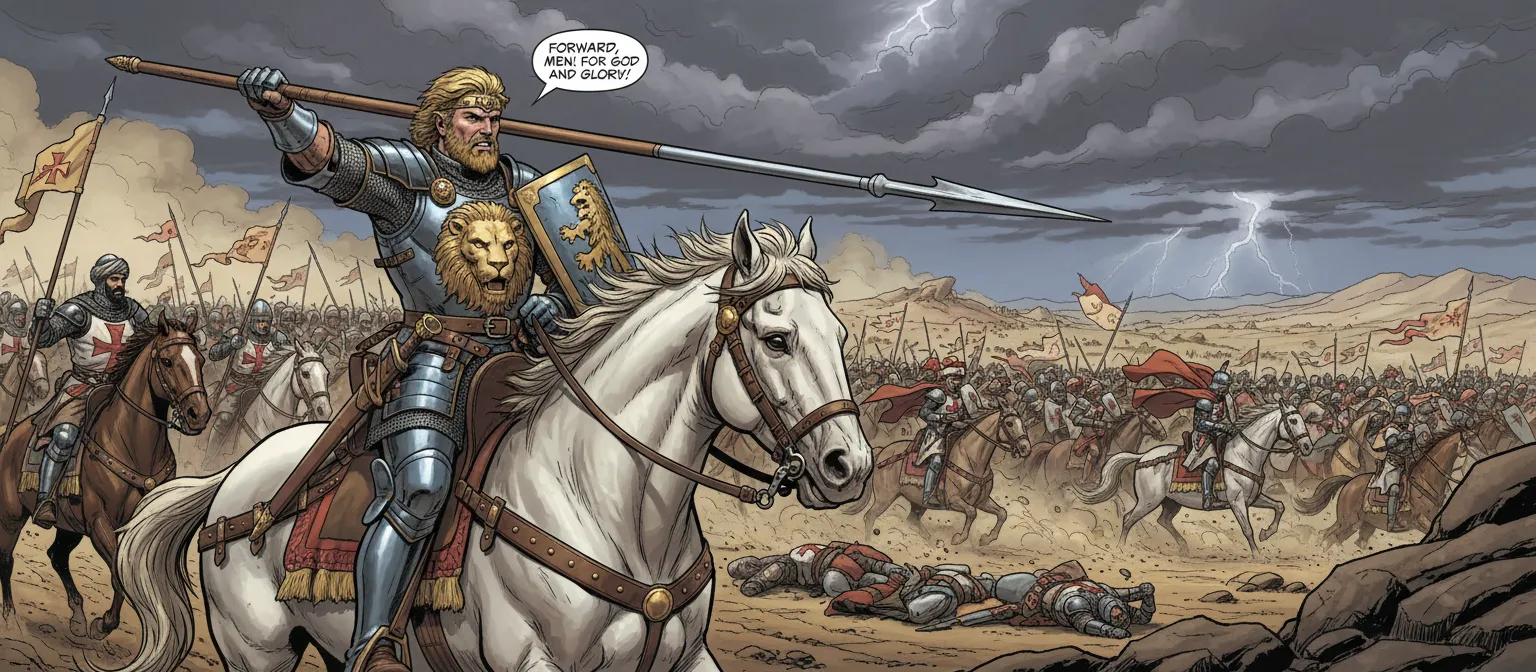
Richard I of England earned his nickname “the Lionheart” through exceptional military prowess. He was 32 years old when he took the cross and brought England’s full military might to bear. His tactical genius would prove critical in several key battles.
Philip II of France joined as both ally and rival to Richard. The French king commanded substantial resources and battle-hardened troops. His political calculations often conflicted with the crusade’s religious objectives.
Frederick Barbarossa of the Holy Roman Empire was the expedition’s elder statesman. At nearly 70 years old, he led the largest contingent of soldiers. His experience and prestige gave the crusade significant credibility throughout Europe.
Beyond these monarchs, numerous other forces participated. The Knights Templar and Knights Hospitaller provided professional military expertise. Italian maritime republics like Genoa, Pisa, and Venice contributed critical naval support. Archbishops, dukes, and counts from across Europe brought their own contingents.
| Leader | Kingdom/Empire | Key Contribution | Approximate Forces |
|---|---|---|---|
| Richard I | England | Military strategy and battlefield victories | 8,000 soldiers |
| Philip II | France | Financial resources and political influence | 7,000 soldiers |
| Frederick Barbarossa | Holy Roman Empire | Largest army and European prestige | 15,000 soldiers |
| Military Orders | Templars & Hospitallers | Professional warriors and local knowledge | 2,000 knights |
Strategic Goals and Expectations
The crusade’s primary objective was clear: recapture Jerusalem and restore Christian control over Christianity’s holiest sites. This goal united all participants, despite their political differences. The city held immense symbolic and spiritual significance for medieval Christians.
The campaign had important secondary objectives too. Securing coastal cities along the Mediterranean was essential for establishing reliable supply lines. These ports would enable reinforcements and provisions to reach crusader forces in the holy land.
Leaders also aimed to create a sustainable Christian military presence. They wanted to reverse Saladin’s conquests throughout the region. This meant recapturing fortresses, cities, and strategic positions beyond just Jerusalem.
The economic dimension shouldn’t be overlooked either. European rulers sought to protect trade routes connecting Europe to Asia. The holy land’s geographic position made it valuable for commercial interests. Italian maritime cities, in particular, valued access to eastern Mediterranean ports.
Religious devotion motivated thousands of ordinary crusaders who left their homes. They believed participating in the crusade would earn spiritual rewards and forgiveness for sins. This religious fervor provided the expedition with determined soldiers willing to endure tremendous hardships.
Military planners understood the challenges ahead. The journey to the holy land itself posed significant risks through hostile territories and treacherous seas. Once there, crusaders would face Saladin’s experienced armies in unfamiliar desert conditions. Despite these obstacles, European confidence remained high as the massive expedition began moving eastward in 1189.
The Context of the Crusade
Before Richard the Lionheart arrived in the Holy Land, a series of events changed medieval Christendom. The Third Crusade was a response to nearly a century of conflict and failed diplomacy. It was shaped by the power struggles between Christian and Muslim forces.
To understand why thousands of Europeans went east, you must know the historical context. The battle between Richard and Saladin was just one part of a long story of religious war and territorial ambitions.
Historical Background of the Crusades
The crusading movement started in 1095 with Pope Urban II’s call to reclaim Jerusalem. His speech at the Council of Clermont sparked the First Crusade. This crusade captured Jerusalem in 1099.
This victory led to the creation of the Kingdom of Jerusalem and other Crusader states in the Levant. These Christian enclaves were always at risk from Muslim counterattacks.
For nearly a century, Christians held these territories through military strength and diplomacy. But this balance couldn’t last.
The fall of Edessa in 1144 shocked Europe. This loss prompted the Second Crusade from 1147 to 1149.
The Second Crusade failed miserably. Poor coordination between German and French forces led to heavy casualties. A defeat at Dorylaeum on October 25, 1147, was a major blow.
Attacking Damascus, a Muslim city that could have been an ally, was a strategic mistake. This move failed militarily and lost the crusaders allies.
The failure of the Second Crusade had lasting effects. Muslim leader Nur al-Din unified Syria, reducing the Crusader states’ size and influence.
The Fall of Jerusalem in 1187
By 1169, Saladin emerged as a major force. He became the most formidable Crusader opponent.
Saladin unified Muslim territories and built a strong force. His victory at the Battle of Hattin on July 4, 1187, crushed the Crusaders.

After Hattin, Saladin’s forces quickly took the Kingdom of Jerusalem. City after city fell, including Acre, Beirut, and Ascalon.
On October 2, 1187, Jerusalem surrendered. Saladin showed mercy, allowing Christians to ransom themselves and leave.
This act of mercy made Saladin respected even by his enemies. His honor contrasted with the violence of previous wars.
Not all cities fell. Tyre resisted Saladin’s siege from 1187 to 1188, thanks to Conrad of Montferrat. This city became a key base for the counterattack.
The Role of Pope Gregory VIII
Jerusalem’s fall shocked Europe. Pope Gregory VIII issued “Audita tremendi” on October 29, 1187, calling for a new crusade.
This document was more than a call to arms. Gregory VIII saw Jerusalem’s loss as punishment for Christian sins. He urged Europeans to repent and reclaim the Holy City.
The Pope’s message inspired many. Kings, nobles, and common people felt called to join the crusade.
Frederick Barbarossa, the Holy Roman Emperor, was among the first to answer. Despite being sixty-six, he planned the most organized crusade yet.
Frederick’s involvement added prestige to the crusade. His military experience and power inspired confidence across Europe.
It’s important to note that Pope Innocent III called for the Fourth Crusade later. During the Third Crusade, Pope Gregory VIII and his successor Pope Clement III coordinated the effort.
The call to arms was successful. Within months, Frederick Barbarossa, Richard I of England, and Philip II of France committed to the crusade. This marked one of the largest military mobilizations in medieval Europe.
Richard the Lionheart: A King in Action
The Lionheart didn’t just inherit his military skills. He earned them through years of fighting and strategy. Richard I of England was a perfect mix of medieval chivalry and tactical genius. His Third Crusade campaigns showed revolutionary warfare tactics ahead of their time.
Richard’s success wasn’t just about bravery. It was about combining bravery with smart military planning. He turned the crusader army into a disciplined force that achieved the impossible.
From Duke to Warrior King
Born in 1157, Richard grew up in a powerful and turbulent family. At eleven, he became Duke of Aquitaine, thrown into a world of intrigue and conflict.
Richard spent his early years on battlefields, learning medieval warfare firsthand. He fought rebellions across his territories. These battles taught him valuable lessons for the crusade.
The Angevin Empire he inherited was vast but unstable. Richard fought his family members in brutal conflicts. These struggles made him a hardened commander who knew war’s reality.

When Henry II died in 1189, Richard became king with a focus on military glory. The Third Crusade was his chance to shine.
Revolutionary Military Leadership
Richard the Lionheart was unique for his understanding of combined arms tactics. Unlike many, he knew the importance of coordinating different units. His tactics would influence medieval warfare for generations.
After capturing Acre in July 1191, Richard showed genius in logistics. He planned the march to Jaffa carefully, considering the harsh summer conditions.
Richard marched in the morning, resting often to avoid the heat. He chose water sources for breaks.
Richard’s army formation was brilliant. He placed the Mediterranean Sea on his right flank. This allowed his fleet to support him, keeping supplies flowing.
The infantry protected the knights, and crossbowmen defended against skirmishers. This layered approach maximized each unit’s strength.
Richard organized his cavalry into twelve mounted regiments, each with about a hundred knights. This gave him flexibility and easier command during battles.
He rotated his infantry regularly to keep them fresh. The knights templar led the charge, while the Knights Hospitaller defended the rear. Both orders were key to maintaining discipline.
Richard balanced discipline with flexibility. He demanded obedience but adapted quickly when needed. This made his army resilient under pressure.
Decisive Campaigns and Battle Mastery
The Battle of Arsuf on September 7, 1191, tested Richard’s leadership. Saladin’s attacks pushed the crusaders hard, testing their endurance and discipline.
At Arsuf, Richard commanded about 10,000 infantry and 1,200 heavy cavalry. Victory depended on his tactical deployment.
The knights templar and Hospitallers faced Saladin’s harassment. At a key moment, the Hospitallers charged, possibly without Richard’s order. A lesser commander might have lost control.
Richard quickly recognized the situation and made a split-second decision. He committed his entire force to support the charge, turning a disaster into a coordinated attack. His army’s discipline allowed for this rapid response.
Richard’s control over his cavalry after breaking the Ayyubid army was extraordinary. He restrained them from pursuing too far. This level of control was rare in medieval warfare.
By regrouping, Richard achieved a decisive tactical victory at Arsuf. This victory opened the road to Jaffa and showed Saladin’s forces could be defeated in open battle. The psychological impact was huge.
Richard’s campaigns show a commander who combined chivalry with modern military thinking. He understood logistics, maintained discipline, and adapted tactics for the Holy Land. These qualities made him a formidable leader.
Richard’s success wasn’t just about winning battles. His systematic approach to warfare influenced strategy for centuries. His legacy goes beyond the Lionheart legend to represent true innovation in war.
Saladin: The Adversary
Richard faced Saladin on the battlefield. Saladin was a Kurdish warrior who united the Muslim world. He aimed to reclaim the Holy Land. His story is one of ambition, strategic brilliance, and honor.
Saladin’s rise to power wasn’t just about winning battles. He united fractured Muslim territories. This made him the Crusaders’ most formidable opponent.

Early Life and Rise to Power
Saladin was born around 1137 in Tikrit, Iraq. His name means “Righteousness of the Faith, Joseph, son of Job.” He studied religion, not warfare, early on.
His uncle Shirkuh introduced him to military service. When Shirkuh died in 1169, Saladin became the leader of Egypt. Nur al-Din, the Syrian ruler, later regretted choosing him.
Saladin quickly gained power. He defeated rival Muslim factions. At the Battle of the Horns of Hama in 1175, he won control over Syria, except for Aleppo.
The Assassins tried to kill him in 1176. Saladin survived and grew stronger. By the mid-1180s, he united the Muslim world around the Kingdom of Jerusalem.
His empire stretched from Egypt to Mesopotamia. No Muslim leader before him had united the Holy Land like this. This put a lot of pressure on the Crusader states.
Saladin’s Leadership and Tactics
Saladin was a military genius. He knew the Crusaders were weak because they had few soldiers and relied on Europe. He used this to his advantage.
His victory at the Battle of Hattin on July 4, 1187, was a big win. He made the Crusaders fight in the heat without water. They were too tired to defend themselves.
At Hattin, Saladin captured many Crusader leaders. He beheaded Reynald of Châtillon for breaking truces. The others were enslaved.
After Hattin, Saladin took Jerusalem. He treated the Christians better than the Crusaders had treated Muslims. This earned him respect from his enemies.
Against Richard, Saladin changed his tactics. He used many horse archers to wear down the Crusaders. This strategy worked well at the Battle of Arsuf.
At Arsuf, Saladin had 25,000 cavalry. He kept attacking the Crusaders until they were tired. But Richard’s army held strong.
Saladin knew how to fight against the Crusaders’ strengths. He used their weaknesses, like heat and thirst, to his advantage.
The Significance of His Legacy
Saladin’s legacy is more than his military wins. He was known for justice, honor, and tolerance. His story has been celebrated for centuries.
Baha al-Din ibn Shaddad, a Muslim chronicler, wrote about Saladin. Shaddad saw Saladin as a defender of Islam and Jerusalem. His writings help us understand Saladin’s goals and methods.
Even Christians saw Saladin as honorable. He was merciful to his enemies and kept his promises. This made him stand out in a brutal time.
Saladin’s victory in Jerusalem was his greatest achievement. He restored Islam’s third-holiest city. His success united Muslim territories for generations.
Today, Saladin is a symbol of resistance and leadership. His leadership and mercy inspire discussions about ethical warfare. His legacy touches on leadership, faith, and respect across cultures.
Major Battles of the Third Crusade
The Third Crusade was marked by key battles that shaped its outcome. These battles showed the growth of medieval warfare and the tactics of both sides. Three major battles stand out in history, defining the conflict’s end.
Each battle highlighted different military strategies. Siege warfare, cavalry tactics, and naval power were all used in new ways during the crusade.
The Siege of Acre
The Siege of Acre was the longest battle of the crusade. Guy of Lusignan started the siege in August 1189 with a small force. But, troops kept coming from Europe over two years.
Count Henry II of Champagne arrived on July 27, 1190, with a large group. Danes, Frisians, Flemings, French, Germans, and Italians from Genoa and Pisa also joined. This made the siege a huge effort from around the world.
The Crusaders were under siege by Saladin’s army from outside. This double siege was a test of endurance for all.
Richard and Philip Augustus arrived in 1191, changing the game. Their siege engines and naval blockade weakened Acre. The city fell on July 12, 1191, after nearly two years.
The victory was huge. A large part of the Egyptian fleet fell into Crusader hands. This gave them a big naval advantage for the rest of the campaign.
The Battle of Arsuf
The Battle of Arsuf on September 7, 1191, was a key fight. Richard’s army marched south from Acre toward Jaffa, facing Saladin’s forces. It was a battle of tactical genius.
Richard had about 11,200 troops. His army included 10,000 infantry and 1,200 heavy cavalry. Saladin had about 25,000 cavalry, outnumbering the Crusaders.
The Crusaders were well-organized. Knights Templar under Robert de Sablé led the march. Richard’s Angevin troops followed, with Poitevins behind them. The English and Normans protected the royal standard in the center.
French contingents, Flemings, and barons from Outremer followed. The Knights Hospitaller under Garnier de Nablus faced the most pressure from Saladin’s forces.
Saladin’s forces attacked with fanfare. Clashing cymbals, drums, and trumpets led the charge. Warriors screamed war cries as they attacked the Crusader column.
| Battle Element | Crusader Forces | Saladin’s Forces | Strategic Impact |
|---|---|---|---|
| Total Troop Strength | 11,200 troops (10,000 infantry, 1,200 cavalry) | 25,000 cavalry | Numbers favored Muslims, but Crusader discipline prevailed |
| Formation Strategy | Knights Templar vanguard, Knights Hospitaller rearguard | Harassment tactics targeting rearguard | Organized formation withstood constant attacks |
| Key Tactical Moment | Controlled cavalry charge ordered by Richard | Army broke under heavy cavalry impact | Secured Crusader control of coastal Palestine |
| Naval Support | Fleet provided supplies and refuge for wounded | No naval capability | Allowed sustained coastal advance |
For hours, the Crusaders marched under constant harassment. The Muslim forces targeted the rearguard, trying to break the formation. Muslim chronicler Baha al-Din ibn Shaddad was amazed by their discipline.
The crossbowmen were very effective. Baha al-Din saw enemy soldiers with multiple arrows stuck in their backs continuing to march. This frustrated Saladin’s tactics.
When the Hospitallers were under too much pressure, their marshal Baldwin le Carron charged. Richard saw the moment and ordered a general charge. This broke the Ayyubid army.
Richard controlled his knights from pursuing too far. This rare control allowed him to secure a complete victory.
After the battle, Crusaders took control of the central coast of Palestine. This victory opened the road to Jerusalem and showed Richard’s mastery of medieval warfare tactics.
The Impact of Naval Warfare
Naval power was key in the third crusade. Richard’s control of the sea allowed him to march down the coast safely. His fleet provided supplies and supported the army.
The ships also evacuated wounded soldiers, keeping the army strong. They even attacked enemy positions along the shore, adding to coastal warfare.
On June 6, 1191, Norman ships intercepted a Muslim supply vessel heading to Acre. This cut off supplies for the besieged garrison. Such victories happened often, strangling Saladin’s ability to resupply his coastal fortresses.
This use of land and naval forces was sophisticated for its time. Medieval warfare usually separated these elements. But Richard’s campaign showed their combined power. This gave the Crusaders a big logistical advantage that Saladin couldn’t counter.
Without naval power, the Crusaders couldn’t have kept their coastal conquests. The sea was their supply line, refuge, and strategic highway through hostile territory.
Diplomatic Efforts and Treaties
The fight between Richard the Lionheart and Saladin wasn’t just about war. It needed careful talks and compromises. Even in the heat of battle, both sides kept talking.
Medieval battles were more than just fighting. Leaders sent envoys, swapped prisoners, and made temporary peace deals. This showed they were smart to talk instead of fight.
The Role of Diplomacy in Warfare
Medieval wars weren’t just about fighting. Diplomacy was key in the Third Crusade. It let both sides achieve their goals through talks and battles.
Richard and Saladin were surprisingly practical. They knew endless war didn’t help anyone. Their chivalry went beyond their faith.
Even when fighting, diplomats kept talking. They sent messages and made peace deals. This let armies rest and heal.
Exchanging prisoners and paying ransoms was common. It saved lives and raised money for more battles. It was a win-win for everyone.
Key Negotiations Between Leaders
The rivalry between Richard and Saladin was famous. But they never met in person. They talked through trusted messengers.
After the Battle of Arsuf, both sides knew they were stuck. Richard had the coast but couldn’t take Jerusalem. He had to leave for England.
Saladin had his own problems. He couldn’t beat Richard in open battle. His army and treasury were tired.
Summer and early fall of 1192 saw intense talks. Richard even suggested a creative solution: his sister Joan marrying Saladin’s brother. This plan failed, but it shows their creative diplomacy.
They talked about many things, not just Jerusalem. They discussed borders, trade, and pilgrim rights. Both sides made offers and compromises.
The Treaty of Jaffa
On September 2, 1192, Richard and Saladin signed the Treaty of Jaffa. This deal ended the Third Crusade’s fighting and set terms both sides could live with.
The treaty let Jerusalem stay Muslim. This was hard for Crusaders who fought to take it back. But it gave Christians some rights.
Crusaders kept the coastal strip from Tyre to Jaffa. This helped the Kingdom of Jerusalem survive through trade. The sea kept the Christian presence alive.
The treaty was for three years. Both armies needed time to rest and recover. It helped everyone, soldiers and civilians.
For Richard, this was the best he could get. He had to go home to face his brother John. He’d kept Christian access to holy places without taking the city.
For Saladin, keeping Jerusalem was a big win. But he couldn’t keep fighting. The treaty saved his greatest achievement and stopped the war’s drain.
Richard left the Holy Land on October 9, 1192, never to return. Saladin died in March 1193. Their famous fight ended with a smart choice, not a final battle.
The Treaty of Jaffa was a balance between faith and war’s limits. Neither side won everything, but both got something important. It showed enemies could find common ground when needed.
The Experience of Crusaders
The Third Crusade was not just about battles. It was a test of survival against heat, thirst, disease, and enemy attacks. While kings and generals planned, ordinary crusaders faced daily hardships. The journey to the Holy Land showed the harsh reality of medieval warfare.
Daily Realities for Soldiers During the Campaign
Soldiers faced different challenges based on their role. Knights had better equipment but wore heavy armor in hot weather. Their warhorses were both assets and vulnerable points, as Muslim archers targeted them.
Richard the Lionheart adapted his strategies to the heat. He marched in the morning and rested near water to prevent dehydration.
The fleet supported the army with supplies and fresh water. It also provided refuge for wounded soldiers. This support gave Richard’s army an advantage.
Infantry soldiers had it toughest. They marched backwards to face the enemy. Crossbowmen loaded and shot while in tight formation.
Baha al-Din ibn Shaddad was amazed by Frankish infantrymen. He saw soldiers with many arrows in their armor but they kept marching. This showed the toughness of medieval warriors.
The Knights Templar and Knights Hospitaller faced the most danger. They were the vanguard and rearguard, showing great discipline and courage.
Many knights lost their horses to enemy arrows. They had to fight on foot, showing the need for flexibility in battle.
Obstacles Encountered on the Journey
The journey to the Holy Land was hard. Crusaders faced storms, pirates, and disease on ships. The voyage could last weeks or months.
Those who traveled overland faced their own challenges. The German contingent crossed hostile territory and fought off attacks. They struggled with supplies and the heat.
Tragedy struck the Germans on June 10, 1190. Frederick Barbarossa drowned, demoralizing the army. Most Germans turned back before reaching the Holy Land.
| Challenge Type | Primary Threats | Affected Groups | Mortality Impact |
|---|---|---|---|
| Sea Voyage | Storms, pirates, cramped conditions, disease | All crusaders traveling by Mediterranean | Moderate – 10-15% casualties |
| Overland March | Hostile territory, Seljuk attacks, river crossings | German and some French contingents | High – 30-40% casualties or desertion |
| Disease in Camp | Dysentery, malaria, typhoid, infections | All crusaders during sieges | Severe – More deaths than combat |
| Heat and Thirst | Dehydration, heat exhaustion, armor weight | Infantry and cavalry during marches | Moderate – Reduced combat effectiveness |
Diseases like dysentery and malaria spread in crusader camps. During the Siege of Acre, thousands died from disease, more than in battle.
Clean water was scarce. Food and medical care were limited. Army physicians struggled with tropical diseases.
The heat was a major enemy. Richard’s army marched in the morning and rested near water to avoid dehydration.
Faith as the Foundation of Endurance
Religion played a huge role in the crusader experience. For medieval Christians, it was a holy pilgrimage to earn spiritual merit and salvation.
The Archbishop of Canterbury recruited crusaders with passionate preaching. He promised remission of sins for those who took the cross and journeyed to the Holy Land.
Those who set out for the Holy Land do not merely fight for territory, but wage war for the salvation of their immortal souls, earning through their sacrifice a place in the kingdom of heaven.
— Medieval crusader recruitment sermon
Clergy provided spiritual support during the campaign. They held masses and encouraged soldiers before battle. This created strong bonds between soldiers.
The Knights Templar and Knights Hospitaller were warrior monks. They fought for Christ and the protection of Christian pilgrims.
For crusaders, faith gave meaning to their suffering. They believed their pain served a divine purpose. This belief made their hardships more bearable.
The sense of being part of a holy cause united the crusaders. When comrades fell, their deaths were seen as martyrdom. This belief in a higher purpose gave them strength.
Religious motivation was key to the crusaders’ endurance. Their faith, promise of salvation, and sense of community made them warriors capable of extraordinary feats.
Conclusion: Outcomes of the Third Crusade
The Third Crusade had mixed results. Jerusalem stayed in Muslim hands, but Christians won back key coastal areas. This mix would affect Christianity and Islam for many years.
Richard and Saladin’s agreements changed the Holy Land. Christians kept a foothold, but their big dreams were not met. This crusade was a key moment in medieval history.
Short-Term Consequences
The Treaty of Jaffa, signed on September 2, 1192, showed the crusade’s immediate effects. Jerusalem stayed Muslim, a big disappointment for crusaders. They had traveled far and fought hard for years.
But, Richard’s battles had taken back most of Saladin’s gains. Acre and Jaffa were back in Christian hands. This created a smaller kingdom of jerusalem along the coast.
The treaty let unarmed Christians visit Jerusalem. This was a big deal, even without control. Your faith could bring you to holy sites, but not as a conqueror.
Cyprus was another key gain. Richard conquered it on his way to the Holy Land. It became a key Christian base for centuries.
When Richard left on October 9, 1192, a fragile Christian presence remained. Saladin died on March 4, 1193. Their deaths marked the end of an era.
Long-Term Implications for Christendom
The failure to take Jerusalem raised big questions. If God had punished Christians in 1187, what did the failure to retake it mean? This challenge had lasting effects on crusade theology.
The crusade’s huge cost made future efforts hard. The financial and human costs were huge:
- Massive treasury expenses
- Thousands of lives lost
- Years of royal focus away from home
- Political troubles in kingdoms
Richard’s absence hurt England. The Fourth Crusade of 1202-1204 was inspired by the third crusade’s failure. But it famously attacked Constantinople instead.
This mistake weakened the Byzantine Empire. It created a lasting split between Eastern and Western Christianity. The wounds from that crusade never healed.
Europeans briefly got Jerusalem back in 1229 through diplomacy. Emperor Frederick II negotiated its return without fighting. But, it was lost again by 1244, never to be recovered by crusaders.
The pattern was clear: military campaigns could secure coastal areas, but Jerusalem itself was impossible to hold. The kingdom of jerusalem survived in a reduced form, but Jerusalem remained out of reach.
The Ongoing Impact of the Crusade
The third crusade set patterns for Christian-Muslim interactions. It mixed warfare with cultural exchange. You can see both bitter enmities and surprising mutual respect in history.
Richard the Lionheart and Saladin became legendary figures. Richard symbolized Christian valor. Saladin showed Muslim chivalry and kindness. These figures transcended history to become symbols.
Their influence is seen in literature and art for centuries:
- Sir Walter Scott’s “The Talisman” (1825) romanticized their rivalry
- Ridley Scott’s “Kingdom of Heaven” (2005) brought the era to modern audiences
- Youssef Chahine’s epic “Saladin” (1963) presented an Arab view
- Many medieval works celebrated their deeds
The crusade taught military lessons that shaped European warfare. Commanders learned about logistics, naval support, and tactics. These lessons influenced military thinking for generations.
The kingdom of jerusalem, though smaller, kept crusading efforts alive. It maintained a Christian presence until Acre fell in 1291. That defeat ended Christian control in the Holy Land after two centuries of crusading.
The third crusade defined the crusading movement. It showed the military power of Christians and the limits of achieving big religious goals. Its influence is seen in medieval thought, military history, and the lasting cultural memory of Richard and Saladin.
The crusade’s legacy shows that outcomes are complex. They create patterns that shape societies and cultures in ways the original participants could not imagine.
Reflections on the Third Crusade
Looking back at the Third Crusade today, you’ll find a story that speaks to us across centuries. It wasn’t just another medieval war. It was a defining moment that shaped how different cultures viewed each other for generations to come.
Why This Crusade Stil Matters
The Kings’ Crusade brought together three powerful rulers: Richard the Lionheart, Philip II of France, and Frederick Barbarossa. This made it unique in crusading history. The tragic death of Frederick Barbarossa while crossing a river changed everything. His loss devastated German forces and shifted the entire campaign’s direction.
You can see how individual leaders shaped the course of history. The legendary rivalry between Richard the Lionheart and Saladin captured imaginations then and now. These two never actually met face-to-face, which makes their relationship even more fascinating.
What We Can Learn Today
Your modern world mirrors many Third Crusade challenges. Extended supply lines, coalition difficulties, and balancing ideals with reality remain relevant issues. Both Saladin and Richard the Lionheart struggled to manage religious passion while facing practical warfare limits.
Connecting With History Now
You can explore this legacy through films like Ridley Scott’s “Kingdom of Heaven” or earlier works by Sir Walter Scott. These cultural touchstones show how each generation reinterprets the crusade through its own lens. Understanding this complex history helps you navigate today’s cultural conversations with greater wisdom.
FAQ
Did Richard the Lionheart and Saladin ever meet face-to-face during the Third Crusade?
No, Richard the Lionheart and Saladin never met in person. They knew each other through warfare and messages. Their legendary rivalry adds a fascinating twist to their relationship.
What was the main objective of the Third Crusade, and was it achieved?
The Third Crusade aimed to take back Jerusalem from Muslim control. Despite efforts, Jerusalem stayed under Muslim rule. Yet, the crusade did achieve other important goals, like retaking Acre and Jaffa.
Why was the fall of Jerusalem in 1187 so shocking to medieval Europe?
Jerusalem’s loss was a huge shock to Europe. It had been under Christian control for 88 years. Saladin’s victory at Hattin showed the Crusaders were vulnerable.
What was the “Saladin tithe” and why was it significant?
The Saladin tithe was a 10% tax to fund the Third Crusade. It showed the crusade’s importance and European monarchs’ ability to raise funds. This tax was a massive effort to support the campaign.
How did Richard the Lionheart earn his legendary nickname?
Richard earned “the Lionheart” for his bravery and military skills. His leadership and tactics were unmatched in his time. His victory at Arsuf showcased his exceptional abilities.
What made Saladin different from other Muslim leaders of his time?
Saladin was known for his military genius and mercy. Unlike the Christian conquest of Jerusalem in 1099, he allowed inhabitants to ransom themselves. His leadership united Muslim territories under one rule.
What was the Battle of Arsuf and why was it so important?
The Battle of Arsuf was a key victory for Richard’s army. It showed his tactical brilliance and opened the path to Jaffa. The battle was a turning point in the crusade.
Why did Frederick Barbarossa’s death have such a major impact on the crusade?
Frederick Barbarossa’s death was a huge blow to the crusade. His German forces were a major part of the army. Without him, many German crusaders turned back, weakening the campaign.
What role did the Knights Templar and Knights Hospitaller play in the crusade?
The Knights Templar and Hospitaller were key in the crusade. They fought bravely, with the Templars leading the charge and the Hospitallers protecting the rear. Their discipline and devotion were unmatched.
How harsh were conditions for ordinary crusaders during the campaign?
Life for crusaders was brutal. They faced exhaustion, danger, heat, thirst, and disease. The Muslim chronicler Baha al-Din ibn Shaddad described seeing Frankish infantrymen with up to ten arrows in their armor.
What was the Treaty of Jaffa and what did it accomplish?
The Treaty of Jaffa ended the crusade. Jerusalem stayed under Muslim control, but Christians could visit the holy sites. The treaty also gave the Crusaders control of the coastal strip from Tyre to Jaffa.
Why did naval warfare play such an important role in the Third Crusade?
Naval warfare was key to the crusade’s success. Richard’s control of the sea allowed him to march safely. The capture of the Egyptian fleet gave the Crusaders a big advantage.
How did religion and faith sustain crusaders through such hardships?
For crusaders, the campaign was a holy pilgrimage. They believed fighting for Christ would earn them salvation. Their faith gave them strength to endure unimaginable hardships.
What were the long-term consequences of the Third Crusade for Christian-Muslim relations?
The crusade set a pattern of warfare and cultural exchange. It failed to recapture Jerusalem but allowed Christian pilgrims to visit. The legacy of the crusade continues to shape relations today.
How have Richard the Lionheart and Saladin been remembered in popular culture?
Richard and Saladin have inspired countless stories and films. Their legendary rivalry has captivated audiences for centuries. Their names evoke heroism and honor.
What modern lessons can we learn from the Third Crusade?
The Third Crusade offers lessons on distant campaigns, coalition unity, and cultural factors. It shows the importance of balancing ideology with practicality. The Treaty of Jaffa shows the value of compromise in conflict.
Was the Third Crusade ultimately a success or a failure?
The Third Crusade was both a success and a failure. It failed to recapture Jerusalem but achieved other goals. The legacy of the crusade remains complex and debated.

Leave a Reply