
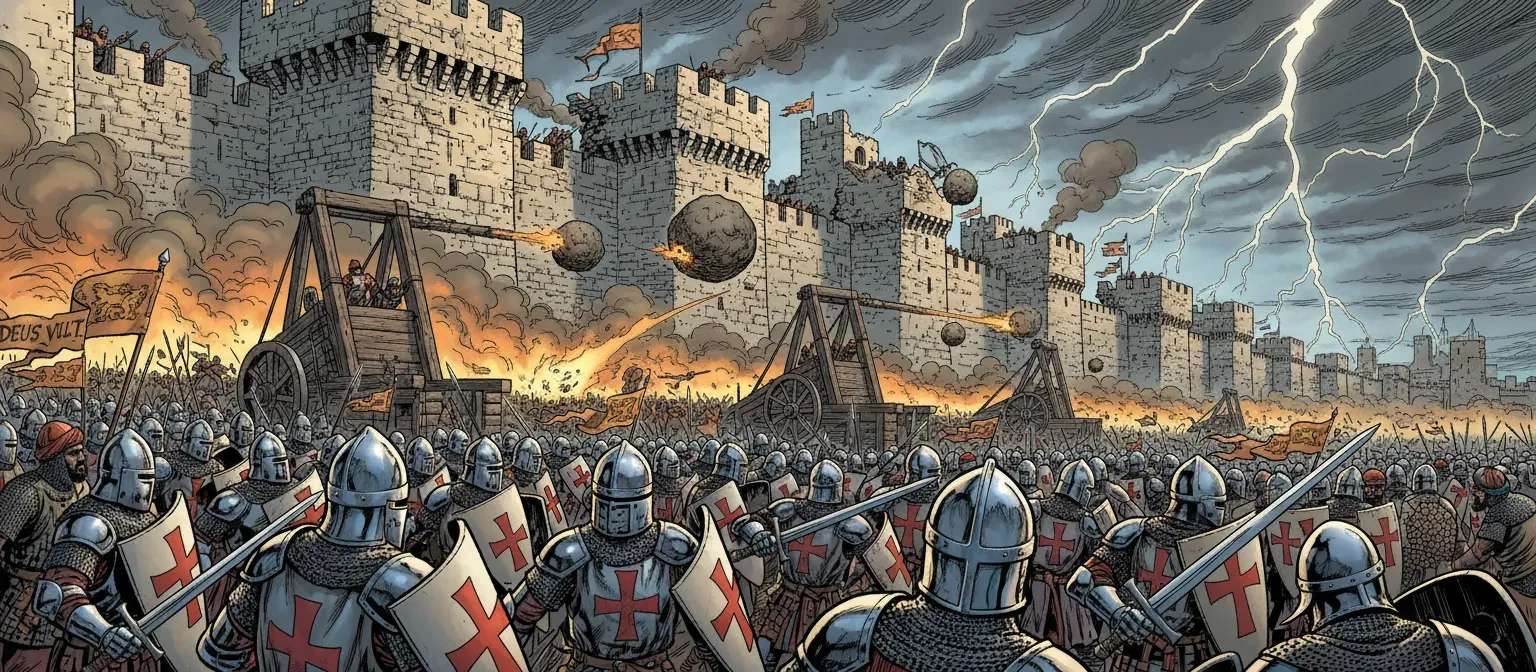
Did you know the Siege of Acre was a key moment in the Third Crusade? It changed the game for the Crusaders and their foes.
This long battle tested everyone’s will and brains. It lasted almost two years. In the end, the Crusaders won a big victory.
This event was very important. It had big effects on the Crusader states and the area’s future.
Exploring the Siege of Acre will help you understand its role in the Crusades. It shows the complexity of this important conflict.
Key Takeaways
- The Siege of Acre was a critical juncture in the Third Crusade.
- The battle lasted from August 1189 to July 1191.
- The siege marked a significant turning point in the conflict.
- The Crusaders’ victory had far-reaching consequences.
- The event is key to grasping the Crusades’ complexities.
The Road to the Third Crusade
Exploring the Third Crusade’s history means looking at what led to it. The conquest of Jerusalem by Saladin in 1187 was a key event. It shook the Christian world and prompted the Third Crusade.
Saladin’s Conquest of Jerusalem in 1187
Saladin’s victory at the Battle of Hattin was a turning point. It led to Jerusalem’s fall. This battle was a major shift in the Crusades’ history.
The Battle of Hattin and Its Consequences
The Battle of Hattin happened on July 4, 1187. It was a big defeat for the Crusaders. Jerusalem then fell to Saladin on October 2, 1187. This loss shocked Europe, calling for a new crusade.
Pope Gregory VIII’s Call for a New Crusade
Pope Gregory VIII called for a new crusade after Jerusalem’s fall. This appeal excited European leaders. They saw it as a chance to win back the Holy Land.
Why You Should Understand the Political Landscape of 1189
Knowing the politics of 1189 is key to understanding the Third Crusade. The alliances of that time greatly influenced the war’s path.
| Event | Date | Consequence |
|---|---|---|
| Battle of Hattin | July 4, 1187 | Crushing defeat for Crusader forces |
| Fall of Jerusalem | October 2, 1187 | Jerusalem under Saladin’s control |
| Pope Gregory VIII’s Call | 1187 | Call for a new crusade |
The Siege of Acre: Opening Moves
The Siege of Acre started in August 1189, a key moment in the Third Crusade. It was a time of bold moves and strategic responses. Let’s dive into the complex strategies that shaped this historic event.
Guy of Lusignan’s Desperate Gamble
Guy of Lusignan decided to besiege Acre to turn the Crusaders’ fortunes around. His army set up camp around the city, starting a long and bloody fight.
The Initial Christian Encampment
The Crusaders camped around Acre, trying to cut off the city’s supplies. They hoped to force the city to surrender. But, they faced many challenges in besieging a well-defended city.

Saladin’s Counter-Siege Strategy
Saladin knew the Crusaders were a threat. He trapped them between the city and his army. This created a deadly standoff. The Middle East became a battleground, with both sides losing many lives.
The Double Siege: Christians and Muslims in Deadlock
The double siege showed the strategic genius of Guy of Lusignan and Saladin. The conflict drew resources from across the region, including from the Ottoman Empire’s predecessors. This set the stage for a long and brutal war.
The siege turned into a war of attrition. Both sides were determined to outlast the other. The outcome was far from certain, as the siege continued into the fall of 1189.
Key Players on the Battlefield
The Siege of Acre brought together powerful leaders with unique styles. They clashed in a complex battle of strategies and tactics.
Richard the Lionheart and Philip II: Allies and Rivals
Richard the Lionheart and Philip II of France were key figures. Their relationship was complex, with both cooperation and rivalry. Richard’s aggressive strategy often clashed with Philip’s cautious approach.
Saladin: The Defender of Islam
Saladin, the Sultan of Egypt and Syria, led the Muslim forces. He was known for strategic brilliance and charisma.
Historian Ibn Shaddad said Saladin’s resolve never faltered. This earned him respect from enemies and loyalty from his troops.
Leadership Styles That Changed History
The leadership of Richard, Philip, and Saladin greatly influenced the Siege of Acre. Richard’s bold tactics, Philip’s diplomacy, and Saladin’s defense were all key. These approaches shaped the conflict’s outcome.
The Military Orders: Templars and Hospitallers
The Templars and Hospitallers were vital in the Siege of Acre. They brought disciplined units with advanced tactics. Their presence was a big factor in the Crusader army’s fight against Saladin.

Medieval Warfare and Survival
Medieval warfare during the Siege of Acre was marked by new siege engines and constant attacks. Imagine the battle’s intensity as both sides tried to outdo each other.
Siege Engines and Assault Tactics You Would Recognize
The siege of Acre featured catapults and trebuchets, key in breaking the city’s defenses. Assault tactics involved coordinated attacks by infantry and cavalry, aiming to overwhelm the defenders.

Naval Warfare: Controlling the Mediterranean
Naval warfare was key, as control of the Mediterranean Sea was vital for supplies and communication. The maritime powers of the time, such as the Italian city-states, supported the Crusader forces significantly.
Disease, Famine, and Winter: The Invisible Enemies
Disease, famine, and harsh winter conditions heavily affected both sides. Sanitation was poor, and medical care was limited, making survival a big challenge.
How Soldiers Survived Two Years of Siege
Soldiers made it through the long siege with resilience, makeshift shelters, and occasional reinforcements. The table below outlines some survival strategies used during the siege.
| Survival Strategy | Description | Impact |
|---|---|---|
| Makeshift Shelter | Construction of temporary shelters to protect against the elements and siege engines. | Reduced casualties from environmental factors. |
| Foraging | Searching for food and supplies in the surrounding areas. | Supplemented diets and maintained troop morale. |
| Reinforcements | Arrival of fresh troops and supplies. | Boosted troop numbers and morale. |
The Turning Point of the Crusades
The Siege of Acre was a key event in the Third Crusade. It lasted from 1189 to 1191. This siege showed the Crusaders’ determination and military skill. It also marked a turning point in the conflict.
The Fall of Acre in July 1191
The city of Acre fell to the Crusaders in July 1191. King Richard I of England and King Philip II of France arrived with fresh troops and advanced siege technology. Their victory was a big blow to Saladin’s forces and gave the Crusaders a foothold in the Holy Land.

The Massacre of the Muslim Garrison
After Acre’s fall, a significant massacre occurred. King Richard I ordered the execution of over 2,000 Muslim prisoners. This event hurt Saladin’s forces’ morale and strained Richard and Saladin’s relations.
How This Victory Changed Crusader Strategy
The victory at Acre changed the Crusaders’ strategy. They now had a secure base in the Holy Land. This allowed them to attack more cities. The success at Acre also led to the Treaty of Jaffa.
The Treaty of Jaffa and Its Implications
The Treaty of Jaffa was signed in 1192. This treaty established a temporary peace between Richard and Saladin. It allowed Christian pilgrims to travel safely to Jerusalem, though the city was under Muslim control. This treaty brought a period of calm to the region.
| Event | Year | Impact |
|---|---|---|
| Siege of Acre | 1189-1191 | Pivotal Crusader victory |
| Massacre of Muslim Garrison | 1191 | Strained Richard-Saladin relations |
| Treaty of Jaffa | 1192 | Temporary peace established |
Conclusion: The Legacy That Shapes Your World Today
The Siege of Acre had a lasting impact on the history of the Middle East. This region is shaped by past events. Reflecting on this event, you see its lasting influence on our world today.
The complex dynamics between the Crusaders and Saladin’s forces during the siege set a precedent for future conflicts in the region. Exploring the Middle East’s rich history, you understand how events like the Siege of Acre have shaped the region’s complexities.
FAQ
What was the Siege of Acre, and why is it considered a turning point in the Crusades?
The Siege of Acre was a key battle in the Third Crusade. It was fought between the Crusaders and Muslim forces led by Saladin. The Crusader win was a big change in power in the area.
Who were the key leaders during the Siege of Acre?
Richard the Lionheart, Philip II, and Saladin were the main leaders. Richard and Philip led the Crusaders. Saladin defended the city for the Muslims.
What was the significance of the Battle of Hattin, and how did it lead to the Third Crusade?
The Battle of Hattin was a big loss for the Crusaders. Saladin’s army won, leading to the loss of Jerusalem. This defeat called for a new crusade to retake the city.
What medieval warfare tactics were used during the Siege of Acre?
The Siege of Acre saw many medieval tactics. Siege engines, assault tactics, and naval warfare were used. These helped the Crusaders breach the city walls and capture it.
How did the Siege of Acre impact the Crusader states?
The Siege of Acre was a big win for the Crusaders. It let them regain a key city in the region. This victory also affected the Treaty of Jaffa and the Crusader strategy.
What was the role of the military orders, such as the Templars and Hospitallers, during the Siege of Acre?
The military orders were very important during the Siege of Acre. They provided leadership and fighting forces to the Crusaders. They were key to the Crusader victory.
How did the Siege of Acre shape the modern world?
The Siege of Acre has had a lasting impact. It has shaped our view of the Crusades and their legacy. Historians and scholars today study it to understand medieval warfare and regional politics.
What were the consequences of the fall of Acre in July 1191?
The fall of Acre in July 1191 was a turning point. It let the Crusaders regain a key city. The consequences included the massacre of the Muslim garrison and a change in Crusader strategy.

Leave a Reply