
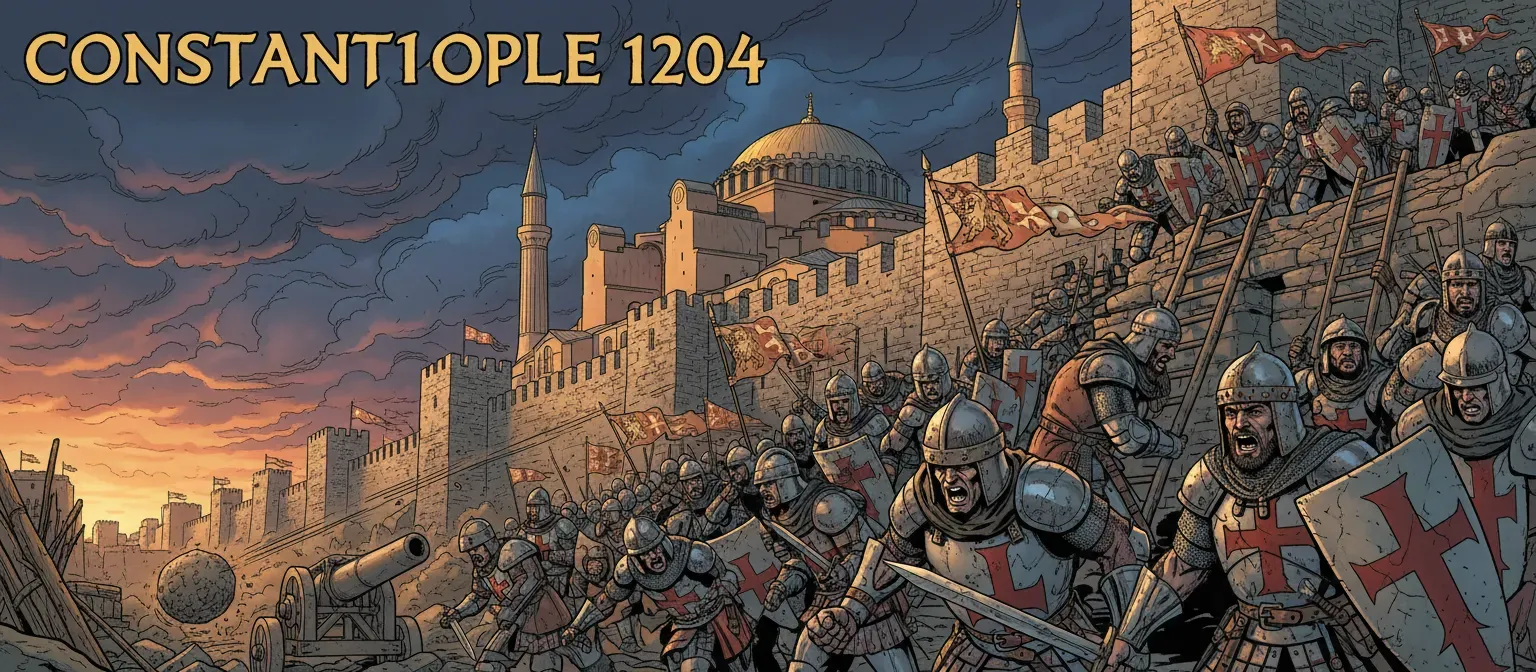
Imagine setting out to save Jerusalem, but ending up battering down the walls of Christianity’s greatest city. That’s what happened to thousands of crusaders in 1204.
They had vowed to fight Muslims in the Holy Land. But instead, they looted churches, stole holy relics, and killed fellow Christians in Constantinople.
The fourth crusade is one of history’s most shocking betrayals. It began as Pope Innocent III’s call to free Jerusalem. But it turned into something entirely different.

You’re about to learn how greed, politics, and ambition took over a sacred mission. The 1204 siege didn’t just destroy a city.
It also broke the bond between Eastern and Western Christianity. This weakened the Byzantine Empire so much that it never got better.
And it accidentally made it easier for the Ottomans to conquer centuries later. This wasn’t just a military failure—it was a turning point in medieval history that changed the world.
Key Takeaways
- The crusade was originally called by Pope Innocent III in 1202 to recapture Jerusalem from Muslim control
- Crusaders diverted from their mission and attacked the Christian city of Constantinople instead of fighting Muslims
- The sack of Constantinople occurred April 12-15, 1204, resulting in widespread destruction and looting
- Latin forces established the Latin Empire after the conquest, crowning Baldwin IX of Flanders as emperor
- The Byzantine Empire never fully recovered from this devastating attack by fellow Christians
- This event permanently damaged relations between Eastern and Western Christianity for centuries
- The weakening of Byzantium eventually led to easier Ottoman conquest of southeastern Europe
Overview of the Fourth Crusade
To understand the Fourth Crusade, you must know its players, politics, and promises. Pope Innocent III became pope in January 1198 and made launching a new crusade his top priority. He issued the papal bull Post miserabile, calling for Christian Europe to reclaim the Holy Land from Muslims.
But the crusade turned into something different. Instead of liberating Jerusalem, it destroyed the greatest Christian city in the East. This was a major failure that changed history.
Background of the Crusading Movement
The Fourth Crusade was part of a larger crusading movement. It started in 1095 when Pope Urban II called for the First Crusade. He urged Christian knights to travel to the East and reclaim Jerusalem from Muslim rule.
Over the next century, several more crusades followed with mixed results. The Second Crusade (1147-1149) largely failed. The Third Crusade (1189-1193) achieved some success under leaders like Richard the Lionheart, securing coastal cities such as Acre and Jaffa. But Jerusalem remained under Muslim control after Saladin captured it in 1187.
By the time Pope Innocent III took office, Jerusalem had been in Muslim hands for over a decade. The new pope saw reclaiming the Holy City as both a religious duty and a way to strengthen papal authority. He believed reuniting the Eastern and Western churches under Rome’s leadership was equally important.
Key Players in the Fourth Crusade
The Fourth Crusade brought together a fascinating cast of characters. Each had their own motivations and agendas. Understanding these key players helps explain how things went so terribly wrong.
Pope Innocent III was the spiritual leader who initiated the crusade. He wanted to liberate Jerusalem and expand papal influence over the Eastern Orthodox Church. His vision was grand, but he would lose control of the crusade’s direction almost immediately.
Enrico Dandolo, the elderly Doge of Venice, was another key player. Despite being in his 90s and possibly blind, Dandolo proved to be the most influential figure in the crusade’s diversion. He leveraged Venice’s naval power to steer the expedition toward outcomes that benefited his city’s commercial interests.
The military leadership fell to Boniface of Montferrat after the original leader, Count Thibaut of Champagne, died unexpectedly. Boniface brought Italian political connections that would prove significant. Baldwin IX of Flanders represented the powerful French nobility and would eventually claim the Byzantine throne for himself.
Two Byzantine princes also played critical roles. Alexios IV Angelos sought crusader help to reclaim his throne, making promises he couldn’t keep. Later, Alexios V Doukas would seize power, providing the crusaders with their excuse to attack Constantinople.
| Key Figure | Role | Origin | Primary Motivation |
|---|---|---|---|
| Pope Innocent III | Spiritual Leader & Initiator | Papal States | Reclaim Jerusalem, reunite churches |
| Enrico Dandolo | Doge of Venice | Venice | Venetian commercial expansion |
| Boniface of Montferrat | Military Commander | Northern Italy | Glory, land, political influence |
| Baldwin IX | Noble Leader | Flanders | Religious duty, territorial gains |
| Alexios IV Angelos | Exiled Byzantine Prince | Byzantine Empire | Reclaim imperial throne |
Objectives of the Crusade
The original plan for the Fourth Crusade was straightforward and ambitious. Instead of marching overland through hostile territory, the crusaders would sail directly to Egypt. The Ayyubid Sultanate centered in Egypt represented the real power behind Muslim control of Jerusalem. Defeat Egypt, the thinking went, and Jerusalem would fall easily.
The crusade planners calculated they needed a massive force: 4,500 knights, 9,000 squires, and 20,000 foot soldiers—totaling 33,500 warriors. This was an extraordinarily ambitious number, far larger than any previous crusade had assembled. The bulk of these forces would come from France, with additional contingents from Flanders, Montferrat, and the Holy Roman Empire.
The strategy made military sense. Egypt’s Nile Delta provided the economic foundation for Muslim power in the region. Control the delta, and you control the resources needed to hold Jerusalem. It was a sound plan that showed sophisticated strategic thinking.
But this ambitious vision contained fatal flaws from the start. The projected numbers proved wildly optimistic—nowhere near 33,500 crusaders would actually show up. This miscalculation would force desperate compromises that eventually led the Crusaders sack Constantinople instead of attacking their intended Muslim targets. What began as a carefully planned Egyptian campaign would transform into one of history’s most infamous betrayals.
Reasons Behind the Fourth Crusade
Thousands of warriors were drawn to the East for many reasons. The Fourth Crusade was driven by a mix of beliefs, ambitions, and financial needs. It didn’t start with one reason but with several powerful forces working together.
The mix of faith, power, and profit led to a situation where no single group could control the outcome. Church leaders had their goals, nobles had theirs, and merchants looked for profit. This mix would lead to tough choices when circumstances forced them.
Sacred Duty and Spiritual Salvation
The call to reclaim Jerusalem was strong across Christian Europe. Saladin had taken the holy city in 1187, and it had haunted the faithful for over a decade. Pope Innocent III saw reclaiming it as his divine mission.
For ordinary crusaders, the journey was deeply personal. Taking the cross meant securing salvation for their souls and fulfilling a sacred duty. The promise of spiritual rewards motivated many to risk everything.
The Great Schism of 1054 had split Christianity into Catholic and Orthodox branches. Pope Innocent III hoped to reunite these churches under his authority. This goal added complexity to the crusade’s religious mission.
The papal court believed showing Catholic military strength could convince the Orthodox Church to reunite. But this strategy would spectacularly backfire when religious unity turned to conquest and plunder. The dream of Christian brotherhood became one of history’s greatest ironies.
Ambitions of Power and Territory
European nobles saw the crusade as a chance to expand their influence and secure new lands. The Byzantine Empire’s chaos made it an attractive target. Political instability in Constantinople offered opportunities for Western powers to exploit.
The deposed Emperor Isaac II Angelos and his son Alexios IV tempted the crusaders with promises. They offered military support, financial backing, and political cooperation in exchange for help reclaiming the Byzantine throne. These promises gave political cover for what would become an attack on a Christian city.
Pope Innocent III wanted to assert his authority over both secular rulers and religious institutions. Organizing a major crusade showed his power and influence across Europe. You can see how personal ambitions and institutional goals became entangled with spiritual missions.
Various European kingdoms competed for prestige and dominance during this period. The crusade offered a stage for rulers to show their piety while pursuing territorial gains. Medieval warfare served as both a religious expression and a tool for political expansion.
Commercial Interests and Financial Realities
Venice was the crusade’s main financial backer and its greatest beneficiary. The maritime republic had invested heavily in building a fleet for the crusaders. When crusaders couldn’t pay, Venice found itself with a powerful military force and unpaid debts.
The Venetian influence on the crusade’s direction was huge. Doge Enrico Dandolo saw chances to eliminate rivals and secure trade routes. The Eastern Mediterranean offered lucrative markets that Venice wanted to dominate.
Trade relationships made things more complicated. Venice had profitable ties with Egypt, the crusade’s target. Attacking Muslim territories would disrupt these arrangements, while redirecting the crusade could serve Venetian interests better.
The mix of faith and finance created impossible contradictions. Crusaders had vowed to fight for Christianity, yet they were indebted to merchants with different priorities. Economic necessity began driving decisions that started with religious conviction.
| Motivation Type | Primary Actors | Main Objectives | Ultimate Impact |
|---|---|---|---|
| Religious | Pope Innocent III, ordinary crusaders, clergy | Recapture Jerusalem, reunite Christian churches, secure salvation | Deepened Catholic-Orthodox divide, damaged interfaith relations |
| Political | European nobles, Byzantine claimants, papal court | Gain territory, assert authority, exploit Byzantine instability | Weakened Byzantine Empire, created Latin states in Greece |
| Economic | Venice, merchants, maritime powers | Control trade routes, recover fleet investment, eliminate rivals | Established Venetian commercial dominance in Eastern Mediterranean |
| Combined Effect | All parties involved | Mix of spiritual, territorial, and financial gains | Diverted crusade from Holy Land to Constantinople |
The crushing debt crusaders owed Venice was a turning point. This financial pressure turned a holy war into a tool for commercial and political ambition. You can trace the crusade’s tragic outcome to this moment when economics overrode ideology.
Understanding these three motivations—religious fervor, political ambition, and economic opportunity—explains why the Fourth Crusade took its unexpected path. No single force could have diverted the crusade alone, but together they created circumstances that made tragedy inevitable. The collision of these interests led to decisions that shocked the Christian world and altered history.
The Departure for the Crusade
The Fourth Crusade’s fate was sealed in Venice’s shipyards and counting houses in the spring of 1202. Instead of a triumphant Christian army, a financial disaster unfolded. This gave Venice control over the entire expedition. The Venetian influence led to a shocking act of violence against other Christians.
The tension grew as crusade leaders saw their plans fail. Negotiations with Venice had promised much, but reality was harsh.
The Crusader Assembly Crisis
In March 1201, crusade leaders made a strategic decision. They approached Enrico Dandolo, the Doge of Venice, with a plan. They needed ships to attack Egypt, believing it was key to Jerusalem.
Enrico Dandolo agreed, and Venice committed to a massive undertaking. The city stopped normal commerce for a year. Shipwrights worked day and night, and sailors underwent special training.
Venice’s commitment was huge. They built 50 war galleys and 450 transport vessels. This was enough for an army three times larger than the actual number.
But disaster struck in May 1202. Only about 12,000 crusaders showed up, one-third of the promised number. The financial implications were dire.
The numbers show the problem clearly:
| Category | Expected Amount | Actual Amount | Shortfall |
|---|---|---|---|
| Crusaders | 33,500 men | 12,000 men | 21,500 fewer (64% shortage) |
| Initial Payment | 85,000 silver marks | 35,000 silver marks | 50,000 marks short |
| Additional Funds Raised | 50,000 marks needed | 14,000 marks collected | 36,000 marks owed |
| Fleet Capacity | 33,500 spaces | 36,000+ spaces built | 24,000 empty spaces |
The crusaders sold everything they had. They were left in extreme poverty. Despite raising 14,000 silver marks, they owed Venice 36,000 marks.
This financial crisis trapped the crusaders in Venice. They couldn’t leave without ships, and they couldn’t pay for them. The Venetian influence over the crusade became total.
Dandolo’s Strategic Advantage
The Venetian fleet was a masterpiece of medieval naval engineering. Enrico Dandolo, despite his age and blindness, knew its value.
The fleet’s capabilities were impressive. The 50 war galleys provided military strength, while the 450 transports carried troops and supplies. Venice had invested heavily, and Dandolo wasn’t willing to lose.
Venice’s commitment went beyond building ships. Training thousands of sailors disrupted the city’s trade. The economy was disrupted for a year, and families had committed their sons and fathers to the fleet.
With the crusaders unable to pay and desperate for transportation, Dandolo held all the cards. He proposed an alternative that would change history. If the crusaders helped Venice recapture Zara, Venice would defer the debt payment.
It’s hard to understand how Christian crusaders could attack a Christian city. They were trapped in Venice, impoverished, and needed Venetian ships to reach the Holy Land. Dandolo’s proposal offered them a way forward, even if it meant betraying their crusading vows.
Dandolo’s influence went beyond financial pressure. His decision to take the cross and join the crusade added moral authority to Venice’s demands. At over 90 years old and nearly blind, Dandolo’s commitment impressed the crusaders and made refusing Venice’s terms hard.
This crisis in Venice set the stage for everything that followed. The Fourth Crusade would never reach Egypt or the Holy Land. Instead, it became a tool for Venetian ambitions, leading to the sack of Constantinople.
The Siege of Zara
Before attacking Constantinople, the Crusaders first targeted Zara, a Christian city on the Adriatic coast. This move was the crusade’s first major moral failure. It raises questions about how an army fighting for Christianity could attack fellow believers.
The answer lies in debt, desperation, and Venetian ambition. These factors plagued the expedition from the start.
The siege of Zara in November 1202 set a dangerous precedent. It showed that financial needs could override religious values. What happened at Zara foreshadowed the tragedy that awaited Constantinople.
Strategic Value of the Adriatic Port
Zara was immensely strategic for Venice’s trade dominance. Today known as Zadar in Croatia, it controlled key shipping routes. Venice had dominated this prosperous port economically for the 12th century.
In 1181, Zara rebelled against Venetian rule. It sought protection from King Emeric of Hungary and Croatia. This rebellion was a commercial threat and a loss of prestige for Venice.
Doge Enrico Dandolo wanted to recapture Zara. Its independence challenged Venice’s authority. Zara’s control threatened Venetian trade networks, which were very profitable.

Zara’s port and location made it invaluable. Whoever controlled Zara controlled the eastern Adriatic. Venice needed it back to maintain its regional power.
The Path to Christian Conflict
The crusading army had a massive debt to Venice. Doge Dandolo proposed attacking Zara to reduce this debt. This plan put the crusade’s leaders in a difficult position.
King Emeric of Hungary, Zara’s protector, was Catholic. He had crusading vows. Attacking his territory meant Christians would fight Christians, violating their holy mission.
Pope Innocent III was furious when he learned of the plan. He threatened excommunication for attacking Zara. The crusade’s leaders had to choose: attack Zara or abandon the expedition.
Some nobles refused to compromise. Simon de Montfort and Guy of Vaux-de-Cernay left the crusade. But most leaders kept the Pope’s letter secret to avoid desertions.
The crusading fleet arrived at Zara on November 10-11, 1202. Citizens showed religious symbols to appeal to the crusaders’ conscience. They were fellow believers.
Their appeals failed. The crusaders used medieval warfare tactics against the city. They built siege engines and launched attacks. The siege showed their military skill, even if misdirected.
| Faction | Position on Zara Attack | Primary Motivation | Action Taken |
|---|---|---|---|
| Venetians | Strongly in favor | Reclaim lost territory and prestige | Provided fleet and leadership |
| Crusade Leaders | Reluctantly agreed | No alternative to pay debt | Led the assault despite misgivings |
| Pope Innocent III | Vehemently opposed | Protect Christian unity | Threatened excommunication |
| Some Nobles | Refused to participate | Maintain crusading ideals | Abandoned the expedition |
| King Emeric | Defended his territory | Protect vassal city’s sovereignty | Provided diplomatic protests |
Zara fell on November 24, 1202, after a brief siege. The city’s defenses couldn’t withstand the combined crusader and Venetian force. The expedition’s discipline and unity began to deteriorate.
Destruction and Divine Punishment
The aftermath of Zara’s capture was chaotic. Extensive pillaging erupted immediately. Venetians and crusaders nearly fought over spoils. They fought over treasure taken from fellow Christians.
The victors destroyed Zara’s fortifications. This served Venice’s strategic interests by preventing future rebellions. The message was clear: resist Venetian authority and face total devastation.
Pope Innocent III followed through on his threat. He excommunicated the entire expedition for attacking a Christian city. This was the harshest spiritual punishment the Church could impose. Every participant was technically cut off from the Church’s sacraments and salvation.
But the Pope partially relented in February 1203. He rescinded the excommunication for non-Venetian crusaders. Innocent III considered them coerced by Venice and desperate. The Venetians remained excommunicated, but this didn’t trouble Doge Dandolo.
The crusading army wintered in Zara’s ruins. They had succeeded militarily but failed morally. The attack showed how financial pressures could corrupt a religious mission. It proved that medieval warfare could target any faith or principle.
This first betrayal set a dangerous pattern. The crusaders had already compromised their holy mission before reaching any Muslim territory. The siege of Zara prepared the way for an even greater catastrophe. Soon, these warriors would apply similar tactics against Constantinople itself, marking the end of Christian unity.
The lessons from Zara went unheeded. Instead of returning to their original mission, the crusaders made another fateful diversion. The path from Zara led directly to Constantinople’s gates, where the Crusaders sack Constantinople in 1204, shattering Christian unity forever.
The Journey to Constantinople
The decision to sail toward Constantinople was not accidental. It was the result of careful manipulation and desperate circumstances. The crusader forces were in a tough spot, facing a huge debt to Venice and a distant goal of liberating Jerusalem.
This journey would change the fourth crusade in ways no one could have imagined. It would become one of history’s most controversial diversions.
Many forces pushed these warriors away from their sacred goal. Financial desperation, personal vendettas, political ambition, and commercial rivalry all played a role.
The Offer That Changed Everything
On January 1, 1203, a messenger arrived with an offer that seemed to solve all the crusaders’ problems. Alexios IV Angelos, a young Byzantine prince, had been working to recruit the crusade army. His father, Emperor Isaac II, had been overthrown by his brother.
The young prince promised to pay the crusaders’ debt to Venice. He also offered 200,000 silver marks to fund their expedition.
Alexios IV Angelos promised military support. He offered 10,000 elite Byzantine troops for the campaign. He also promised to place the Orthodox Church under papal authority.
This promise was very appealing to some. It would heal the Great Schism of 1054 that had divided Christianity for nearly 150 years. For Pope Innocent III, this religious reunification could justify the entire diversion.
The catch? The crusaders had to make a “brief detour” to Constantinople. They had to overthrow the usurper Alexios III and restore Isaac II to the throne. It all sounded so reasonable, so providential.
This offer wasn’t spontaneous. Boniface of Montferrat, the military commander, had discussed this plan with Philip of Swabia before the fleet departed Venice. Philip was Alexios IV’s brother-in-law and protector.
Hidden Motivations Behind the Decision
The crusade leadership debated intensely in January 1203. Some believed this was Divine Providence solving their problems. Others saw it as a dangerous diversion from their holy mission.
Several powerful undercurrents pushed them toward acceptance. Financial desperation, personal vendettas, political ambition, and commercial rivalry all played a role.
Doge Enrico Dandolo had his own reasons to support attacking Constantinople. He had been blinded during a diplomatic embassy to Constantinople in 1171. His personal vendetta aligned perfectly with Venice’s commercial interests.
Venice and Constantinople had been trade rivals for decades. Venetian merchants wanted to break Byzantine control over eastern Mediterranean commerce. An assault on Constantinople offered the perfect opportunity to establish Venetian dominance.
The memory of the Massacre of the Latins in 1182 fueled Western hatred toward Byzantines. During this horrific event, thousands of Catholic merchants and their families were killed in Constantinople. The crusaders could frame their attack as righteous revenge for murdered Christians.
Faced with financial ruin, excommunication, and no clear path forward, the crusade leadership accepted the offer. They convinced themselves this detour would be quick and profitable, allowing them to reach the Holy Land with proper resources.
The Road to Constantinople and Its Obstacles
Once the decision was made, the crusaders faced immediate challenges. Maintaining morale became increasingly difficult as word spread through the ranks. Many ordinary crusaders had taken religious vows to liberate Jerusalem, not to interfere in Byzantine politics.
Some crusaders openly defected, refusing to participate in what they saw as a betrayal of their sacred mission. These men found their own way to the Holy Land or returned home in disgust. The leaders worked constantly to justify the diversion through religious arguments and promises of future success.
Logistical challenges multiplied as the fleet prepared to sail. Managing supplies for thousands of men and horses required constant attention. The Venetian fleet needed maintenance after wintering at Zara. Coordinating movement between the various national contingents—French, German, Italian, and Flemish—created communication headaches.
Internal tensions simmered throughout the journey. The Venetians remained under papal excommunication for the Zara attack, creating an awkward divide. The excommunicated sailors and soldiers worked alongside crusaders who were in the Pope’s good graces. This religious uncertainty poisoned relationships and undermined unit cohesion.
The fleet departed Zara in April 1203 and sailed along the Dalmatian coast before crossing to Corfu. At each stop, leaders reinforced the narrative that they were doing God’s work by restoring the rightful emperor and reuniting the Church. They promised the Constantinople operation would take only weeks, then they would proceed to their true mission.
| Promise Made by Alexios IV | Strategic Value | Reality After Events |
|---|---|---|
| Pay entire Venetian debt | Eliminated financial burden immediately | Byzantine treasury couldn’t fulfill this promise |
| 200,000 silver marks additional funding | Would finance entire Holy Land campaign | Empire lacked resources to deliver |
| 10,000 Byzantine troops for campaign | Provided elite professional military support | Political instability prevented troop deployment |
| Submit Orthodox Church to papal authority | Healed 150-year Christian schism | Orthodox clergy and population violently rejected this |
As the fleet approached Constantinople in late June 1203, the crusaders had no idea how catastrophically wrong their calculations would prove. The promises that seemed so solid would crumble like sand. The “brief detour” would become a permanent derailment, and the fourth crusade would forever be remembered not for liberating Jerusalem, but for destroying the greatest Christian city in the East.
The Initial Assault on Constantinople
Choosing Constantinople as a target was a bold move. The city was protected by walls that had stood for 800 years. When the Crusader fleet arrived on June 23, 1203, they faced walls stretching 20 kilometers around the city.
These walls were not ordinary. Constantinople’s triple-wall system was a marvel of medieval warfare defense. It sheltered approximately 500,000 people.
The city had never fallen to direct assault in its long history. The Crusaders must have felt a mix of excitement and dread looking at those massive fortifications from their ships.
The attackers set up their base camp across the Golden Horn in Galata. This strategic position gave them a staging area for their assault while keeping their fleet relatively safe. But, the real challenge was how to breach walls that had turned back countless armies.

Battle Tactics and Naval Innovation
The Crusaders adapted their tactics for this unique challenge. Traditional medieval warfare focused on land-based sieges. But Constantinople’s location on a peninsula surrounded by water demanded something different.
The Venetians brought naval expertise to the campaign. Doge Enrico Dandolo, despite his advanced age and blindness, commanded the fleet with skill. His engineers modified the Venetian galleys with special platforms and flying bridges.
These innovations allowed attackers to approach the sea walls directly from their ships. The wooden bridges could extend from the vessels to the top of the walls, creating assault paths that bypassed the need for siege towers.
The Venetian ships were fitted with scaling ladders and flying bridges, turning the fleet into mobile siege platforms that could strike anywhere along the waterfront defenses.
The Crusaders planned to concentrate their attack on the Golden Horn fortifications. These walls along the harbor were somewhat less formidable than the massive Theodosian Walls facing land approaches. The strategy combined several elements of medieval warfare:
- Naval bombardment using shipboard catapults and ballistae
- Direct scaling operations from specially equipped vessels
- Coordinated assaults at multiple points to divide the defenders
- Use of Greek fire and incendiary weapons
- Psychological warfare through displays of force
By March 1204, Emperor Alexios V had seized power and immediately strengthened Constantinople’s defenses. He understood the threat and worked tirelessly to prepare the city for the coming assault. Fresh troops reinforced key positions, and the Byzantine navy prepared to challenge the Venetian fleet.
| Defensive Advantages | Crusader Challenges | Strategic Solutions |
|---|---|---|
| Triple wall system spanning 20 km | No experience attacking sea walls | Modified Venetian ships with bridges |
| Varangian Guard elite warriors | Limited siege equipment | Naval-based assault platforms |
| 500,000 population for defense | Exposed troops during landings | Coordinated multi-point attacks |
| Byzantine fire weapons technology | Weather vulnerability at sea | Timing assaults for favorable conditions |
The Failed April Attack and Its Consequences
The first major assault of the 1204 siege came on April 9, 1204. This was during the second siege period, after political complications had forced the Crusaders to return. The timing seemed right—the Crusaders had spent weeks preparing their equipment and planning their approach.
Early that morning, Crusader and Venetian forces launched their assault across the Golden Horn. The ships approached the northwest wall, their flying bridges ready to deploy. Initial progress seemed promising as vessels reached the fortifications.
Then everything went wrong. Bad weather suddenly struck, with strong winds making it impossible for the ships to maintain position against the walls. The carefully planned coordination fell apart as vessels struggled to stay in formation.
Crusader troops who managed to land found themselves in a deadly situation. Open ground stretched between the shoreline and the city walls—a killing zone under Byzantine control. Byzantine archers unleashed devastating volleys from their protected positions on the walls.
The Varangian Guard led the defensive effort with fierce determination. These elite warriors, many of Scandinavian origin, had served Byzantine emperors for generations. Their battle axes and disciplined fighting style made them formidable opponents in close combat.
You can picture the chaos of medieval warfare at its most brutal. Crusaders caught in the open fell to arrows while trying to retreat to their boats. The flying bridges that had seemed so innovative proved difficult to maneuver in the rough water and wind.
Emperor Alexios V personally directed the defense from behind the walls. His presence energized the defenders and demonstrated his commitment to protecting the city. He had stationed troops at critical points and coordinated counter-attacks against Crusader landing parties.
By midday, the assault had clearly failed. The Crusaders withdrew with significant casualties and damaged morale. Their first attempt to breach Constantinople’s defenses had been thoroughly defeated. The question now became whether they would try again or abandon the siege entirely.
This failure taught the Crusaders important lessons about attacking Constantinople. They realized they needed better weather conditions, improved coordination between land and sea forces, and more aggressive tactics. The Byzantine defense had proven stronger than anticipated, but it had also revealed some vulnerabilities that observant Crusader commanders noted for future reference.
The events of April 9 set the stage for what would come just three days later. The Crusaders regrouped, adjusted their strategy, and prepared for another attempt. This time, they would apply everything learned from their costly failure—and the outcome would change history forever.
The Siege of Constantinople
When the Crusaders arrived at Constantinople’s walls in June 1203, no one expected the tragic events that followed. The city fell less than a year later. The 1204 siege was a series of diplomatic failures and violence.
This siege was different from typical medieval battles. The Crusaders didn’t plan to destroy Constantinople. They wanted payment and cooperation. But things spiralled out of control, turning allies into enemies.
Key Moments Leading to Disaster
The events leading up to the disaster are key. On June 23, 1203, the Crusader fleet arrived with 20,000 soldiers and 60 Venetian war galleys. They restored Isaac II to the throne by August 1, 1203.
At first, it seemed the mission would end peacefully. Alexios IV ruled with his father, and the Crusaders waited for their payment. But the Byzantine treasury was nearly empty, and the people refused to accept the Crusaders.
Tensions rose in late 1203. Riots broke out between Greeks who opposed the Crusaders and those who supported them. Churches were attacked, and neighborhoods burned.
The situation worsened in January 1204. Isaac II died on January 25, causing widespread rioting. Alexios IV was deposed, and Alexios V took power on February 5, 1204.
Three days later, Alexios IV was strangled. This act removed any reason for the Crusaders to stay. The Crusaders sack Constantinople became their only option.
Emperor Alexios V tried to negotiate with the Crusaders. But they refused to leave without payment. In March 1204, they decided to conquer Constantinople and divide the Byzantine Empire.
Forces Arrayed for Battle
The siege involved a complex mix of forces. The attackers were not a unified army but a coalition with different goals and abilities.
The Crusader contingent included about 20,000 men from Western Europe:
- French knights and infantry, the largest group under Boniface of Montferrat
- Flemish forces known for siege expertise and heavy cavalry
- German knights from the Holy Roman Empire territories
- Specialized siege engineers and artillery operators
- Support troops including archers, crossbowmen, and camp followers
The Venetian contribution was also key. Doge Enrico Dandolo, despite being in his 90s, commanded 10,000 sailors and marines. His fleet included 60 war galleys and 150 transport vessels.
Defending Constantinople were the Byzantine forces under Emperor Alexios V:
- About 15,000 Byzantine infantry and city militia fighters
- The elite 5,000-strong Varangian Guard, legendary axe-wielding warriors
- 20 Byzantine war galleys to defend the harbor
- Civilian volunteers manning the walls and towers
- Greek fire operators at key defensive points
The defenders had the advantage of Constantinople’s legendary walls. But they faced a crisis of morale and leadership. Many questioned whether to fight for an emperor who had murdered his predecessor.
The Final Assault Unfolds
The Crusaders launched their first major assault on April 9, 1204. They tried to scale the sea walls using siege towers on Venetian ships. The Byzantine defenders repelled them with Greek fire and missile barrages.
On April 12, 1204, a strong north wind helped the Venetian ships approach the sea walls. This allowed the attackers to reach the towers from the ships’ elevated platforms.
About 70 Crusaders fought their way into the city. They opened gates for thousands more to pour in. The Crusaders captured the Blachernae section in the northwestern part of the city.
During the night of April 12, Emperor Alexios V fled through the Polyandriou Gate. Without him, Byzantine resistance collapsed. Individual units fought bravely, but coordinated defense became impossible.
By dawn on April 13, the Crusaders controlled most of Constantinople. The sack that followed was catastrophic. It shocked even medieval observers accustomed to warfare’s brutality.
The 1204 siege technically ended on April 12. But the real tragedy was only beginning. The sack itself and its immediate impact on Constantinople are detailed in the next section.
The Sack of Constantinople
When Constantinople’s defenses fell, the worst was yet to come. The next three days were a dark chapter in Christian history. Emperor Alexios V fled on April 12, 1204, leaving the city defenseless against an army that would betray its Christian values.
This was not a foreign invasion but Christian warriors attacking a fellow Christian city. They had sworn sacred oaths to protect Christians and free the Holy Land. Instead, they turned against the heart of Eastern Christianity.
Three Days of Destruction
From April 12 to April 15, 1204, the Crusaders sack Constantinople unfolded with brutal efficiency. The city saw violence on a medieval scale. Despite threats from Pope Innocent III, the Crusaders and Venetians spent seventy-two hours looting and destroying centuries of wealth and knowledge.
Approximately 2,000 Greek civilians were killed during the rampage. Some historians believe the number could be much higher. These were ordinary people, not soldiers, caught in the path of an army that had lost all Christian virtue.
The cultural treasures destroyed were staggering. Here are a few examples:
- The bronze horses from the Hippodrome were taken to Venice, where they adorn St. Mark’s Basilica today
- A bronze statue of Hercules, created by Lysippos, was melted down for coins
- The Church of the Holy Apostles, where Byzantine emperors were buried, was plundered
- Church altars were smashed to extract gold and marble
- Libraries containing ancient manuscripts were burned or scattered
Churches and monasteries, sacred to all, were invaded and stripped. Nuns were assaulted, and treasures were stolen. Religious sanctuaries became targets, not refuges.

The Venetians focused on stealing religious relics and artworks. Many treasures were taken to Venice, where they remain today. This is evidence of the cultural theft.
The financial plunder was massive. The total loot was approximately 900,000 silver marks. Here’s how it was divided:
- The Venetians got 150,000 silver marks as their share
- 100,000 marks were divided between Crusaders and Venetians
- 500,000 marks were stolen by individual Crusaders, violating their oaths
More than half the loot was taken through theft, even among the looters. Greed overwhelmed them, causing them to break their agreements.
“Even the Saracens are merciful and kind compared to these men who bear the cross of Christ on their shoulders.”
—Nicetas Choniates, Byzantine historian and eyewitness
Nicetas Choniates, a Byzantine historian who witnessed the sack, described it as barbaric. Crusaders acted worse than Muslim armies, he said.
Irreversible Damage to a Great City
The sack’s impact went beyond material losses. It was a cultural genocide against Eastern Christianity. In seventy-two hours, nearly nine centuries of Byzantine civilization were lost.
Constantinople was not just wealthy but the keeper of classical civilization. When Rome fell, Constantinople preserved ancient knowledge and art. Its libraries and churches held treasures beyond measure.
The Byzantium fall began with this sack. It was not just a political collapse but the destruction of a bridge between the classical and medieval worlds. Artworks from ancient Greece were destroyed for their value, not their historical significance.
The religious impact was profound. The desecration of Christian sites by Christian warriors created a deep wound between Eastern and Western Christianity. Orthodox Christians watched in horror as Latin crusaders treated their sacred spaces worse than Muslim armies.
Consider the long-term cultural losses:
- Ancient manuscripts were burned or scattered, losing irreplaceable texts
- Priceless icons were destroyed or stolen, ending artistic traditions
- The city’s role as a center of learning and culture was damaged
- Master craftsmen were killed or scattered, ending artistic traditions
The economic impact was catastrophic. Constantinople was the wealthiest city in Christendom, a trading hub. The looting destroyed wealth and the infrastructure that created it. The city would never regain its former prosperity.
The sack marked the beginning of the Byzantium fall. The empire would never fully recover. It would reclaim Constantinople in 1261 but be weakened, impoverished, and conquered by the Ottomans in 1453.
The three-day sack turned Constantinople into a traumatized, plundered shell. Greed consumed centuries of civilization in just a weekend.
Aftermath of the Sack
The sacking of Constantinople was just the start of a big change. Crusaders had planned to divide the land before they even attacked. They set out to create a new political order in the Eastern Mediterranean.
The spoils were not given out randomly. A treaty from March 1204 showed how the Byzantine territories would be divided among the winners.
Political Consequences in the Region
The Latin Empire of Constantinople was formed from the ruins. It was a Western European state imposed on Greek lands. Many thought Boniface of Montferrat would become emperor because of his family ties to the Byzantine aristocracy.
But the Venetians had other plans. They blocked Boniface’s election because of his family ties. Instead, Baldwin of Flanders was crowned Emperor Baldwin I in the Hagia Sophia.
Boniface didn’t go without reward. He got the Kingdom of Thessalonica as a vassal state under the Latin Empire. Venice, on the other hand, took the most valuable prizes for itself.
The Venetians created the Duchy of the Archipelago across Aegean Sea islands. They got strategic ports and commercial centers that dominated Eastern Mediterranean trade for generations. This was exactly what Venice had wanted all along—not religious glory, but commercial dominance.
Byzantine aristocrats fled Constantinople in waves. But ordinary people didn’t sympathize with them. They blamed the aristocrats for the empire’s downfall.
Refugees were mocked by peasants as they scattered. These aristocrats didn’t disappear, though. They formed rival states:
- The Empire of Nicaea under Theodore Laskaris, a relative of the deposed Alexius III, became the strongest claimant
- The Empire of Trebizond in the remote northeast along the Black Sea coast
- The Despotate of Epirus controlling western Greece
Each state claimed to be the true Roman Empire. For 57 years, they fought the Latin occupiers and each other for supremacy.
Effects on the Byzantine Empire
The sack of 1204 was a wound that Byzantium could never heal. The Empire of Nicaea recaptured Constantinople in 1261, but it was a hollow victory. Recovering the capital didn’t restore the empire’s strength.
The centuries of wealth were lost forever. The population had greatly decreased. The productive lands of Anatolia were lost to Turkish advances.
The empire’s prestige and authority were shattered. The restored Byzantine state couldn’t resist the Sultanate of Rum and the Ottoman Turks. It lacked resources, manpower, and diplomatic weight.
The Fourth Crusade was meant to defend Christianity but destroyed its strongest eastern fortress. The crusaders eliminated the barrier protecting southeastern Europe from Islamic expansion.
The final Byzantium fall came in 1453 when Ottoman Sultan Mehmed II captured Constantinople. But historians say the empire’s fate was sealed 249 years earlier in 1204. The Fourth Crusade accelerated the collapse of Christendom in the east.
The Byzantine Empire never regained its former territories or economic vitality. It was conquered by the Ottomans over two centuries, growing weaker with each generation. The actions of the crusaders had facilitated the very Muslim conquests they claimed to oppose.
This is tragic because it was preventable. The Byzantium fall was not due to historical forces but the greed and miscalculation of those who should have protected Byzantium.
The Legacy of the Fourth Crusade
The fourth crusade left a complex legacy, far beyond simple military victory. It changed medieval history, Christianity, and East-West relations. Its effects lasted for centuries, influencing religious practices and political boundaries.
The immediate damage was huge, but the long-term effects were even worse. The events of 1204 led to lasting religious divisions. The sack of Constantinople left deep wounds that took centuries to heal.
How the Crusade Changed Holy War Forever
The fourth crusade damaged the crusading movement’s credibility. It raised questions about how Christians could attack other Christians. This question haunted many for generations.
Only a few crusaders went to the Holy Land after Constantinople. The original mission was forgotten. Future popes found it hard to rally support because of the fourth crusade’s corruption.
The Latin Empire in Constantinople lasted from 1204 to 1261. It was weak and never gained legitimacy. Byzantine states constantly challenged Latin rule.

When Byzantines recaptured Constantinople in 1261, it was too late. The Byzantine Empire was too weak to resist Ottoman expansion.
The Crusader states in the Holy Land suffered from the fourth crusade’s diversion. Without Byzantine support, they fell to Muslim forces. Tripoli and Acre, the last strongholds, fell in 1289 and 1291, respectively.
Papal authority was severely damaged. Pope Innocent III’s crusade attacked Christians, contradicting his own rules. This damaged the papacy’s moral standing for generations.
The papacy’s collapse led to major crises. The Avignon Papacy started in 1309, and the Western Schism followed from 1378 to 1417. These failures were linked to the fourth crusade’s damage to credibility.
Cultural Wounds That Never Fully Healed
The fourth crusade solidified the East-West Schism. The churches had split in 1054, but reconciliation attempts continued. The events of 1204 ended any hope of reunification for centuries.
Crusader brutality shocked the Orthodox world. The trauma of desecrating Orthodox churches and stealing relics lasted for generations. These acts created deep psychological wounds.
Orthodox Christians saw Western Catholics as dangerous enemies, more threatening than Muslim rulers. Many Greeks preferred Ottoman rule to Latin domination, famously saying, “Better the Turkish turban than the Latin miter.”
The cultural artifacts stolen from Constantinople are visible today. Bronze horses in Venice and relics in Western churches remind us of the fourth crusade’s destruction.
The Byzantine Empire fell to Ottoman conquests over two centuries. Constantinople fell in 1453. The fourth crusade made the Byzantine collapse inevitable, historians believe.
| Impact Area | Immediate Effect (1204-1261) | Long-term Consequence (1261-1500) | Lasting Legacy |
|---|---|---|---|
| Religious Relations | Orthodox-Catholic hostility deepened | East-West Schism became permanent | Centuries of mutual distrust and division |
| Political Structure | Latin Empire established in Constantinople | Weakened Byzantine Empire fell to Ottomans | Ottoman dominance in Eastern Mediterranean |
| Crusading Movement | Loss of moral authority and popular support | Failure of future crusades and fall of Acre | End of major crusading expeditions |
| Papal Authority | Credibility crisis for Pope Innocent III | Avignon Papacy and Western Schism | Rise of nationalism and secular warfare |
The rise of nationalism was partly due to the papacy’s loss of authority. Without moral superiority, secular rulers gained power. European warfare became less about religion and more about national interests.
This shift led to the Protestant Reformation’s criticism of Catholic practices. Reformers pointed to the fourth crusade as proof of church corruption. The secularization of Europe, ongoing today, has roots in the credibility crisis of 1204.
Modern ecumenical movements aim to heal the wounds of the fourth crusade. In 2004, Pope John Paul II apologized for the sack of Constantinople. This acknowledged the ongoing need for healing.
The fourth crusade’s legacy extends beyond religious divisions. It changed how we view military campaigns’ stated intentions versus actual outcomes. It showed how greed and politics can corrupt even sacred missions. These lessons are relevant for analyzing modern conflicts.
Lessons from the Fourth Crusade
The Fourth Crusade is a clear example of mission failure. Crusaders aimed to free Jerusalem but ended up destroying a major Christian city. This shows how noble goals can go wrong. It teaches us valuable lessons about the dangers of corruption.
The crusaders’ mission was clear. They wanted to defeat the Ayyubid Sultanate in Egypt and then head to Jerusalem. This was a sacred mission blessed by church leaders.
Pope Innocent III thought he was doing God’s work by calling for the crusade. But the outcome was far from what he expected. The crusaders never got close to Jerusalem and didn’t fight the Ayyubids.
Reflection on Objectives vs. Outcomes
The Fourth Crusade’s failure is one of the biggest in military history. Instead of weakening Islamic control, it weakened Christianity’s eastern stronghold. The crusaders conquered Constantinople twice, destroying the city they were supposed to protect.
How did things go so wrong? Bad decisions were made at every step. When they couldn’t pay Venice, attacking Zara seemed like a solution. Then, when Alexios IV offered to pay everything, it seemed like a divine solution.
But when Alexios IV was murdered and the new emperor refused to pay, conquering Constantinople seemed justified. At each step, leaders thought they were doing the right thing for their holy goal.
The following table shows how the crusade failed to meet its goals:
| Stated Objective | Actual Outcome | Long-term Consequence |
|---|---|---|
| Recapture Jerusalem from Muslim control | Never came within 1,000 miles of Jerusalem | Jerusalem remained under Muslim rule for another 650 years |
| Defeat the Ayyubid Sultanate in Egypt | Never fought the Ayyubids at all | Ayyubid power remained unchallenged in the region |
| Strengthen Christian presence in the East | Conquered and devastated Constantinople twice | Byzantine Empire fatally weakened, eventually conquered by Ottoman Turks |
| Unite Christians against common enemies | Committed greatest attack on fellow Christians in medieval warfare | Created permanent schism between Eastern and Western Christianity |
This comparison shows a huge gap between what was intended and what happened. Every goal was not only unmet but also reversed. Instead of helping Christianity, the crusade caused lasting harm.
Moral and Ethical Considerations
The Fourth Crusade raises serious moral questions. Pope Innocent III forbade attacks on fellow Christians, but his crusade committed a major atrocity. This raises questions about leader responsibility.
Pope Innocent III was shocked when he learned what happened. He condemned the actions and excommunicated the perpetrators. Yet, his inability to control the crusade shows the dangers of holy warfare.
Once a holy war is blessed, it’s hard to stop. Soldiers believe they’re serving God, making them less likely to follow moral rules.
Not all crusaders gave up their values. Some leaders, like Enguerrand II of Boves, Simon de Montfort, 5th Earl of Leicester, and Guy of Vaux-de-Cernay, refused to attack Christian cities. They chose to leave the crusade, showing that one can stay true to ethics even when others don’t.
Their actions show that individuals can make the right choice, even when many don’t. This is a powerful lesson in integrity.
The Fourth Crusade also teaches about the dangers of financial interests. The Venetians’ commercial goals took over the crusade because crusaders needed their money. This shows that who controls the money often controls the mission, no matter the ideals.
The most touching part of this story happened 800 years later. In 2001 and 2004, Pope John Paul II apologized for the Fourth Crusade. His words acknowledged a historical wrong and sought healing.
It is tragic that the assailants, who set out to secure free access for Christians to the Holy Land, turned against their brothers in the faith. The fact that they were Latin Christians fills Catholics with deep regret.
In April 2004, Ecumenical Patriarch Bartholomew I accepted this apology. His words showed the power of reconciliation:
The spirit of reconciliation is stronger than hatred… We receive with gratitude and respect your cordial gesture for the tragic events of the Fourth Crusade. It is a fact that a crime was committed here in the city 800 years ago.
This exchange teaches us about the value of acknowledging historical wrongs. It shows how we can heal divisions and build reconciliation, even centuries later.
The Fourth Crusade is a warning about the dangers of putting practical concerns over principles. Financial pressures corrupted a sacred mission. A series of compromises led to disastrous outcomes.
Each step away from the original goal led to morally indefensible actions. Studying this history helps us see patterns in today’s world, where practical concerns often overshadow principles.
Conclusion: The Fourth Crusade’s Enduring Significance
You’ve explored a key moment in medieval history. The fourth crusade aimed to free Jerusalem but ended in the fall of Constantinople. This was the greatest Christian city at the time.
Understanding the Long-Term Consequences
The 1204 events had lasting effects. The Byzantine Empire never fully recovered. It weakened and fell to the Ottoman Turks in 1453, after 250 years.
The crusade also damaged the bond between Western and Eastern Christians. This split lasted for eight centuries. It wasn’t until 2001 and 2004 that Pope John Paul II and Ecumenical Patriarch Bartholomew I apologized for it.
Lessons That Stil Matter Today
This story teaches us valuable lessons. Financial troubles and political gain can corrupt even the noblest of causes. The gap between good intentions and bad outcomes is huge when we give up our values for ease.
The fourth crusade shows us that betrayal can come from anywhere. Those who said they were defending Christianity actually destroyed its strongest stronghold. The effects of their choices shaped centuries of history, showing how our actions can have far-reaching impacts.
FAQ
What was the Fourth Crusade and when did it take place?
The Fourth Crusade was called by Pope Innocent III in 1202. It aimed to retake Jerusalem by attacking Egypt first. But, it turned against Constantinople, the greatest Christian city, in 1204. This led to the establishment of the Latin Empire after the sack of Constantinople.
Who were the key leaders of the Fourth Crusade?
Key leaders included Pope Innocent III and Enrico Dandolo, the Doge of Venice. Boniface of Montferrat was the military commander. Baldwin IX of Flanders became the first Latin Emperor. Alexios IV Angelos, a Byzantine prince, also played a role.
Why did the Fourth Crusade attack Constantinople instead of going to Jerusalem?
The crusaders couldn’t pay their debt to Venice. Alexios IV Angelos promised to pay their debts and more if they helped him regain his throne. When he was murdered, they attacked Constantinople to get their money back.
What happened during the Siege of Zara?
The Siege of Zara in November 1202 was a betrayal of the crusade’s mission. Venice wanted to recapture Zara, a Christian city in Croatia. Despite threats from Pope Innocent III, the crusaders helped Venice capture Zara. This led to the entire expedition being excommunicated.
How did the Crusaders successfully breach Constantinople’s defenses?
The Crusaders used special ships to breach the sea walls on April 12, 1204. A strong north wind helped the Venetian ships get close. About 70 Crusaders entered through the sea walls and opened gates for others.
What happened during the three-day sack of Constantinople?
From April 12-15, 1204, the Crusaders sacked Constantinople. They killed about 2,000 civilians and looted churches. Priceless artworks were destroyed or stolen, including the famous bronze horses.
What was the Latin Empire of Constantinople?
The Latin Empire was established after the Crusaders conquered Constantinople in 1204. Baldwin of Flanders was crowned Emperor. The Byzantine Empire was divided among the conquerors. The empire lasted until 1261, when the Empire of Nicaea recaptured Constantinople.
What role did Enrico Dandolo play in the Fourth Crusade?
Enrico Dandolo, the Doge of Venice, was key in diverting the crusade. He used the crusaders’ debt to Venice to advance Venetian interests. He orchestrated the partition that gave Venice commercial advantages in the Eastern Mediterranean.
How did Pope Innocent III react to the sack of Constantinople?
Pope Innocent III was horrified by the Fourth Crusade’s actions. He had forbidden attacks on Christians and threatened excommunication. He condemned the sack of Constantinople and excommunicated the perpetrators.
What were the long-term consequences of the Fourth Crusade on the Byzantine Empire?
The Fourth Crusade led to the fatal fall of Byzantium. The Empire of Nicaea recaptured Constantinople in 1261, but the empire never recovered. It was weakened and eventually fell to the Ottoman Turks in 1453.
How did the Fourth Crusade affect relations between Catholic and Orthodox Christianity?
The Fourth Crusade solidified the Great Schism between Eastern Orthodoxy and Roman Catholicism. The sack of Constantinople created a lasting wound. Orthodox Christians viewed Western Catholics as enemies, sometimes preferring Ottoman rule.
What happened to the artifacts stolen from Constantinople?
Countless priceless artifacts were stolen during the sack of Constantinople. Many remain in Western Europe today. The famous bronze horses from the Hippodrome are in Venice, where they adorn St. Mark’s Basilica.
Why did so few crusaders actually show up in Venice in 1202?
Only about 12,000 men arrived in Venice in May 1202, barely one-third of the expected number. Many crusaders sailed from other ports, never intending to use the Venetian fleet. This left the crusaders unable to pay their debt to Venice.
What happened to Emperor Alexios IV Angelos?
Alexios IV Angelos was the Byzantine prince who promised the Crusaders enormous payments and military support. He was deposed and executed by Alexios V Doukas on February 8, 1204, after failing to fulfill his promises.
What was the Varangian Guard and what role did they play?
The Varangian Guard was the elite Byzantine imperial guard. They provided fierce resistance during the Crusader assaults. When Emperor Alexios V fled, the Varangian Guard’s organized resistance collapsed.
Did anyone refuse to participate in attacking Christian cities during the Fourth Crusade?
Yes, several prominent crusaders refused to attack Christian cities. Simon de Montfort and Guy of Vaux-de-Cernay left the crusade to maintain their moral integrity. They were a minority among the crusaders.
What were the Byzantine successor states after 1204?
After Constantinople fell, Byzantine aristocrats established three rival successor states. The Empire of Nicaea recaptured Constantinople in 1261. The Empire of Trebizond and the Despotate of Epirus were also established.
How much wealth was looted from Constantinople during the sack?
The total amount looted was staggering—approximately 900,000 silver marks. The Venetians took 150,000 marks, and individual Crusader knights stole an estimated 500,000 marks.
What was the Massacre of the Latins in 1182?
The Massacre of the Latins occurred in 1182, when thousands of Catholic merchants were killed in Constantinople. This event created resentment among Western Europeans. The 1204 sack of Constantinople was much worse.
How did the Fourth Crusade inadvertently help Islamic expansion in Europe?
The Fourth Crusade weakened Byzantium, leaving it vulnerable to Ottoman expansion. The Sultanate of Rum gained ground in Anatolia. The Ottoman Turks eventually conquered Constantinople in 1453.
What medieval warfare techniques were used during the siege?
The siege showcased advanced medieval warfare. The Crusaders used siege engines and towers. The Venetians used specialized ships to breach the sea walls.
How did the Fourth Crusade affect future crusading efforts?
The Fourth Crusade damaged the credibility of the crusading movement. Future crusades faced skepticism and reduced support. The mainland Crusader states eventually fell, ending the Crusader presence in the Levant.
What was the Great Schism of 1054?
The Great Schism of 1054 was the formal split between the Catholic and Orthodox Churches. The Fourth Crusade’s sack of Constantinople made the division permanent. Orthodox Christians viewed Catholics as enemies.
Who was Nicetas Choniates and why is his account important?
Nicetas Choniates was a Byzantine historian who witnessed the sack of Constantinople in 1204. His account provides a detailed description of the destruction. It remains a valuable source for understanding the events of 1204.
What happened during the initial restoration of Constantinople after the crusade?
The Empire of Nicaea recaptured Constantinople in 1261. But, the city was in ruins, and the empire never recovered. It was eventually conquered by the Ottoman Turks in 1453.

Leave a Reply