
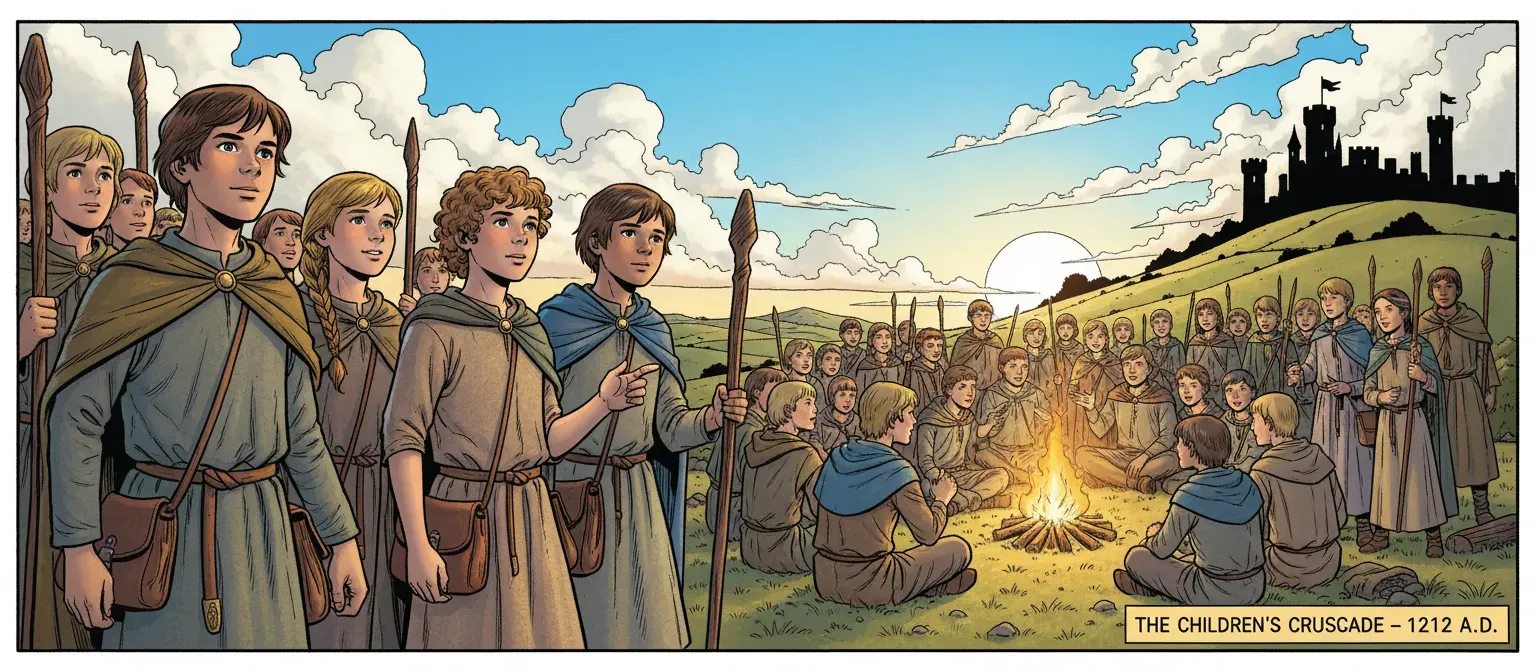
Imagine a classroom where your teacher talks about thousands of young kids going to Jerusalem with wooden swords. That’s how many see the children’s crusade. But, the truth is far from this myth.
The story of 1212 is not about small kids. Teenagers and young adults were the main ones. And, they weren’t even recognized as official Crusaders by the Church.
This was more like a big migration of poor young people. They were swept up in the Crusading movement between Easter and Pentecost in 1212. This happened in both France and Germany.
The Church didn’t really care. There were no official statements against or for it. This event is full of legends that hide the real story.
Get ready to learn the true story of one of the most misunderstood events in medieval history. We’ll sort out fact from fiction and find out what drove these young people on their journey.
Key Takeaways
- The “Children’s Crusade” is a misleading name because most were teenagers and young adults, not small children
- None of the participants were officially recognized as Crusaders by the Catholic Church
- The movement happened between Easter and Pentecost in 1212, with groups in France and Germany
- This was an urban migration of poor youth influenced by Crusading culture
- The Church stayed neutral, with no official support or condemnation
- Most of what we think about this event is based on myths and legends, not facts
Understanding the Children’s Crusade: A Brief Overview
To understand the Children’s Crusade, we must look back at 13th-century Europe. This wasn’t just another event—it was a complex medieval children’s march. Historians debate it to this day. The truth is far from the romantic tales you might have heard.
The movement started when thousands believed they could change history through faith. It was a time when people made extraordinary decisions based on religious visions. To grasp this, we must see the world through medieval eyes.
The Crusading Era That Shaped Everything
Between 1096 and 1291, Europeans launched many military expeditions to reclaim Jerusalem. These were massive efforts that reshaped society. The First Crusade began in 1095, when Pope Urban II urged Christians to free Jerusalem by force.
Crusading became a part of European culture by 1212. People grew up hearing stories of heroic knights and sacred missions to the Holy Land.
This wasn’t just military history—it was personal for millions. The idea of pilgrimage to Jerusalem was deeply spiritual. It inspired entire communities to march thousands of miles.
The Crusades were the most powerful expression of medieval Christian faith. They transformed devotion into collective action that shaped centuries of European history.
Here’s something key: the Children’s Crusade never received papal approval from Pope Innocent III. It wasn’t an official crusade. It was a spontaneous movement driven by charismatic individuals and popular enthusiasm. This distinction is important for understanding what happened.
The Leaders Who Sparked a Movement
Ordinary young people, not noble knights or experienced military commanders, led this march. Their stories show how powerful religious visions could shape this movement.
Stephen of Cloyes was a young shepherd from Northern France. He claimed Jesus appeared to him and gave him letters to deliver to the French king. Thousands followed him, believing his story.
Stephen wasn’t a trained leader or theologian. He was a common shepherd who became the center of a massive movement. His charisma and conviction convinced people to follow him.
In Germany, Nicholas of Cologne was gathering his own followers. He believed the Mediterranean Sea would miraculously part for his followers, just like the Red Sea had for Moses. In 1212, such miracles seemed possible to devout Christians.
These weren’t the only figures involved, but they were the most prominent. Their stories are fascinating because contemporary sources describe them as “pueri.” This word is key to understanding what really happened.
- The word “pueri” could mean children, specific boys
- It also referred to young peasants without land or inheritance
- The term described young wage workers and laborers
- It sometimes simply meant followers or disciples of a religious leader
This linguistic ambiguity is crucial to understanding what really happened. You’re not necessarily looking at a march of young children. It might be a movement of young, poor, landless people seeking spiritual purpose and perhaps economic opportunity.
When and How It All Unfolded
The year 1212 marks the center of this extraordinary story. The movements began gathering momentum between Easter and Pentecost. This timing wasn’t accidental—it coincided with major religious celebrations when spiritual fervor reached its peak.
Here’s the timeline you should understand:
- Spring 1212: Stephen of Cloyes begins preaching in Northern France, attracting followers who believe in his divine mission
- Early Summer 1212: Nicholas of Cologne launches a similar movement in Germany, gathering thousands of supporters
- Mid-1212: Both groups begin their separate journeys toward the Mediterranean, believing they’ll reach Jerusalem
- Late 1212: The movements encounter various outcomes—none of which involved reaching the Holy Land successfully
What you need to recognize is that these were two completely separate movements happening around the same time in different countries. They weren’t coordinated, and the leaders probably never met. Over time, historians and storytellers conflated these distinct events into a single narrative about “children” marching to war.
The French movement and the German movement had different routes, different challenges, and different endings. By understanding them as separate historical youth movements, we get a clearer picture of medieval society. These weren’t unified crusades with military organization—they were spontaneous, religiously-motivated migrations that reflected the hopes and desperation of common people.
This historical context reveals something important: the medieval children’s march wasn’t one event but a phenomenon that emerged from the intense religious atmosphere of early 13th-century Europe. We’re witnessing what happens when faith, poverty, and charismatic leadership converge in a society that believed miracles were not only possible but expected.
The Myths Surrounding the Children’s Crusade
The myths about the children’s crusade come from Enlightenment politics, not medieval times. What you think you know has been shaped by centuries of wrong information and intentional changes. The story of young kids marching to their death wasn’t made by medieval writers. It was created by later writers with their own goals.
These myths were not random. They were made to fit certain political and religious goals, long after the events happened.
How These False Stories Began
The false understanding started with Enlightenment thinkers who were against the Catholic Church. Voltaire used the children’s crusade to attack the Church, saying the clergy caused the kids’ deaths. He saw it as proof of Church corruption and medieval superstition.
These Enlightenment writers didn’t care about truth. They wanted to criticize organized religion, focusing on the Catholic Church.
The story says the Church tricked innocent kids into dying. This tale is in many elementary-school books today. You’ll see pictures of small kids with swords and stories that make the Middle Ages seem like a nightmare.

The truth is more complicated. The idea of a “children’s crusade” came from writers like Vincent of Beauvais and Matthew Paris, decades after the events. They had their own views to share.
The Truth About Who Actually Participated
The biggest mistake is thinking the participants were just kids. Medieval writers used terms that later authors misunderstood. The Latin word “pueri” is key to this confusion.
“Pueri” can mean children, but it usually meant young working people without property. Think of them as the medieval lower class youth—teenagers and young adults in their late teens and twenties. They weren’t toddlers or small children at all.
The idea of small children leading the crusade is a later invention. What really happened was poor young adults seeking economic and spiritual opportunities. They were marginalized youth looking for purpose and a better life.
This mistranslation has had lasting effects. The way this story is shown in popular culture and education is based on centuries of wrong understanding. The tale of innocent babies marching to their doom is not true.
Knowing this changes everything. You’re not looking at a story of naive children being tricked by evil clergy. Instead, you’re seeing a complex social movement of young people seeking meaning in a tough world. This is something that resonates today.
Reality Check: What Actually Happened?
Let’s look into what history really says about 1212. The real story is both more ordinary and more sad than myths make it out to be. When you check the evidence, you see these movements weren’t battles. They were faith journeys led by leaders who believed God would help them succeed where armies failed.
The gap between what people hoped for and what really happened shows a lot about medieval faith and the risks of too much enthusiasm.
Initial Motivations for the Crusade
The main reasons for the 1212 movements were peaceful conversion, not war. Stephen of Cloyes, a young shepherd from the Loire Valley, said Jesus Christ appeared to him. He claimed to have received letters from God for King Philip II Augustus in Paris.
Stephen’s message quickly spread across the French countryside. His followers believed their purity would work where armed knights had not.
In Germany, Nicholas of Cologne preached a miracle too. He said God would split the Mediterranean Sea like Moses did. His followers thought they could walk across the sea to the Holy Land, converting Muslims with God’s power.
- Faith in miraculous intervention: Both leaders promised supernatural solutions to problems
- Rejection of violence: The goal was conversion through divine demonstration, not force
- Youth-led initiative: These movements emerged outside traditional authority
- Popular religious enthusiasm: Participants came from lower classes seeking spiritual meaning
The Journey: Challenges and Obstacles
The reality of medieval travel quickly shattered these optimistic visions. When Stephen of Cloyes and his followers reached Paris, they expected a royal audience. Instead, King Philip II refused to meet them and commanded them to return home immediately.
This royal rejection proved decisive for many participants. Contrary to the myth of mindless zealotry, most followers obeyed the king’s order and returned to their villages. This shows they respected secular authority when faced with it.
But some continued eastward, hoping to reach the Mediterranean regardless.
Nicholas of Cologne faced even more daunting obstacles. His group attempted to cross the Alps into Italy in late July 1212. Imagine thousands of people, many poor and unprepared, trying this dangerous mountain passage without supplies or organization.
Contemporary chronicles suggest the journey proved catastrophic:
- Two out of every three participants died from exposure, starvation, or accidents
- Many others turned back when they realized the impossibility of their quest
- Those who persisted arrived exhausted in Piacenza and later Genoa in August 1212
- The survivors waited at the Mediterranean coast for the promised miracle
When the group reached Genoa, reality crashed down upon them. The sea remained stubbornly un-parted. No divine miracle manifested. The Mediterranean waves continued lapping the shore just as they always had.
Faced with this crushing disappointment, the movement splintered. Some participants settled permanently in Genoa. Others traveled to Pisa hoping for better luck. A portion made their way to Marseilles seeking passage by other means.
The Outcome: Success or Failure?
By any measure, the Children’s Crusade ended in complete and utter failure. Nobody reached Jerusalem. No Muslims were converted. No divine miracles occurred to validate the leaders’ visions.
But the tragic story doesn’t end with simple disappointment.
In Marseilles, two French merchants named Hugh the Iron and William of Posqueres offered what seemed like salvation. They provided ships and promised to transport the stranded pilgrims to the Holy Land. For desperate young people far from home with no resources, this appeared to be divine providence.
Instead, it was exploitation of the cruelest kind. The merchants sailed their human cargo not to Jerusalem but to Tunisia in North Africa. There, they sold the participants into slavery. These young people who had set out to convert Muslims through faith instead became property in Muslim markets.
The casualties extended beyond slavery:
- Shipwrecks: Some vessels foundered off San Pietro Island near Sardinia, drowning their passengers
- Disease: Many died from illness contracted during the arduous journey
- Abandonment: Those who made it to Rome sought release from Pope Innocent III
- Continued obligation: The Pope released younger participants but held those over fourteen to their crusading vows
This wasn’t a glorious spiritual adventure. It was a tragedy born from religious fervor meeting medieval reality—and human greed. The Children’s Crusade shows what happens when charismatic promises meet the harsh realities of logistics, geography, and exploitation.
The movement left no lasting military or religious impact. Instead, it served as a cautionary tale about the dangers of mass religious enthusiasm without practical planning and proper authority. The participants paid the price for their faith with their freedom, and in many cases, their lives.
The Children’s Crusade in Popular Culture
The Children’s Crusade has deeply influenced modern culture. This medieval event has inspired works in literature, film, and music. These artistic pieces have shaped our understanding of this historical moment, often more than academic texts.
Creators are drawn to the crusade’s themes of innocence, faith, and tragedy. These works keep the narrative alive while transforming it. Each retelling gives the crusade new meanings, reflecting today’s concerns.
Literary Representations
Literature has embraced the children’s crusade more than any other medium. Marcel Schwob’s “La Croisade des enfants” (1896) popularized the romantic version you know today. His poetic approach turned the event into a symbolic journey, focusing on spiritual purity.
Henry Treece’s 1958 novel “The Children’s Crusade” brought the story to younger readers. His version includes Stephen of Cloyes trying to part the Mediterranean Sea. This creative liberty shows how authors explore faith and disillusionment through the crusade.

Jerzy Andrzejewski wrote “The Gates of Paradise” in 1960, presenting a darker view. His work strips away romance to explore the psychological motivations behind religious fervor. Andrzejewski’s approach is more cynical, questioning the belief that drove these young participants.
Kurt Vonnegut’s “Slaughterhouse-Five” (1969) is famous for referencing the children’s crusade. He drew a comparison between the medieval event and World War II. Vonnegut suggested both were wars fought by the young and unprepared.
Thea Beckman’s “Crusade in Jeans” (1973) added a twist with time travel. Her protagonist travels from modern times to experience the crusade firsthand. This narrative device makes the historical distance feel closer and more immediate.
Film Adaptations
Film versions of the children’s crusade are rare compared to literature. Andrzej Wajda’s 1968 film “Gates to Paradise” adapted Andrzejewski’s novel. His film presents a stark, existential vision that challenges viewers to confront uncomfortable questions about faith and manipulation.
“Crusade in Jeans” was adapted into a 2006 film, introducing the story to a new generation. This adaptation kept the time-travel element, making the medieval setting accessible. The film balances adventure with the tragic nature of the historical events.
Beyond direct adaptations, the crusade is referenced in documentaries and educational films. These works aim to separate myth from reality, reflecting the cultural fascination with the story. The scarcity of major film productions highlights the challenge of balancing historical truth with drama.
Musical compositions have also been inspired by this historical moment. Gabriel Pierné’s 1902 oratorio “La Croisade des Enfants” features children’s chorus. His work captures the emotional weight of young people on an impossible journey.
Sting’s 1985 song “Children’s Crusade” uses the medieval event as a metaphor for modern conflicts. Instead of retelling the historical story, he draws parallels to contemporary wars. This approach shows how the crusade serves as a cultural touchstone for discussing youth and violence.
Impact on Modern Understanding
Artistic representations have deeply shaped our modern understanding of the children’s crusade. Most people’s mental image comes from novels and films, not medieval chronicles. You likely picture thousands of innocent children marching toward the Holy Land, a vision created by artists.
This creates a fascinating paradox. Popular culture has kept the story alive and relevant for centuries. Yet, these works have also perpetuated myths and misconceptions that historians have tried to correct.
When you consume these artistic works, you’re experiencing layers of interpretation built up over generations. Each creator adds their own perspective, influenced by their time and cultural context. A 1896 poem reflects different concerns than a 1969 novel or a 2006 film.
The children’s crusade in popular culture serves multiple functions. It acts as historical memory, moral lesson, artistic inspiration, and cultural myth. You can appreciate these works for their creativity while recognizing they may not reflect historical reality. Understanding this distinction helps you separate entertainment from scholarship, allowing both to coexist without confusion.
Lessons from the Children’s Crusade
Learning from the Children’s Crusade can teach us about successful youth activism. The events of 1212 were not just a medieval tragedy. They offer insights that are surprisingly relevant today. Examining this historical youth movement closely reveals patterns that echo through centuries of social change efforts.
The Church showed little interest in this spontaneous uprising. There were neither condemnations nor public pronouncements of support. This indifference proved critical to the movement’s fate.
Without backing from religious or political authorities, these young crusaders faced impossible odds from the start. The absence of institutional support became their greatest obstacle.
What History Teaches About Young People Rising Up
The most important lesson from this historical youth movement is about institutional legitimacy. King Philip II of France promptly sent the French participants home. Pope Innocent III never sanctioned the crusade, despite his support for other crusading efforts.
The movement lacked three essential elements:
- Organizational structure to coordinate participants and resources
- Financial backing from wealthy patrons or authorities
- Legitimate authority that could negotiate safe passage and provisions
Young people’s motivations were complex. Many participants came from desperate circumstances—poor, landless youth seeking meaning and purpose. Norman Cohn identified it as a chiliastic movement where the poor attempted to escape their daily misery.
This wasn’t an isolated phenomenon. Gary Dickson points to numerous “impossibilist” movements across Western Europe during this period. These groups shared common traits: shunning wealth, refusing monastery life, traveling together, and depending on donations.
The pattern repeats throughout history—young people seek radical change when conventional paths offer little hope. Their religious fervor mixed with socioeconomic desperation created volatile energy without direction.
Another critical lesson involves charismatic leadership without accountability. Stephen of Cloyes and Nicholas of Cologne inspired thousands through their passionate preaching. Yet they had no realistic plan, no resources, and ultimately led followers toward disaster.
How Today’s Youth Activism Compares
Modern youth movements show similarities and differences with the Children’s Crusade. Today’s young activists fight for climate change, social justice, and educational reform. They share the same passion and idealism as their medieval counterparts.
Yet, today’s movements have advantages the medieval crusaders lacked:
- Digital communication networks that coordinate action instantly across vast distances
- Established advocacy organizations providing resources and expertise
- Media platforms amplifying their message to broader audiences
- Legal frameworks protecting their right to protest and organize
The historical youth movement of 1212 failed because passion alone couldn’t overcome practical obstacles. Modern movements like the March for Our Lives or Fridays for Future show what happens when youthful energy meets strategic planning and partnerships.
The lesson isn’t that youth movements are inherently naive or doomed to fail. Rather, you need to couple passion with practical planning. You need realistic assessments of what’s achievable and support structures that can sustain momentum.
The movement was not sanctioned by the Church, nor supported by any major secular ruler, and that factor, more than any other, ensured its failure.
This historical truth remains relevant today. Young people bring fresh perspectives and moral clarity to social issues. But lasting change requires building coalitions, securing resources, and working within systems even while challenging them.
You can honor the memory of those medieval crusaders by learning from their tragedy. Their story reminds you that good intentions need strategic thinking, and passionate conviction requires organizational backing to create real change.
The Role of Religion in the Children’s Crusade
Religion was at the heart of the Children’s Crusade. It was the reason behind the movement and why so many young people joined. Their faith was real and shaped their lives deeply.
The crusading spirit had been around for over a century. Stories of brave warriors and holy pilgrimages filled their minds. This made them believe in the power of faith.
Religious Motivations Behind the Movement
The children’s drive was genuine and intensely personal. Stephen of Cloyes believed Jesus had called him to lead a journey to the Holy Land. He felt a strong calling from God.
Nicholas of Cologne also believed in a divine mission. He thought God would help the crusaders through miracles. He envisioned a peaceful conversion of Muslim kingdoms to Christianity.

Nicholas’s vision was unique. He believed in a spiritually pure crusade, relying on faith alone. He thought divine power could achieve what armies couldn’t.
These young leaders inspired many. They saw the crusade as a chance to serve God. Their faith was genuine, drawing from a long tradition of crusading fervor.
The Church’s Influence on the Crusade
The Church played almost no role in the Children’s Crusade. Pope Innocent III didn’t support it. It was a grassroots movement, not an official Church campaign.
When the crusaders reached Rome, the Pope was practical. He released those under fourteen and the elderly from their vows. But others were expected to keep their promises.
The Pope’s response shows he didn’t see the crusaders as heroes. He was dealing with an unexpected situation. Local clergy were also skeptical, fearing the movement’s impact on their control.
The tragedy of the Children’s Crusade wasn’t caused by an evil Church. It was due to genuine spiritual passion without guidance or realistic goals. Faith motivated them but couldn’t overcome the challenges of medieval travel and politics.
Religion inspired and limited the crusade. It gave them courage but also unrealistic expectations. When these expectations weren’t met, the consequences were devastating.
Key Locations Involved in the Children’s Crusade
The Children’s Crusade’s paths show why geography was a huge challenge. Mountains, seas, and long distances made reaching Jerusalem impossible. Knowing these places helps us understand why the child pilgrimage to Jerusalem was doomed from the start.
Three main areas defined this journey. Each had its own obstacles that tested the faith and strength of the pilgrims. Their routes show their determination and the harsh realities they faced.
Southern France
The journey began in the Chartrain region near Paris. Stephen of Cloyes had a vision there. This area was deeply religious, and Stephen’s message spread quickly.
Stephen and his followers went to Vendôme and then Paris. But when King Philip II told them to go home, many did. Yet, a dedicated group kept going with Stephen towards the Mediterranean.
The trip from Vendôme to Marseille started in June 1212. Hundreds of miles of walking through medieval France awaited them. The roads were dangerous, food was scarce, and the summer heat was overwhelming. This was no easy pilgrimage.
Marseille was their hope. As a major port, they thought they’d find ships to cross the sea. But, some met merchants with bad intentions. The port turned into a place of disappointment for many.
Southern Italy: The Port of Genoa
Nicholas led the German group on a very tough route. They had to cross the Alps to get to Italy. In late July 1212, thousands tried this dangerous mountain crossing.
Many died from cold, exhaustion, or accidents. Others gave up when they saw how hard it was. Those who kept going arrived in Piacenza on August 20 or 21, after a terrible journey.
From Piacenza, they went to Genoa. The Genoese offered citizenship to anyone who wanted to stay. Many accepted, knowing the journey was too risky. This choice saved lives but ended their crusade dreams.
But some refused to give up. They looked for ships in Pisa or Marseille. Others went as far as Ancona and Brindisi. Nicholas was last seen in Brindisi, searching for a way across the Mediterranean.
Jerusalem: The Ultimate Destination
Jerusalem was the dream destination. The Holy City was where they believed their faith would be rewarded. For medieval Christians, Jerusalem was the site of Christ’s crucifixion and resurrection.
In 1212, Jerusalem seemed like another world for these young pilgrims. Without support from kings or the Church, and no money for passage, the child pilgrimage to Jerusalem failed. Geography was too tough for faith alone to conquer.
None of the participants reached the Holy Land. The long distances, mountains, and seas were too much. Geography had spoken its final word.
| Location | Distance from Origin | Primary Challenges | Outcome for Participants |
|---|---|---|---|
| Southern France (Marseille) | Approximately 450 miles from Paris | Long overland journey, summer heat, lack of provisions, dangerous medieval roads | Some found ships (possibly to slavery), others returned home disappointed |
| Southern Italy (Genoa) | Over 500 miles including Alps crossing | Treacherous mountain passes, altitude sickness, exposure, steep terrain | Many died in Alps, survivors offered citizenship, some continued to other ports |
| Jerusalem (Destination) | Over 2,000 miles from Western Europe | Mediterranean Sea crossing, lack of transport, no funding, political instability | No participants known to have reached the Holy Land via these movements |
The Children’s Crusade’s failure is clear when you look at its geography. Even today, these distances are a challenge. For medieval youth traveling on foot with little, these dreams were impossible.
Modern Interpretations of the Children’s Crusade
Ever wondered what really happened in the Children’s Crusade? Modern scholars have rewritten the story. The tale of innocent kids marching to Jerusalem has been challenged. Today, historians see a different picture, based on medieval documents and social structures.
It took decades to uncover the truth. Scholars worked hard to clear up myths and misunderstandings. They found that the story was about social class, economic struggles, and how history gets twisted.
Scholarly Reexamination of Historical Evidence
In 1977, Dutch historian Peter Raedts changed everything with his study. Before him, most thought children marched to reclaim the Holy Land. Raedts showed that medieval sources used “parvuli,” “infantes,” or “pueri” differently.
These Latin terms don’t just mean “children.” Raedts found they described the medieval working class. This group included landless youth and young adults without inheritance.
The pueri movement wasn’t about toddlers or kids in school. It was about teenagers and young adults from the lowest classes. When the Chronica regia Coloniensis from 1213 talked about people leaving their work, it was about working people, not small children.
This new view changes everything you thought you knew. The participants were young adults trying to escape poverty through religion.
Gary Dickson’s 2008 work built on Raedts’s findings. Dickson said while most weren’t small children, some younger ones played key roles. He argued against erasing children from the story, keeping it nuanced.
Modern scholars agree that these movements included various ages. Most were young adults and teenagers from lower classes, but some actual children were there too.

Contemporary Relevance and Political Dimensions
This new understanding has big social and political implications today. Seeing the pueri movement as about young, poor people changes how we view history. It’s not just about naive children but about societies dealing with youth unemployment and lack of opportunities.
Historians now wonder why the “children” story stuck for so long. Some say medieval writers used it to show the purity of religious devotion. Others used it to criticize medieval religion as manipulative.
This shows how stories can be used for different political goals. The Children’s Crusade teaches us to question historical accounts and their biases.
Understanding this movement as a quest for meaning by desperate young adults connects to today’s issues. Youth radicalization, economic inequality, and the appeal of transformative movements are all relevant today.
Academic views today also explore the role of children in traditional stories. Medieval sources used innocence to validate religious movements. Today’s stories either criticize or support established beliefs by focusing on children.
This shift in understanding history teaches us about the importance of careful analysis. It shows the need to question accepted narratives and understand linguistic context. What we think we know about history might be based on centuries of misunderstanding.
These modern views make us rethink not just the Children’s Crusade but how history is remembered. The story changed not because new documents were found, but because historians asked new questions and analyzed sources more deeply.
How the Children’s Crusade Reflects on Today’s Youth
The Children’s Crusade is more than just a piece of medieval history. It shows us how today’s youth are driving social change. Looking back at the 1212 march, we see lessons that are just as relevant today.
The Fifth Crusade, starting in 1217, was inspired by the fervor of Nicholas and Stephen. This shows how young people’s actions can challenge authority, even if they don’t achieve their goals.
Youth Activism Today
Today’s youth activism has surprising connections to the medieval movement. Young people today are leading movements on big issues. These campaigns show the power and complexity of youth-led change.
Here are some examples of today’s youth activism:
- Climate strikes led by activists like Greta Thunberg, mobilizing millions globally
- Gun violence prevention campaigns organized by school shooting survivors
- Social justice movements addressing systemic inequalities and discrimination
- Educational reform initiatives demanding changes to school systems
- Mental health awareness campaigns breaking stigmas among young people
The medieval march was a procession of deeply pious young people. Today’s activists share that passion. They believe systems are failing them and they won’t accept the status quo.
But there are key differences. Today’s activists have technology, social media, and established groups. Unlike the 1212 participants, today’s activists strategize and work within power structures.
| Aspect | Medieval Children’s March (1212) | Modern Youth Activism |
|---|---|---|
| Communication | Word of mouth, limited information spread | Social media, instant global connectivity |
| Organization | Charismatic leaders without formal structure | Established groups with institutional support |
| Goals | Mystical, often impossible objectives | Specific, measurable policy changes |
| Adult Support | Minimal or exploitative | Often collaborative with advocacy groups |
Yet, some parallels are striking. Just as medieval authorities dismissed the 1212 movements, today’s young activists face skepticism. Critics question their knowledge, experience, or motives, echoing past dismissals.
Norman Cohn saw the Children’s Crusade as a chiliastic movement. This reminds us that socioeconomic factors often drive participation. Today’s youth activists respond to systems that leave them feeling powerless or exploited.
The Importance of Historical Awareness
Understanding the Children’s Crusade gives you a critical perspective on youth movements. This historical awareness is practical wisdom for today’s activists.
Studying the medieval march teaches us that passion without planning leads to tragedy. The 1212 participants had enthusiasm but lacked realistic strategies. Their movements collapsed when they faced practical obstacles.
Institutional support is key. The movements of Nicholas and Stephen failed without powerful backing. Modern youth activism succeeds with coalitions and authentic youth leadership.
Kurt Vonnegut saw these connections. He used “The Children’s Crusade” as an alternative title for “Slaughterhouse-Five.” He compared World War II to the medieval crusade, suggesting both were wars fought by children.
The real lesson from the Children’s Crusade for today’s youth: your passion and idealism are valuable and necessary. But they must be channeled through realistic strategies, supported by credible institutions, and grounded in clear, achievable goals.
The medieval movements failed not because young people can’t make a difference. They failed because they lacked structures, support, and practical planning. This distinction is critically important for understanding activism.
Historical awareness also teaches you to be skeptical of narratives. Medieval chroniclers emphasized innocence and piety, while modern critics sometimes dismiss youth activism as naive. The truth is more complex. Young activists possess genuine moral clarity but need practical tools for lasting change.
When you appreciate both the power and the limitations of youth-driven social movements, you become a more effective activist. You understand that your voice matters while recognizing the importance of strategy, coalition-building, and institutional knowledge. This balanced perspective honors the courage of those young people in 1212 while learning from their tragic mistakes.
Further Reading and Resources on the Children’s Crusade
Exploring the 1212 crusade doesn’t have to stop here. There are many great resources to learn more about this interesting historical event.
Books Worth Your Time
Gary Dickson’s “The Children’s Crusade: Medieval History, Modern Mythistory” (2010) is a must-read. It clearly separates fact from fiction.
Peter Raedts’s 1977 study changed how historians see the event. He found most participants were young adults, not small children. Dana Carleton Munro’s early work from 1913-14 also offers valuable insights.
Norman Zacour’s “A History of the Crusades” (1962) puts the 1212 crusade in a broader medieval context. Steven Runciman’s “A History of the Crusades” also covers these events, but some scholars say it has errors.
Digital Learning Options
Academic databases like JSTOR have peer-reviewed articles for scholarly views. University medieval studies departments often share lectures and articles online. But, be cautious of general websites that spread outdated myths.
Visual Storytelling
Andrzej Wajda’s 1968 film “Gates to Paradise” is an artistic take worth seeing. The 2006 “Crusade in Jeans” adaptation takes creative liberties but is good for younger viewers. Henry Treece’s novel “The Children’s Crusade” (1958) and Thea Beckman’s “Crusade in Jeans” (1973) offer literary views, but remember they are fiction.
Always check the date of sources and if they reflect current scholarship or just repeat old stories.
FAQ
Were the participants in the Children’s Crusade actually children?
No, not in the way you might imagine. The term “Children’s Crusade” is a bit misleading. Most participants were young adults, not small children. Scholars like Peter Raedts have shown that “pueri” meant young working people, not kids.While some young ones might have joined, the idea of toddlers with swords is a myth. This myth grew centuries later, during the Enlightenment, to criticize the Catholic Church.
What really happened during the 1212 crusade?
In 1212, two groups set out. Stephen of Cloyes, a young shepherd, claimed Jesus gave him letters for the French king. His group went to Paris, but King Philip II sent them back.Nicholas of Cologne led a German group to Genoa, hoping the sea would part. But it didn’t. Many died or turned back. Those who reached Genoa were offered citizenship.Others continued to other ports, where some were sold into slavery. This wasn’t a military campaign but a failed pilgrimage.
Did Pope Innocent III support the Children’s Crusade?
No, Pope Innocent III never supported it. This is a big myth. When participants reached Rome, the Pope was practical, not enthusiastic.He released the young and elderly but held those over fourteen accountable. The Church was wary of these movements, seeing them as threats to authority.
How many people participated in the pueri movement of 1212?
Thousands joined, but exact numbers are hard to find. Medieval sources suggest many thousands were involved. Both the French and German groups were significant.But many turned back or died trying to cross the Alps. The numbers were big enough to worry authorities and be documented by many.
What happened to the participants who reached the Mediterranean ports?
Outcomes varied by port. In Genoa, many were offered citizenship. But others faced darker fates.Some were sold into slavery in North Africa. A few made it to Rome and got a dispensation from the Pope. But none reached Jerusalem.
Why did the myths about the Children’s Crusade develop?
Myths grew centuries later, during the Enlightenment. Writers like Voltaire used it to attack the Catholic Church. They focused on the “children” angle to make their point stronger.Over time, the story got more sensational. But modern scholarship has corrected these myths, showing the truth about 1212.
What motivated Stephen of Cloyes and Nicholas of Cologne to lead these movements?
They believed God called them. Stephen said Jesus gave him letters for the French king. Nicholas thought God would part the sea for his followers.They weren’t cynical. They believed in a holy mission. Their vision was different from later Crusades, focusing on peaceful conversion.
How does the Children’s Crusade relate to modern youth activism?
Today’s youth movements share similarities with the 1212 crusade. Young activists today are driven by idealism and frustration. But they have advantages like technology and support from adults.The lesson from 1212 is that passion needs planning. Without support and realistic goals, idealism can lead to tragedy.
What are the best sources for learning the truth about the Children’s Crusade?
Start with Gary Dickson’s “The Children’s Crusade” (2010). It’s the definitive work. Peter Raedts’s 1977 study also changed our understanding.For visual media, check out Andrzej Wajda’s 1968 film “Gates to Paradise.” But be careful of websites and older sources that repeat myths.
Did anyone from the 1212 crusade actually reach Jerusalem?
No, none reached Jerusalem. The journey was too long and the obstacles too great. The sea didn’t part, and there were no ships willing to take them for free.This failure is a key part of the 1212 story. Unlike other Crusades, it didn’t achieve its goals. Jerusalem remained in Muslim hands.
What role did merchants play in the Children’s Crusade?
Merchants played a dark role. They took young pilgrims to North Africa and sold them into slavery. This was a betrayal of their religious ideals.But not all merchants were bad. Some cities offered humane alternatives, like citizenship. This shows how vulnerable the pilgrims were to exploitation.
How did the medieval children’s march differ from official Crusades?
The 1212 movements were different in many ways. Official Crusades were sanctioned by popes and led by nobles. They had military goals and were well-organized.The Children’s Crusade had none of these. It was a grassroots movement without support or resources. It was discouraged by secular authorities.

Leave a Reply