
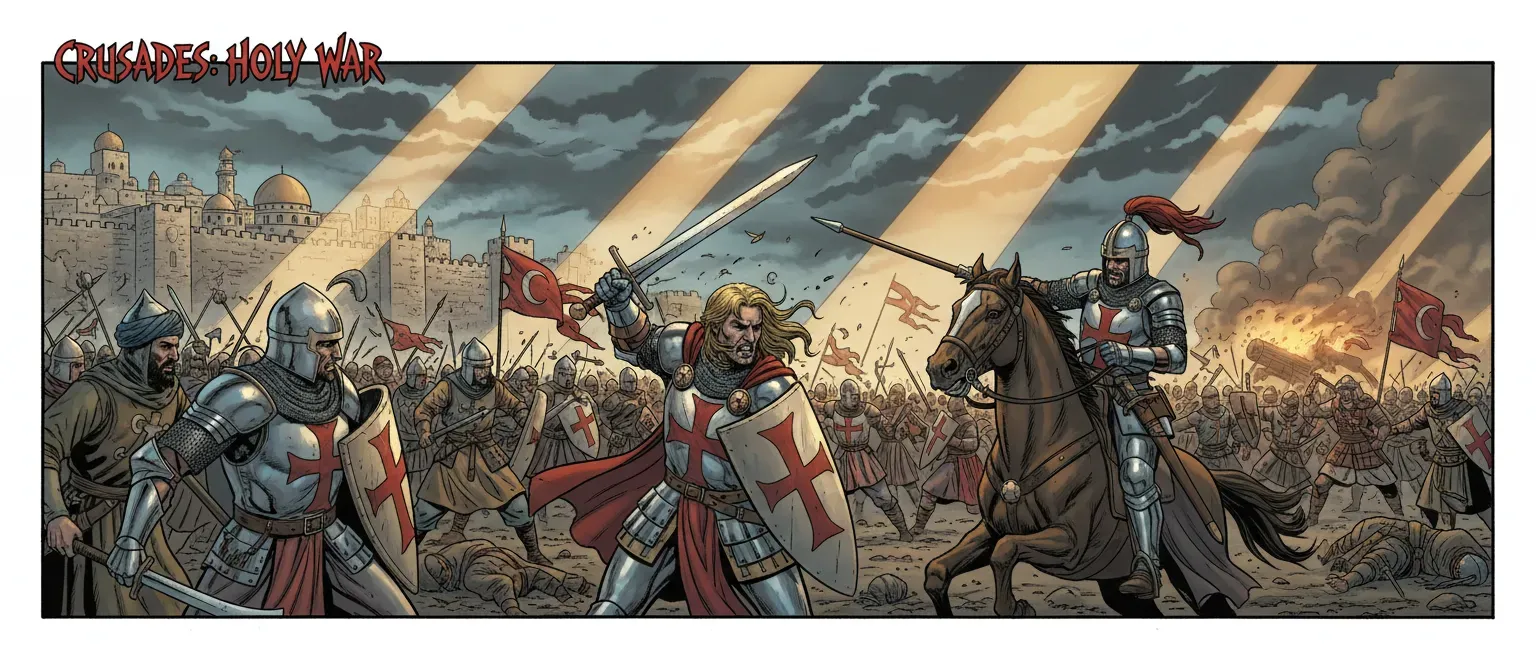
The Later Crusades. Imagine a French knight named Jean standing in the scorching Egyptian desert in 1250. He’s starving, sick with dysentery, and watching his king get captured by enemy forces. This wasn’t supposed to happen. Jean had left his farm and family behind, believing he’d liberate Jerusalem and return home a hero.
Instead, he’s living through one of history’s greatest military disasters.
You might know about the famous First Crusade that captured Jerusalem in 1099. You’ve probably heard of Richard the Lionheart during the Third Crusade. But what happened after these early victories? The medieval religious wars of the 13th century tell a very different story.
The crusades after 1200 represent a turning point marked more by failure than triumph. These military campaigns struggled with poor leadership and strategic mistakes. You’ll discover what went wrong during three critical expeditions to the Holy Land.
From the siege of Damietta to King Louis IX’s tragic fate, these stories reveal why Christian kingdoms ultimately collapsed in the East.
Key Takeaways
- The Fifth Crusade targeted Egypt but failed to conquer it between 1219 and 1221 due to strategic miscalculations
- Emperor Frederick II regained Jerusalem through diplomatic negotiation during the Sixth Crusade in 1229
- King Louis IX of France launched an ambitious campaign against Egypt in 1248 that ended in his capture and massive ransom
- Military leadership failures and poor understanding of local politics contributed to the collapse of these expeditions
- Alternative crusading opportunities in Europe diminished enthusiasm for dangerous expeditions to the Holy Land
The Background of the Later Crusades
The crusading disasters started with big changes in medieval Europe and the Middle East. After the Third Crusade ended in 1192, Christian kingdoms along the eastern Mediterranean were barely holding on. Jerusalem was under Muslim control after Saladin’s victory in 1187, making things worse for these fragile territories.
The Fourth Crusade was a disaster for crusading. Instead of fighting for Jerusalem, crusaders attacked Constantinople in 1204 and destroyed it. This betrayal made Eastern and Western Christians very bitter, hurting future cooperation.
By the early 13th century, you could see the crusader states decline everywhere. The military situation was getting worse fast. People in Europe were losing interest in these dangerous, expensive wars.
The Context of the Fifth Crusade
The Fifth Crusade was called by Pope Innocent III in 1215. He wanted to revive the crusading spirit after the disaster in Constantinople. He hoped to make these medieval religious wars seem important again.
But there was a big problem. The Pope now offered indulgences for fighting in different places. You could get forgiveness of sins by fighting Moors in Spain, heretics in southern France, or pagans in the Baltic region.
Why travel thousands of miles to the Holy Land when you could get the same spiritual rewards closer to home? This question was a big problem for crusade organizers in the 13th century.
The focus shifted to Egypt instead of Jerusalem. Military planners thought controlling Egypt would help get Jerusalem back. This indirect approach was a new strategy, but it was flawed.
Key Players in the Crusading Movement
The later crusades had many characters with different interests. Knowing who was in charge helps explain why it was hard to work together.
Pope Honorius III took over after Innocent III died in 1216. He pushed for the Fifth Crusade but had trouble keeping everyone united. His power looked strong on paper but didn’t work well on the battlefield.
Many European leaders joined the crusade, but with different levels of commitment:
- King Andrew II of Hungary led a big force but left early with little success
- Duke Leopold VI of Austria stayed longer and was more dedicated
- John of Brienne, the King of Jerusalem, brought important local knowledge and experience
- Cardinal Pelagius was the papal legate and had a lot of power, but often disagreed with military leaders
The military orders were key to crusading efforts. The Knights Templar, Knights Hospitaller, and Teutonic Knights had permanent bases in Christian territories. They provided the military skill that temporary crusaders lacked.
But the medieval religious wars were getting mixed up with European politics. French kings had their own goals in southern France. German emperors fought with popes over power. English monarchs had their own problems that took away from crusading efforts.
Organizing big campaigns needed strong institutions that didn’t exist before. Crusade taxes upset church officials. The system of indulgences was also criticized for being too easy to get.
By the time the Fifth Crusade started, the crusading movement was facing big problems. The crusader states decline showed deeper issues than just military losses. Political divisions, different goals, and less interest all pointed to future failures.
Analyzing the Fifth Crusade: Goals and Failures
The Fifth Crusade marked a turning point in the later crusades. It showed how good military plans can fail due to bad leadership. Launched from 1217 to 1221, this crusade aimed to win back the Holy Land in a new way.
Instead of rushing to Jerusalem, the leaders had a smarter plan. They wanted to attack Egypt first. Egypt was rich, controlled important trade routes, and was the heart of Muslim power.
Winning Egypt would give the Christians a big advantage. The Nile Delta was full of fertile land, rich cities, and lots of money. From there, they could easily attack Jerusalem.
In 1217, the crusaders arrived in the Holy Land with their plan. They aimed to take Damietta, a key port city. This would be their first step into Egypt and show that the crusades after 1200 could win big battles.

The Siege of Damietta
The Siege of Damietta started in 1218. It was a huge test of the crusaders’ will. They faced many challenges, like diseases that killed hundreds.
They also struggled with food and supplies. The hot weather and floods made things even harder. But they kept fighting.
For over a year, they attacked Damietta’s walls. They built towers, dug tunnels, and launched many attacks. The defenders fought hard, but the crusaders slowly took control.
In November 1219, Damietta fell to the Christians. This was a big win. It made the crusaders think they could win in Egypt.
| Phase of Campaign | Timeline | Key Decision | Outcome |
|---|---|---|---|
| Initial Strategy | 1217 | Target Egypt instead of Jerusalem | Sound military planning |
| Siege of Damietta | 1218-1219 | Maintain prolonged siege despite hardships | Victory – city captured |
| Peace Negotiation | 1219-1220 | Reject Sultan’s offer of Jerusalem | Missed opportunity for success |
| Cairo Advance | 1221 | March during flood season | Complete disaster and surrender |
Missteps in Leadership
The Fifth Crusade failed because of bad leadership. After winning Damietta, the crusaders had to make a big decision. Cardinal Pelagius, with no military experience, took charge.
This caused tension with John of Brienne, the King of Jerusalem. John knew the military situation well. Their disagreement was fatal.
When pride and ambition override military wisdom, even victories turn into defeats.
The Sultan of Egypt offered a deal. He would give Jerusalem back if the Christians returned Damietta. John of Brienne wanted to accept this deal immediately – it would achieve the crusade’s ultimate objective without further bloodshed.
But Cardinal Pelagius refused. He thought they could win everything and that accepting the deal would show weakness. This was a huge mistake.
In 1221, Pelagius ordered the army to move toward Cairo. He ignored warnings and chose to attack during the Nile’s flood season. The Muslims used the water to trap the crusaders, who had no way to escape.
Trapped, starving, and unable to retreat, the crusaders had to surrender. They lost Damietta and had to leave Egypt in shame. The Fifth Crusade had a promising start but failed due to poor leadership.
This failure had a lasting impact on the later crusades. It showed that winning battles meant nothing without good leadership. The Fifth Crusade taught a hard lesson: success on the battlefield is not enough without wise leaders.
Understanding the Sixth Crusade
Frederick II took up the cross in 1228 with a new approach: diplomacy. The Sixth Crusade was unlike others before it. Frederick, a scholar and linguist, spoke Arabic fluently.
He respected Islamic culture and learning deeply. Unlike his predecessors, he knew brute force wouldn’t work. His approach challenged everything people thought about medieval religious wars.
Frederick II was different from other crusader kings. He grew up in multicultural Sicily. There, Christian, Muslim, and Jewish communities lived together.
Diplomacy Over Warfare
Frederick’s peaceful strategy shocked the Christian world. Instead of armies, he talked to Sultan al-Kamil of Egypt. They shared mutual respect and curiosity.
Through talks, they made a historic agreement. The Treaty of Jaffa, signed in February 1229, returned Jerusalem, Bethlehem, and Nazareth to Christians for ten years. It also secured a safe path to the Mediterranean.
Frederick achieved what decades of bloodshed couldn’t through conversation.
This victory showed diplomacy could work better than war. Frederick’s approach showed understanding your opponent could lead to better results than fighting.
The sultan valued Frederick’s cultural knowledge and interest in Islamic philosophy. This understanding helped their successful negotiations.
The Price of Innovation
Frederick’s success came with big problems. He was under papal excommunication during the entire crusade due to political disputes with Pope Gregory IX. This was a serious situation.
The Pope’s crusade was led by someone he had excommunicated. When Frederick crowned himself King of Jerusalem, no bishop would help. He crowned himself.
Many crusaders and church officials rejected his treaty. They saw talking to Muslims as betrayal. The military orders, like the Templars and Hospitallers, opposed Frederick’s diplomacy.
These warriors believed only military conquest was honorable. They couldn’t accept that talking could be more effective than fighting. The controversy around Frederick shows how the crusades after 1200 were tied to European power struggles.
When Frederick returned to Italy, he faced war with papal armies. His victory in the Holy Land meant nothing to his enemies at home. The treaty he worked hard for was undermined by Christians who opposed it.
Frederick’s Sixth Crusade shows a hard truth about medieval religious wars. Success wasn’t just about what you achieved, but how. Pride and ideology often mattered more than practical results.
Understanding this crusade shows its unique place in history. Frederick proved diplomacy could work, even when everyone else opposed him. His approach was ignored by those who followed.
The Seventh Crusade: Louis IX’s Ambitions
Louis IX launched his crusade in 1248 with a deep spiritual commitment. He wasn’t after land or glory. Instead, he saw recovering the Holy Land as his duty to God.
Louis IX was different from other crusade leaders. His faith and careful planning set him apart. He spent years preparing and invested a lot from the French treasury.
Unlike political opportunists before him, Louis IX believed this was his divine calling. He was willing to sacrifice everything for his holy mission. Later, the Catholic Church recognized his devotion by making him Saint Louis.

Targeting the Egyptian Stronghold
The crusades after 1200 taught a clear lesson. Controlling Egypt was key to Jerusalem. Louis IX aimed his forces at the Nile Delta in 1249.
His army arrived in Egypt strong and organized. The first target was Damietta, a key port city. In June 1249, the city fell to the crusaders easily.
This victory seemed to promise success. Louis spent months in Damietta, waiting for more troops and supplies. He wanted to be fully prepared before advancing.
By late 1249, Louis was ready to march toward Cairo. His forces moved south, facing desert conditions and skirmishes. The real test came in February 1250 at Mansurah.
The Battle of Mansurah started well for the crusaders. They pushed back the Muslim defense and seemed on the verge of victory. Then, everything changed in the narrow streets of Mansurah.
Louis’s brother, Robert of Artois, led a group of knights in pursuit of retreating enemy soldiers. This decision proved fatal. The Muslim forces had set a trap, and the crusaders rode straight into an ambush within the crowded urban landscape.
Robert died along with hundreds of elite knights. The crusader army found itself surrounded, cut off from supplies, and facing constant attacks. Disease spread through the camps as food ran low. What had begun as a triumphant advance turned into a desperate struggle for survival.
| Campaign Phase | Time Period | Outcome | Key Impact |
|---|---|---|---|
| Arrival and Preparation | June 1249 | Captured Damietta | Initial optimism and strategic foothold established |
| March to Cairo | Late 1249 – Early 1250 | Slow progress with supply challenges | Extended lines weakened army effectiveness |
| Battle of Mansurah | February 1250 | Tactical defeat and heavy losses | Death of Robert of Artois and collapse of offensive |
| Retreat Attempt | April 1250 | Capture of Louis IX and army | Complete military failure requiring ransom |
Understanding the Campaign’s Collapse
The failure of this campaign among medieval religious wars created widespread disappointment across Christian Europe. Several factors explain why things went wrong.
The financial cost was staggering. Louis IX had to pay a ransom of 400,000 livres to secure his freedom and that of his surviving soldiers. This amount nearly bankrupted France and placed enormous strain on the kingdom’s economy.
Second, the strategic mistakes mirrored those of earlier failed crusades. Louis advanced too far from his base without securing adequate supply lines. His army became vulnerable to the same problems that had doomed the Fifth Crusade decades earlier.
The assumption that European military superiority would overcome local resistance proved false. Muslim forces in Egypt were well-organized, familiar with the terrain, and highly motivated to defend their homeland. They used tactical advantages like ambushes in urban settings where heavy cavalry couldn’t maneuver effectively.
After his release in 1250, Louis remained in the Holy Land for four more years. He worked tirelessly to strengthen the remaining Crusader fortifications and negotiate with local leaders. Despite his personal courage and dedication, he couldn’t reverse the fundamental decline of Christian presence in the region.
The Seventh Crusade revealed a harsh truth about the crusades after 1200. Even the best planning, strongest faith, and most substantial funding couldn’t guarantee success. The balance of power in the Eastern Mediterranean had shifted permanently.
Military historians point to several specific errors in Louis’s campaign. His decision to wait months in Damietta gave Muslim forces time to organize their defense. The pursuit into Mansurah’s streets violated basic tactical principles about maintaining formation and avoiding unknown urban terrain.
Perhaps most importantly, this crusade showed that the era of major European military interventions in the Middle East was ending. The Crusader states were slowly dying, and no amount of external support seemed capable of saving them. Louis IX’s noble intentions and personal sacrifices couldn’t change this historical reality.
Common Factors Leading to Failure
Looking into the later crusades, you’ll see the same mistakes over and over. Despite different leaders and strategies, the Fifth, Sixth, and Seventh Crusades faced similar problems. These issues led to the failure of European efforts in the Holy Land.
These weren’t just random mistakes. They were systemic problems that crusading forces couldn’t solve.
Why Divided Command Doomed Crusading Armies
The lack of unified leadership was a major problem. Crusading armies were complex coalitions of French knights, German nobles, and more. They rarely agreed on anything.
Each group had its own commanders and goals. This caused constant friction and delayed decisions at critical moments.
During the Fifth Crusade, Cardinal Pelagius and John of Brienne had different strategies. Their disagreements delayed decisions and led to disaster at Damietta.
The Sixth Crusade had similar leadership issues. Frederick II wanted peace, but the military orders wanted war. This disagreement hindered their efforts.
Even Louis IX faced challenges coordinating with the military orders and local nobles during the Seventh Crusade. Everyone had their own agenda.
These conflicts weren’t just about personalities. They were about fundamental disagreements on how to crusade:
- Should crusaders accept diplomatic solutions or demand total military victory?
- Should they prioritize quick gains or build long-term stability?
- Should papal representatives or military commanders make strategic decisions?
- How much authority should local barons from the crusader states have?
Without a single authority, crusading armies often paralyzed themselves through debate. Muslim forces, on the other hand, had better coordination and command structures.
Missing the Bigger Picture in the Holy Land
European crusaders often misunderstood the local dynamics. They saw the Muslim world as a single enemy, not a complex web of rivalries. This misunderstanding contributed to the decline of the crusader states.
The Muslim world was not unified. It was a complex mix of rival dynasties and feuding factions. Muslims often fought each other as fiercely as they fought Christians.
Smart diplomacy could exploit these divisions, as Frederick II showed during the Sixth Crusade. But most European commanders saw all Muslims as a single enemy. They missed chances to form alliances or negotiate favorable terms.
European leaders also underestimated their opponents’ capabilities. They believed European heavy cavalry and technology would guarantee victory. But defeats at Mansurah during the Fifth and Seventh Crusades proved them wrong.
Muslim armies had learned effective counter-tactics against European knights. They used light cavalry for harassment, controlled river systems, and exploited local terrain.
| European Assumption | Middle Eastern Reality | Result for Crusaders |
|---|---|---|
| Muslims were militarily inferior | Muslim forces adapted effective counter-tactics | Defeats at Mansurah in both Fifth and Seventh Crusades |
| All Muslims were unified enemies | Complex rivalries between Muslim factions | Missed diplomatic opportunities and allies |
| European supplies would be adequate | Muslim control of trade routes and resources | Supply shortages weakened crusading armies |
| Religious superiority ensured victory | Practical military and economic factors mattered more | Overconfidence led to strategic mistakes |
The later crusades also failed to grasp economic realities. The Muslim world was wealthier than most crusaders realized. Muslim rulers could sustain longer campaigns and had better supply lines.
When crusading armies ventured into Egypt, they faced a territory where local forces knew the geography well. The Nile’s flooding patterns, desert conditions, and climate all favored defenders who knew how to use these factors tactically.
These misjudgments weren’t just innocent mistakes. They reflected a deeper cultural arrogance that assumed European military and religious superiority would inevitably triumph. European commanders believed their cause was righteous and destined to succeed.
This assumption blinded them to practical realities. You can’t win campaigns through faith alone when your opponents have better intelligence, stronger supply lines, and superior understanding of local conditions. The repeated failures of the later crusades proved that ideological confidence couldn’t substitute for sound strategic planning and realistic assessment of circumstances.
The Role of Geography in Crusader Efforts
European knights arriving in the Middle East after 1200 faced a harsh environment. The landscape was as tough as any Muslim army. Battles and sieges were not the only reasons for the later crusades’ failure. Geography was a silent killer, claiming more lives than swords.
The terrain, climate, and distances posed huge challenges. European commanders were not ready for these obstacles. These were not small issues but major hurdles that decided the fate of campaigns.
Daunting Obstacles Across Hostile Lands
The crusades after 1200 faced many geographical challenges. These problems would test even today’s military planners. The Middle Eastern environment was hostile to Western European armies.
The journey to the Holy Land or Egypt was the first big challenge. Crusaders had to travel thousands of miles. They could take expensive sea transport or a risky overland route through hostile territories.

Once they arrived, they found conditions unlike anything in Europe. The main challenges included:
- Extreme climate conditions that European soldiers had never faced, with summer temperatures that could kill heavily armored knights through heat exhaustion
- Water scarcity in desert regions where Muslim defenders could poison wells or redirect water sources, leaving crusading armies desperately thirsty
- Disease outbreaks that spread rapidly through crowded siege camps, often causing more casualties than actual combat
- Massive fortifications protecting cities like Damietta and Acre, designed to withstand months of siege in harsh conditions
- The Egyptian Nile Delta with its complex irrigation system that defenders could manipulate to flood areas and trap invading forces
European crusaders came from small, resource-rich territories. They were used to fighting in areas where armies could live off the land and retreat to nearby castles if needed.
The vast, unforgiving expanses of the Middle East required completely different logistics and strategic thinking. An army that ran out of supplies in France could requisition from nearby villages. An army stranded in the Egyptian desert simply died.
The heat, the flies, the lack of fresh water, and the diseases of Egypt destroyed more Christian soldiers than all the Sultan’s warriors combined.
Critical Errors in Campaign Planning
Geographical challenges alone didn’t doom the later crusades—strategic mistakes made by crusading commanders turned these challenges into catastrophes. Time and again, European leaders made decisions that ignored the fundamental realities of Middle Eastern geography.
The Fifth Crusade is a prime example of this ignorance. Cardinal Pelagius ordered his army to advance toward Cairo during the Nile’s annual flood season. Any local advisor could have warned that this was suicidal timing, but Pelagius dismissed such counsel.
The result was predictable: his army became trapped as floodwaters surrounded them, and they were forced into humiliating surrender. This wasn’t bad luck—it was a failure to respect the environment they were fighting in.
Both the Fifth and Seventh Crusades repeated another critical error: overextending supply lines by pushing deep inland toward Cairo. This left crusading armies vulnerable when Muslim forces cut their communications with coastal bases where supplies arrived by ship. You can’t maintain an army thousands of miles from home without secure supply routes, yet crusading commanders consistently gambled with this fundamental principle.
European military thinking treated the Middle East like an extension of European battlefields. Commanders assumed they could apply the same strategies that worked in France or Germany. They couldn’t grasp that distance, climate, and terrain required entirely new approaches.
The magnificent crusader castles in Syria and Lebanon—fortresses like Krak des Chevaliers—prove that crusaders could adapt to Middle Eastern conditions when they took the time to learn. These castles incorporated local architectural knowledge and were designed for the regional climate.
But while crusaders eventually mastered defensive architecture, they never mastered the larger strategic geography of conquest. They never developed the logistics, supply systems, and environmental awareness needed to campaign successfully in such a different landscape. The land itself became their unconquerable enemy, and their refusal to respect its power sealed their fate.
Cultural Misunderstandings and Their Impact
Cultural barriers between crusaders and Muslims caused more problems than any battle loss. These weren’t just language or etiquette issues. The gap between Christian Europeans and Muslims was huge, affecting daily life and beliefs.
Studying the medieval religious wars shows both sides saw each other wrongly. These wrong views made working together almost impossible. They turned simple conflicts into long, bitter struggles.
How Each Side Viewed the Other
The cultural gap in the later crusades was very deep. To educated Muslims, European crusaders seemed like backward barbarians. This wasn’t just prejudice—it showed real differences in development.
The Islamic world kept ancient Greek knowledge alive while Europe struggled. Muslim scholars excelled in mathematics, astronomy, and medicine. Cities like Baghdad, Cairo, and Damascus had libraries, hospitals, and universities that outshone Western Europe.
A Muslim scholar named Usamah Ibn Munqidh wrote about his crusader encounters. His stories showed Europeans as ignorant and violent. One famous tale described a Frankish doctor who treated a patient by cutting a cross into his skull and rubbing salt in the wound. The patient died, naturally.
Whether this story was completely accurate or somewhat exaggerated, it reveals something important. It shows how Muslims genuinely saw a massive cultural gap between their civilization and European society.
From a crusader’s point of view, the world looked different. Muslims were “infidels”—unbelievers who had wrongly seized Christian holy sites. Most crusaders had little interest in understanding Islamic achievements or culture.
They saw the conflict in simple terms: Christian versus infidel, right versus wrong, light versus darkness. This black-and-white thinking made compromise feel impossible. How could you negotiate with people you believed were enemies of God?
- Muslims viewed crusaders as culturally inferior and barbaric
- Europeans saw Muslims as religious enemies blocking access to holy places
- Neither side made serious efforts to understand the other’s perspective
- These perceptions became self-fulfilling prophecies that deepened conflict
Religious Beliefs That Prevented Peace
Religious intolerance on both sides poisoned any chance for lasting peace. The concept of jihad in Islam and the crusading ideology in Christianity created mirror-image justifications for violence. Each side believed God commanded them to fight.
This religious framing transformed ordinary political disputes into cosmic battles between good and evil. When you believe you’re fighting for divine purposes, negotiated settlements feel like betrayals. How can you compromise on God’s will?
When Frederick II successfully negotiated Jerusalem’s return through diplomacy, many Christians rejected his achievement. Why? Because it involved treating Muslims as legitimate partners instead of enemies to destroy. The military orders hated this approach.
Groups like the Templars and Hospitallers saw themselves as eternal warriors for Christ. They believed they could never make peace with God’s enemies. This ideology had serious practical consequences during the medieval religious wars.
It prevented the diplomatic flexibility that might have saved the crusader states. Imagine if Christian rulers had formed alliances with moderate Muslim leaders against more extreme factions. Such partnerships could have changed everything.
But religious intolerance made these sensible strategies impossible. Both sides preferred religiously justified warfare to pragmatic coexistence. The result? Continued conflict that ultimately destroyed the crusader kingdoms entirely.
The Franks possess none of the virtues of men except courage… They are beasts possessing no other virtues but courage and fighting.
— Usamah Ibn Munqidh, Muslim chronicler
You can see how these attitudes created a vicious cycle. Muslims viewed crusaders as brave but stupid barbarians. Christians viewed Muslims as sophisticated but godless infidels. Neither perception left room for mutual respect or understanding.
The tragedy is that cooperation was possible. Frederick II proved it. He spoke Arabic, appreciated Islamic culture, and successfully negotiated with Sultan al-Kamil. Their treaty showed that cross-cultural understanding could achieve what armies couldn’t.
But Frederick’s approach remained the exception, not the rule. Most participants in the later crusades preferred familiar enemies to unfamiliar friends. They chose religious certainty over cultural curiosity.
These cultural misunderstandings weren’t just historical footnotes. They established patterns of mutual suspicion between Christian and Muslim worlds that echo through centuries. When you study these failures, you’re not just learning about the past—you’re understanding roots of conflicts that continue today.
| Cultural Aspect | Muslim Perspective | Crusader Perspective |
|---|---|---|
| Scientific Knowledge | Advanced in medicine, mathematics, astronomy | Practical knowledge focused on warfare and agriculture |
| Religious Legitimacy | Defending lands rightfully governed under Islam | Reclaiming Christian holy sites from infidel occupation |
| Cultural Sophistication | Preserved classical learning, urban civilization | Rural feudal society with emerging city culture |
| View of the Other | Brave but barbaric and ignorant | Sophisticated but godless and illegitimate |
The impact of these misunderstandings shaped every aspect of the crusades. They determined which strategies leaders chose, which alliances they rejected, and which compromises they refused to consider. Cultural blindness proved just as destructive as any military defeat.
The Influence of Local Politics
Looking at the later crusades, one thing stands out: the change in Muslim politics. Crusaders thought they faced a single enemy, but it was more complex. The reality was a shifting landscape.
The politics in the Middle East in the 13th century were key. They decided if crusades would succeed or fail. Military wins and losses were tied to politics.
The crusades after 1200 faced big challenges. The power balance changed, and Europeans were outmaneuvered.
How Muslim Unity Transformed the Military Balance
In the early 13th century, the Muslim world was divided. The Ayyubid dynasty, founded by Saladin, controlled parts of Egypt and Syria. But, his family fought each other for power.
This division helped the crusaders at first. Frederick II made a treaty with Sultan al-Kamil, who needed peace to deal with family rivals. Crusaders could use these divisions to their advantage.
But, this division wouldn’t last. A new force, the Mamluks, was rising. These were slave soldiers who became a powerful military.
In 1250, during the Seventh Crusade, the Mamluks took control of Egypt. The Mamluk resistance was stronger than anything crusaders faced before.

The Mamluks were different from Saladin’s family. They were professional soldiers who got their positions through skill. Leaders like Baibars and Qalawun were tactical geniuses.
They used advanced siege warfare and built strong armies. Their discipline was unmatched by European forces.
By 1260, the Mamluks united Egypt and Syria. They focused on removing Christians from the region. Their goal was relentless.
The crusaders had no way to fight this new, unified threat. The divisions they once exploited were gone, replaced by a strong military machine.
Why Crusader Internal Politics Undermined Defense
Crusader politics were moving in the wrong direction. The states were ruled by families who had lived there for generations. Some families had been there for over a century.
These “native” crusader barons knew local politics well. They spoke Arabic and worked with Muslim neighbors. They needed to play different factions against each other to survive.
New crusaders from Europe didn’t understand this. They wanted clear victories, not complicated negotiations. They saw the local barons’ diplomacy as betrayal or cowardice.
This led to tension among crusaders. Local leaders clashed with newcomers who didn’t know the area. The newcomers, despite their lack of knowledge, had influence because of their European rank.
The military orders added more complexity. The Templars, Hospitallers, and Teutonic Knights answered to the Pope, not local rulers. They often followed their own agendas, which didn’t always help the defense.
These organizations were wealthy and powerful. They could ignore local leaders when it suited them. This made planning defense nearly impossible.
The result was tragic. Muslim forces, united under the Mamluks, focused on defeating the crusaders. The crusader states were systematically eliminated in the late 13th century.
The irony is that many of these problems were self-inflicted. The crusaders’ inability to unite internally led to their failure in the crusades after 1200.
| Political Factor | Early 13th Century | Late 13th Century | Impact on Crusades |
|---|---|---|---|
| Muslim Unity | Fragmented Ayyubid dynasties fighting each other | Centralized Mamluk state controlling Egypt and Syria | Eliminated crusader ability to exploit divisions |
| Military Leadership | Inherited positions, variable competence | Merit-based Mamluk commanders (Baibars, Qalawun) | Created superior strategic planning and execution |
| Crusader Cohesion | Moderate cooperation between local barons | Severe conflicts between locals and newcomers | Prevented unified defense strategies |
| Military Orders | Integrated into local defense systems | Increasingly independent, pursuing separate agendas | Undermined coordinated military responses |
Lessons Learned from the Later Crusades
Every failure teaches us something, and the crusades after 1200 are no exception. Unfortunately, people back then rarely understood their mistakes until it was too late. These failures taught us about the dangers of religious warfare, the importance of knowing local conditions, and the risks of being too rigid.
Why didn’t these lessons sink in sooner? Often, strong beliefs made it hard for crusaders to see their mistakes. By the end of the later crusades, many valuable lessons had been learned, but at a high cost.
Reflections on Political Decisions
Looking at the political choices made during these campaigns, we find some key insights. First, ideological purity often clashes with practical success. Frederick II’s Sixth Crusade succeeded through diplomacy, but many Christians rejected it because it didn’t fit their ideal of crusading.
Why did they reject success? It didn’t match their vision of how crusading should work. This shows that strict frameworks can blind us to victory when it comes in unexpected ways.
Second, political unity is key for military success. The constant fights between papal legates, kings, military orders, and local barons fatally weakened the crusades after 1200. You can’t win wars when your leaders are fighting each other.
Modern armies learned this and created clear command structures. But the crusading movement was plagued by competing authorities that could never be resolved.
Third, long-distance military interventions are very hard to keep up. Even wealthy kingdoms like France under Louis IX couldn’t keep armies far from home for long. Logistics, supply lines, and communication get weaker the farther you are from your base.
Fourth, you can’t impose your solutions on places you don’t understand. European crusaders tried to apply their models to the Middle East, where they didn’t fit. The results were poor.
Military Strategies to Reconsider
The later crusades also taught us important military lessons. The failures at Mansurah in both the Fifth and Seventh Crusades showed that European heavy cavalry could be countered by Muslim forces on familiar terrain.
Heavy cavalry was the top military tech in medieval Europe. Yet, the ambush of knights in urban streets at Mansurah showed that tech doesn’t guarantee victory. Your opponent’s knowledge of the battlefield is more important than your gear.
The importance of naval power became clear during these campaigns. Control of the sea meant control of supply lines, reinforcements, and the ability to retreat. The Italian maritime cities—Venice, Genoa, and Pisa—became critical to crusading operations.
But this gave them a lot of power to pursue their own interests. Sometimes, their business goals conflicted with military objectives, causing more problems for crusader armies.
The value of flexible, adaptive strategies over rigid plans was shown many times. The crusaders who succeeded were those who could adapt to local conditions and form temporary alliances. They knew when to negotiate instead of fighting.
Unfortunately, the crusading ideology often stopped this flexibility. It demanded total victory, even when compromise would have been better.
Perhaps the deepest lesson is about the limits of military force in achieving religious and cultural goals. The crusades after 1200 showed that you can’t permanently occupy territory whose people don’t accept you. No matter how many battles you win, the local people decide your long-term success.
Without converting or replacing the local population—neither of which the crusaders could do—the Christian presence in the Holy Land was always temporary. It needed constant military effort and was unsustainable in the long run.
These lessons seem obvious in hindsight. But they had to be learned through painful experience, and many were forgotten only to be re-learned later. The question is, have modern societies truly learned these lessons or are they being repeated today?
The Legacy of the Later Crusades
The crusades left a lasting mark that goes beyond the battlefields. The crusading movement didn’t stop with the Seventh Crusade. Louis IX launched the Eighth Crusade in 1270, aiming for Tunis. He died soon after from disease, marking the crusades’ decline.
Impact on Christian-Muslim Relations
The fall of Acre in 1291 ended crusader presence in the Holy Land. This conflict lasted nearly two centuries. The memories of these times shaped relations for generations.
Pope Gregory X and later leaders planned new crusades, but they never took off. The Knights Templar dissolution in the early 14th century was tied to crusading failure. Without a Holy Land to defend, they lost their purpose. French kings then seized their wealth.
Ongoing Relevance in Modern Society
Crusading imagery is seen in today’s conflicts. When leaders use crusading language, it brings up old tensions. These medieval campaigns warn of the dangers of mixing religious passion with military action.
They show the consequences of ignoring local realities and cultural differences. Understanding these failures helps us see similar patterns in today’s international relations.
FAQ
What were the later crusades and when did they take place?
The later crusades happened after 1200. They include the Fifth, Sixth, Seventh, and Eighth Crusades in the 13th century. The Fifth Crusade was from 1217-1221, the Sixth from 1228-1229, the Seventh from 1248-1254, and the Eighth in 1270. These wars marked a turning point, with more failures than successes.
Why did the Fifth Crusade fail despite capturing Damietta?
The Fifth Crusade failed due to poor leadership and bad decisions. Crusaders took Damietta in 1219 after a tough siege. But Cardinal Pelagius, a papal legate with no military experience, made big mistakes.He refused a trade offer from the Sultan for Jerusalem. Then, he ordered an advance to Cairo during the Nile’s flood season. When Muslims opened the canals, the crusaders got trapped and had to surrender Damietta and retreat.
How was Frederick II’s Sixth Crusade different from other crusades?
Frederick II’s Sixth Crusade was different because it used diplomacy, not war. He negotiated with Sultan al-Kamil and got the Treaty of Jaffa in 1229. This treaty gave back Jerusalem, Bethlehem, and Nazareth to Christians for ten years.But, his approach was seen as controversial. He was excommunicated by the Pope during the crusade. Many Christians believed crusaders should conquer Muslims by force, not negotiate.
What happened to King Louis IX during the Seventh Crusade?
King Louis IX of France led the Seventh Crusade from 1248-1254. He captured Damietta in Egypt but was defeated at the Battle of Mansurah in 1250. His brother was killed, and Louis was captured along with thousands of his men.He had to pay a huge ransom of 400,000 livres, bankrupting France. Louis later died of disease in 1270 during the Eighth Crusade in Tunis.
Why did the Crusader states eventually collapse?
The Crusader states declined due to several factors. The Mamluks, elite slave soldiers, seized power in Egypt in 1250. They were a unified, strong Muslim force focused on eliminating Christians.The Crusader states also faced internal divisions, lack of reinforcements, and decreasing European support. The fall of Acre in 1291 marked the end, as it was the last Christian stronghold.
What role did the military orders play in the later crusades?
Military orders like the Knights Templar, Knights Hospitaller, and Teutonic Knights were key in the later crusades. They defended territories and provided military leadership. But, they also had their own agendas, sometimes conflicting with the broader goals.They were hostile to Frederick II’s diplomacy and favored military conquest. The Knights Templar were dissolved in the early 14th century, partly due to the failure of the crusades.
What were the major geographical challenges facing crusaders?
Crusaders faced huge geographical challenges. The distance from Europe required expensive sea travel or dangerous overland journeys. The intense Middle Eastern heat and unfamiliar diseases were also major obstacles.Water supplies were critical, and the terrain favored Muslim forces. The Fifth and Seventh Crusades suffered defeats due to overextending their supply lines and advancing in unfavorable conditions.
How did cultural misunderstandings affect the crusades?
Cultural misunderstandings deeply affected the crusades. Many educated Muslims saw European crusaders as backward. Crusaders viewed Muslims as “infidels” to be conquered by force.Religious intolerance turned political conflicts into cosmic struggles. The military orders, like the Knights Templar, rejected diplomacy, believing in only military solutions. Frederick II’s diplomacy was seen as a failure by those who preferred war.
What was the impact of the Mamluks on crusader fortunes?
The Mamluks changed the balance of power against the crusaders. They were elite slave soldiers who took control of Egypt in 1250. Unlike previous Muslim dynasties, they were professional soldiers.By 1260, they had united Egypt and Syria under centralized control. Leaders like Baibars and Qalawun systematically destroyed crusader territories. The crusaders had no effective response to this unified threat.
What lessons can be learned from the later crusades?
The later crusades teach several lessons. Ideological purity often conflicts with practical success. Frederick II’s diplomacy was rejected because it didn’t fit the crusading ideology.Political unity is key for military success, but the crusades were plagued by competing authorities. Long-distance military interventions are hard to sustain logistically. You can’t impose solutions on regions you don’t understand.Military force has severe limitations in achieving religious and cultural goals. You can’t occupy territory whose population doesn’t accept you, even with battlefield victories.
How do the later crusades remain relevant today?
The later crusades continue to influence modern Christian-Muslim relations and international conflicts. From a Muslim perspective, the crusades were unprovoked invasions that created lasting bitterness.The term “crusade” remains controversial in international diplomacy. Historians debate whether the crusades were defensive or aggressive. The most important lesson is the danger of pursuing ideologically driven policies that ignore practical realities.
What happened after the fall of Acre in 1291?
The fall of Acre in 1291 marked the end of the Crusader presence in the Holy Land after nearly two centuries. Acre was the last significant Christian stronghold. When it fell, remaining crusaders evacuated to Cyprus.Popes continued calling for new crusades, but these were never seriously implemented. European enthusiasm for crusading had been exhausted by repeated failures. The Knights Templar dissolution followed in the early 14th century, partly because their mission was impossible.

Leave a Reply